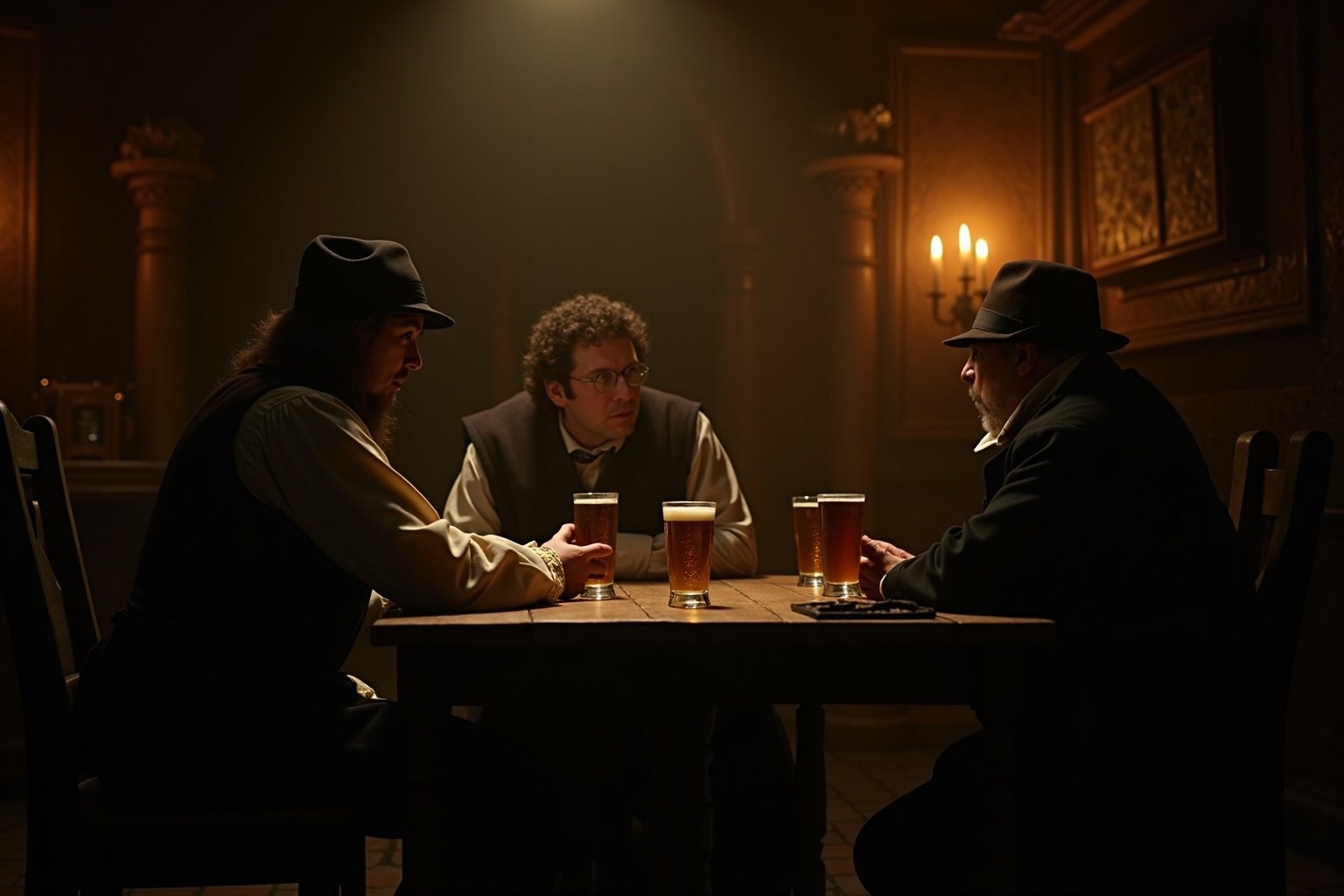
There was a man who published pamphlets advocating for mint reform, while secretly continuing to make counterfeit coins.
Time to read the text: about 20 min The review questions are optional and not included in this time. What you can read: the course opening and contents are free; the full text is for those who have purchased After purchase, you can read the full text once your access starts.
You can't see what's inside a coin from the outside. That's why fakes can be made.
Fakes with a lead core covered in gold appeared early on.
2 / 9
Athenian law placed inspectors for silver coins at the money-changing tables in the market.
It was decided that fakes with a core would be cut on the spot.
3 / 9
A quiet crime continued for a long time: shaving off the edges of coins bit by bit to collect silver.
Hand-struck coins had uneven edges, so you couldn't tell if they had been shaved.
4 / 9
1732
A rope-like pattern was engraved on the edge. Now you could see if it had been shaved.
Lima in 1753, Potosí in 1767. It didn't happen all at once.
5 / 9
1699
Newton, at the Royal Mint, hunted down counterfeiters.
The man who argued for engraving deep grooves on the edges was himself a counterfeiter.
6 / 9
1881
A human face appeared on a banknote for the first time. Because even the slightest error would be noticeable.
Portraits became a key way to prevent counterfeiting.
7 / 9
From 1868
Opening the ledgers reveals that the new government also minted low-quality coins.
6,050,000 ryō
3,810,000 ryō in gold coins and 2,240,000 ryō in silver coins
8 / 9
World War II
Countries have even counterfeited enemy banknotes and used them as weapons.
Unlike recoinage, which changes a country's own standards, this was outside the authority to issue currency.
9 / 9
The people who lost the most from counterfeit money were those forced to accept it at face value.
Ledgers, too, only tell what the person who kept them recorded.
2In numbers
6,050,000ryō
From 1868 to the following year, the amount of low-quality currency minted by the new government at the seized Kinza and Ginza (according to ledgers).
87years
From 1553, when machinery was introduced in Paris, to 1640, when machine striking became widespread.
3What would you do?
In the early Meiji period, low-quality counterfeit money was in circulation. The story goes, 'The culprit was Satsuma.' According to the ledgers, who has the largest amount recorded?
Pick one
The Satsuma domain
Satsuma did not make the amount public. The 1,500,000 ryō is an estimate obtained by questioning an accountant. It's a different kind of number from an official report or a ledger entry.
The new government
The ledgers show 6,050,000 ryō minted by the new government at the seized Kinza and Ginza. However, since Satsuma did not make its amount public, we can't determine which is the largest.
The ledgers reveal the new government's minting, which isn't part of the popular story. But ledgers, too, only tell what the person who kept them recorded.
You can explain why anti-forgery devices aim at recognisability rather than at looks.
Looking at a real coin, you can say that the milled edge is an instrument of inspection, not an ornament.
Can compare the debasement of currency by the state itself with counterfeiting by private individuals, and state the similarities and differences (authority to issue, method of announcement, exchange, who bears the loss).
You can point out what is missing from the phrase "forgery is a matter for criminals."
Can explain the three safeguards of machine-struck coins (perfect circle, beaded border, and edge markings) as anti-counterfeiting measures.
Can explain the differences between the numbers from reports, ledgers, and estimates regarding counterfeit currency during the Bakumatsu and Meiji Restoration, and what the ledgers do not count.
You can start this course without reading any other course.
Also worth reading, to see the connections (optional)
Face Value and Intrinsic Value What you learn: You can explain the gap between nominal and real value using one concrete coin.
If you want to know more about checking sources (optional)
Is It Really True? Checking History We re-examine the origins of money and famous anecdotes, comparing them with historical records and actual artifacts.
Assessment
11 exercises in this course (8 check, 0 compare, 3 written). Progress is recorded by self-assessment.
The 8 chapters of this course
The Inspector Seated in the MarketplaceThe Athenian law of 375/4 BC placed an examiner at the money-changer's table. Passed silver coins went to the market, while plated forgeries were cut and became sacred property of the gods. The state took on part of the burden of verification.
Clipped Silver Coins and the Great Recoinage of EnglandMilled coinage to protect the edge began in England in 1662, but clipped old coins remained until the Great Recoinage of 1696. The edge design served as a clue to identify clipping.
When a King Debases the CoinageBoth a king's debasement and a private individual's counterfeiting profit from the difference between face value and intrinsic value. What differs are the authority to issue, the method of announcement, the terms of exchange, and the path by which the loss is transferred to others.
The copper coinage of Delhi and the king's redemptionCopper currency with the same face value as silver coins invited forgeries struck at home. The king redeemed even the forgeries for gold and silver coins, draining the treasury.
Until the Edge-Protecting Machine Took Root in ParisA machine for marking the edge of coins entered Paris in 1553, but it did not spread due to resistance from hammer-striking moneyers. It was popularized by Varin in 1640. Edge lettering became standard even later.
The Counterfeiter Who Advocated for Grooved Edges — Chaloner and NewtonThe man who advocated for carving deep grooves on the edge was a counterfeiter. A case that collapsed in 1697 when a witness was allowed to escape was rebuilt by Newton in 1699 with eight witnesses.
The Gallows of the Paper Pound and Portraits on BanknotesIn the era of the paper pound, when convertibility was suspended, using counterfeit notes was a capital offense. In 1881, Japanese banknotes began to feature human faces, on which even the slightest imperfection would be noticeable.
Counterfeits of the Bakumatsu Period and Their AftermathThe counterfeits of the domains and the debased coinage of the new government remain in figures of different natures. The cleanup became an international agreement, and the losses fell to the people who had accepted the coins at face value.
Readings (20)
The Birth of the Counterfeit Overview: the world A history of false money General History Section 1. The starting point: counterfeits appeared right after the very first coins.
The Touchstone Overview: the world A history of false money antiquity Section 1. Tools for authentication. Also explains why the scene of pirates biting gold coins is considered a myth.
Clipping Overview: the world A history of false money the Middle Ages – the early modern age §2. Check the scale of the damage done by clipping.
The machine and the revolution Overview: the world the 17th century The Milled Edge §2. The answer to what the milled edge is for.
The pillar dollar Spain 1732 The Mexico City mint §2. An actual piece bearing the corded edge. Note the recorded weight.
The counterfeiter king and the Temple France 1295–1314 The mint of Paris §3. A debasement carried out inside the law. Read as far as Dante's verdict.
Edo, the Kinza Japan The upheaval at the end of the shogunate and the counterfeit coin 1868–1869 Section 8. The figures in the chart are all values recorded at this station. Note the difference between reported figures and estimates.
the domains' residences Japan The upheaval at the end of the shogunate and the counterfeit coin the 1860s Section 8. This is the same event as seen from the perspective of the various domains (han).
The continental currency United States 1775–1779 New York, under British occupation §3. A state forging an enemy's notes. Mind which came first in time.
Counterfeit Pounds Printed in the Camp Overview: the world A history of false money AD 1942 Section 3. This is a record of an operation during World War II in which a state forced concentration camp prisoners to counterfeit the banknotes of other countries.
London Britain Newton's Great Recoinage 1699 Section 6. This is a scene that shows what is meant by the backing for enforcement.
The paper pound Britain 1797–1821 London, the place of execution Section 7. Please confirm the fact that it could not be prevented even with the most severe punishments.
The birth of the yen Japan 1881 the Paper Money Bureau, the engraving room Section 7. This section explains why portraits help prevent counterfeiting.
The War Without End Overview: the world A history of false money the present day Section 7. This is a list of the security features that have been accumulated on modern banknotes.
The louis d'or and machine striking France 1640–1672 The Paris mint Section 5. The original text of the three safeguards. Until 1672, when Varin becomes the sole master of the minting machinery.
The Tower and the taverns of London Britain Newton's Great Recoinage 1696–1727 Section 6. A record of the scientist who became an investigator.
Tokyo, Takanawa Japan The upheaval at the end of the shogunate and the counterfeit coin 1869–1871 Section 8. A record of the conference where the settlement of counterfeit currency became an international agreement.
The Tester Greece 375/4 BC The money-changer's table in the Agora Section 1. This is one of the oldest laws whereby the state, rather than leaving the determination of authenticity to the connoisseurship of private individuals, appointed a full-time official for the task. The place where the official was to sit, and even the 50 lashes with a whip for neglecting their duties, are written into the articles of the law.
A Recoinage India Circa 1329–1330 The King's Decision Section 4. This is the aftermath for the side that lost to counterfeiting. The king redeemed even counterfeit copper coins struck in private homes with gold and silver coins, treating them as if issued in his own name, which depleted the national treasury.
The White Inflation Korea 1890s– Clandestine workshops Where the government sold minting patents to cover fiscal deficits, the line between official, clandestine, and counterfeit coinage began to blur. Coins of the same denomination became indistinguishable, and no one could tell from which furnace they had come.