How to Read History, Starting with 'Where Is That Written?'
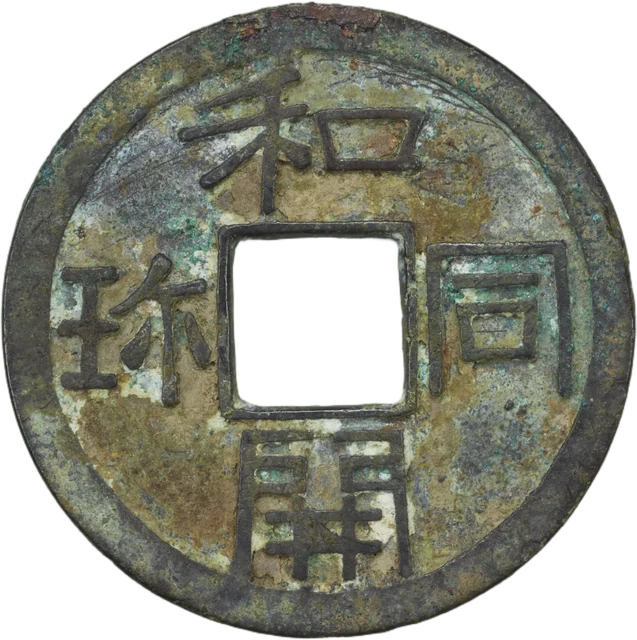
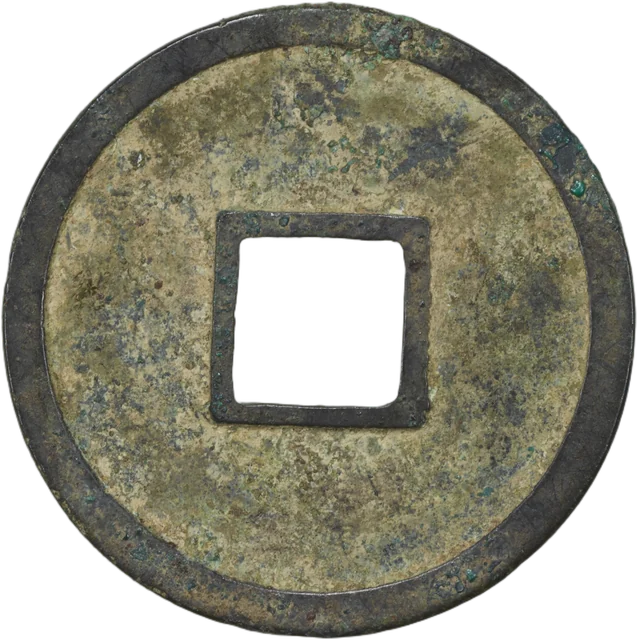
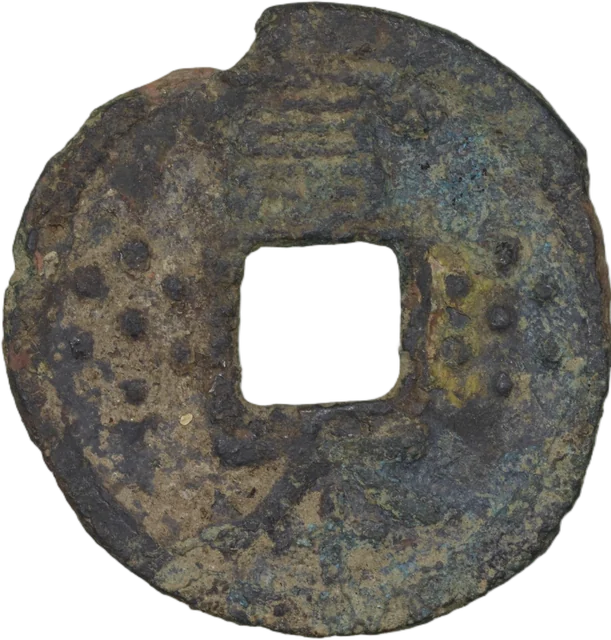
Wadōkaichin, from 708. Collection of the Tokyo National Museum (excavated from the Sōfukuji temple ruins). Although it was the first coin to circulate widely in Japan, the pronunciation of its name is still not definitively known. This single coin embodies the theme of this book. Source: ColBase, National Institutes for Cultural Heritage (E-8770) / CC BY 4.0
TEXTBOOK 01 / First Edition(2026)
BIG QUESTION
How much can we know about the past?
This book in 3 minutes
Some 'common knowledge' in history includes stories that have been cited for two hundred years without anyone verifying them. The explanation that 'money emerged from barter' is a prime example.
The past does not remain as it was. What has survived is biased, and there are reasons for what has not. Coinage, in particular, has been actively erased—melted down by victors, recalled for recoinage, and deliberately destroyed.
What is written in official histories and what physical objects tell us can be verified separately. The official history states that the copper for the Wadōkaichin was 'presented from Chichibu,' but the lead isotope ratios of existing specimens point to a different mountain.
Sources have distance. Was it written on the spot, or is it hearsay? Distinguishing between primary and secondary sources is how we measure this distance.
There are two types of numbers: measured numbers and estimated numbers. Make it a habit to question the order of magnitude and not to trust the last digits.
There is also a way to read what is 'not written.' Was it never written down, was it lost, or has it just not been found yet?
For the same event, different writers will give different numbers. Read this not as a contradiction, but as a range.
Questioning is different from denying. The goal is not to become someone who doubts everything, but someone who can say, 'This much can be said. From this point on, we do not know.'
After the main text, there are 15 WORKBOOK exercises. Practice using the tools with actual materials from this school.
When you finish reading it, the way you read all the subjects in this school — and all history books — will change.
Wadōkaichin, from 708 AD. Diameter approx. 24mm. The four characters can be read in order: top, right, bottom, left. What is noteworthy here is not the beauty of the characters, but the single character 'chin' at the bottom right. The interpretation of this single character keeps the name of this coin in suspense, even thirteen hundred years later. National Institutes for Cultural Heritage ColBase (Tokyo National Museum E-8770) / CC BY 4.0
Museum descriptions say '708.' It's a name seen in Japanese history textbooks. Thus, it seems to be a well-known coin.
However, it is not known how people at the time read these four characters.
Was it 'Wadō Kaichin'? Or 'Wadō Kaihō'?
The problem lies in the single character '珎' in the lower right. Its reading changes depending on whether it is interpreted as a variant of the character '珍' or as an abbreviation of '寳'. This has been a subject of debate since the Edo period, and it remains unresolved to this day.
No historical source that directly records the pronunciation at the time of issue has been confirmed so far.
Why it was not written down is also unknown. Perhaps it was so self-evident to people at the time that it needed no explanation. Or perhaps there was another reason.
What is important here is not to invent an answer.
What we can confirm is that four characters are inscribed, that the issuance of silver and copper coins was recorded in 708, and that no source directly confirming the pronunciation has been found. Beyond that, there are theories.
What is confirmed
That silver and copper coins were issued in 708. That the four characters on the obverse are “Wadō Kaichin”.
Leading theory
Read as 'Wadōkaichin' (the character 珎 is considered a variant of 珍, the mainstream view in current textbooks).
Another theory
Read as 'Wadō Kaihō' (with chin seen as a simplified character for hō). The theory that 'Wadō' is an auspicious term.
What is not known
How the issuers pronounced it. No source that can confirm this has been found.
Textbooks write it as 'Kaichin'. However, this is not because it was definitively decided, but rather because it has come to be called that way without a final determination. There is even a theory that the two characters 'Wadō' do not come from the era name 'Wadō', but from an auspicious phrase signifying the harmony of yin and yang. The entire name has not been definitively established.
When reading history, do not lose sight of this boundary. This book is for that purpose.
There is another point about this coin where 'what is written' and 'what can be found out through investigation' diverge.
The official history 'Shoku Nihongi' records, with the date January 11, 708, that native copper for the raw material was presented from Chichibu in Musashi Province. To celebrate this presentation, the era name was changed to 'Wadō'. However, when the lead isotope ratios of existing Wadōkaichin coins—a kind of fingerprint specific to the origin of the lead contained in the metal—are measured, most match not Chichibu, but the Nagato Dōzan mine in Nagato Province (present-day Mine City, Yamaguchi Prefecture) or Kurameki in Suō Province.
This is not necessarily a contradiction. This is because 'the recording of a presentation' and 'the main source of copper used for mass minting' are fundamentally different questions. The official history records the presentation. The metal analysis indicates a different origin for the copper used in mass production. The two can be verified separately.
Diagram G-1: Documents and physical objects, two testimonies. The description in the official history (left) and the natural scientific analysis (right) are not contradictory; they are answering different questions. Source criticism is the technique of this 'question separation'.Source material: Sen no Kōro, "Chichibu no Wadō," "Nagato Dōzan" no TeiDiagram E-1: Schematic map of the copper's journey. The testimony of the documents (Chichibu, east) and the testimony of the physical objects (Nagato, Kurameki, west) are on opposite sides of the capital. If you only convey the place names through text, the vividness of this 'east-west reversal' is lost.Identification of origin: Sen no Kōro, "Chichibu no Wadō," "Nagato Dōzan" no Tei
How much can we know about the past?
'Where is that written?' — Not many people can ask this question calmly. Source criticism is the art of making this one phrase a habit. Coins are a good practice ground for this. They last longer than writing, the issuing state's own claims are written on their surface, and the material itself provides testimony separate from documents.
How to read this textbook The first half (Chapters 1-2) provides the tools, the middle part (Chapters 3-6) is for practical application, and the latter half (Chapters 7-8) is for advanced application. The main text is followed by a WORKBOOK (15 exercises) and end-of-book materials (chronology, tables, biographies, glossary). Terms in the text are linked to the Glossary, and the coins that appear are linked to the Specimen Database. You can read the chapters in any order, but we recommend reading Chapter 2, 'The Six Types of Caveats,' first. All subsequent chapters will use this tool.
Sources — The Sea Route of Zeni stops on 'Wadōkaichin', 'Wadō of Chichibu', and 'Nagatō Copper Mine' / Actual object: Wadōkaichin from the Tokyo National Museum Collection (ColBase E-8770, CC BY 4.0)
CHAPTER 1
The past does not survive intact
This chapter in 3 lines
The records of the past were not 'preserved'; they were selected and survived
Coins, in particular, have not only disappeared by chance but have been actively destroyed by victors and states
Nevertheless, coins are strong historical sources because they were made in large quantities, inscribed by the issuers themselves, and their material speaks
1-1 Burned, Rotted, Melted Down
Historical records have not come down to us by sitting quietly on library shelves. They have been burned in fires, rotted in floods, scattered in wars, and eaten by insects. For paper, wood slips, or parchment, surviving a thousand years is the exception.
In the case of coins, their disappearance is more active. They are melted down. Gold and silver coins have value in their material itself. It was common for old coins, coins of a previous king, or coins of a changed standard to be melted down and made into new currency. Coins were not made to be preserved for posterity. When they became old, they were collected, melted down, and remade into new coins. The history of currency is also a history reconstructed from the metal fragments that survived.
And yet, museums are filled with ancient coins. Most were not intentionally preserved. Hoards buried by owners who could not return for them. Cities sealed in volcanic ash. Cargo sunk at sea. Misfortune was the preservation device.
The survival of ancient coins is supported not by museums or royal collections, but by pots 'whose owners could not return.' In 2010 in the UK, 52,503 Roman coins were found in a single pot (the Frome Hoard). The pot does not tell us what happened to its owner.→ Stop on the Pound Voyage: 'The Frome Hoard'
And disappearance is not only due to 'accidents' but also 'executions.' The biography of a single silver coin tells us this.
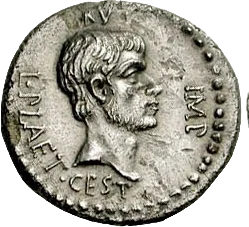
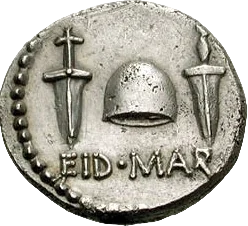
EID MAR Denarius, 43–42 BC. A silver coin struck by Brutus, Caesar's assassin, to pay his soldiers. The reverse features two daggers, a 'cap of liberty', and the inscription EID MAR (March 15). What is remarkable here is not just the boldness of the design, but that this piece is a rare surviving example that escaped being melted down by the victors. Public domain (Wikimedia Commons)
In 42 BC, Brutus was defeated on the plains of Philippi and took his own life. The victors, Antony and Octavian, ordered the commemorative coins of their enemy to be melted down. To inscribe one's claims on a coin meant that if you lost, those claims would be melted down with it. The EID MAR is a world-renowned rarity today not because it is beautiful, but because it is a survivor that escaped execution.
COLUMN — The Owner of the Pot Regarding the 52,503 coins of the Frome Hoard, let's distinguish what can be said from what cannot. What can be said: The number of coins unearthed from a single pot in England in 2010. What cannot be said: Who buried them, why, and why they never returned. The pot does not speak of motives. Yet, the single fact that 'they did not return' is proven by the very presence of the pot here and now — this is how the silence and eloquence of physical evidence coexist.
1-2 The Bias of What Remains
Before we count the surviving historical sources, one point: there is a systematic bias in how things survive.
Only those who can write, can write. Considering literacy rates up to the Middle Ages, the writers of records were almost exclusively clergy, officials, and merchants. The lives of peasants, market prices, daily payments — activities that make up the bulk of history — are only preserved through the pens of 'the observers.'
Inconvenient things are erased. The records of the vanquished are edited by the victors. The melting down of the EID MAR is the numismatic version of this. The same thing happens with documents.
In China, it was institutionalized that 'the official history of a former dynasty is written by the next dynasty.' Official histories are almost always completed by the hands of those who overthrew that dynasty. When reading them, one first checks whose servant the writer was.
Only interesting things are copied. Before printing, books were preserved by hand-copying. Books not deemed worth copying had their lineage end there. Conversely, interesting stories, instructive tales, and stories convenient for those in power were repeatedly copied and proliferated. This is why a story passed down for two hundred years is not necessarily true. Ease of transmission and correctness are different qualities.
Diagram G-2: The hurdles a record must clear to reach the present. The total population of records shrinks at each stage. What is important is not that it shrinks, but that the shrinking is not random at any stage — biases are introduced by the social class of the writer, the editing by the victors, and the preferences of the copyist.
Key to viewing this diagram: Always ask yourself if you can say 'this is how it was back then' just by counting the bottom-most level (what was discovered). The distribution of coin hoards reflects both 'the circulation of currency' and 'the misfortune of those who buried them and could not return.'
Key points of this section Survival is not random. Due to the triple bias of the writer, the victor, and the copyist, do not count 'the amount that remains' as 'the amount that happened.'
1-3 Coins as an Exception
In this sea of bias, coins occupy a slightly special position. There are three reasons for this.
First, they were made in large quantities. While there might be only one original of a decree, coins struck from the same die existed in the thousands or tens of thousands. Even after being melted down or buried, some would survive. That is why even 'executed coins' like the EID MAR could not be completely erased.
Second, they were inscribed by the issuers themselves. The inscriptions, portraits, and emblems on the surface are the primary claims that the state wanted to project at that time. They are not subject to later editing. Brutus's daggers and the 'Wadōkaichin' of Empress Genmei's court are frozen as the assertions of their time and place.
Third, the material speaks. The amount of silver contained can be determined by measurement, regardless of what the issuer claims. Just as the lead isotope ratios in the prologue pointed to the origin, metal is a witness independent of documents. Words can lie, but weight is harder to fake.
Diagram H-1: Trend in the fineness of the silver denarius (schematic). In the 1st century, it was generally in the 90% range. It continued to decline throughout the 2nd century, reaching about 71% during the Severan dynasty, and then around 50%. It still looked like a white silver coin—because a treatment that increased the silver on the surface made it appear white.Numerical data source: Lira's Voyage, 'Silver Quietly Diminishes' stop (including the reservation that the exact fineness for each emperor varies according to research)
Key to viewing this diagram: More important than the decline in value is that the band has width. Measured values also have a 'range depending on the measurement method' — this diagram anticipates the theme of Chapter 4, 'Questioning the Numbers.'
This is why this school reads history from actual coins. However, coins themselves are also subject to 'survivorship bias'. High-value coins, which are easily melted down, are less likely to survive, while those from areas where they were likely to be buried are more likely to survive. They are exceptionally good historical sources, but they are not unbiased sources. With this distinction in mind, let us proceed.
The Fuhonsen coin (c. 683) rewrote the textbooks with the 1998 excavation of the Asukaike archaeological site. After it had long been written that 'the first coin of Japan was the Wadōkaichin,' counter-evidence emerged from the ground. The sum of the surviving records is always provisional.
Diagram F-1: The time of the event and the time of discovery. The Fuhonsen coins, minted around 683, were only identified as "Japan's first coins" in 1998, thirteen hundred years later. History "happens" in the past, but our knowledge "grows" in the present. These two timelines should not be confused.Fuhonsen, c. 683. Collection of the Tokyo National Museum. The 1998 excavation of the Asukaike site rewrote the established theory of "Japan's first coins." What is important to see here is that this single coin is physical proof that new evidence from excavations can overturn established theories at any time. → Object Database ColBase, National Institutes for Cultural Heritage (E-2625) / CC BY 4.0
1-4 Coins and a Great Buddha from the Same Mountain — A Material History of Raw Materials
Let's confirm "what the materials tell us" with a Japanese example. As seen in the prologue, the lead isotope ratio of existing Wadōkaichin coins points to the Chōdo copper mine in Nagato. Numerous wooden slips recording the inflow and outflow of copper have been found at this mountain. This was a mine directly controlled by the state. Ledgers (primary documentary sources) and the lead "fingerprints" (physical evidence) have been unearthed together from the same mountain.
Copper from this mountain was also used for the casting of the Great Buddha of Tōdai-ji, which began in 746. This means that the coins of the capital and the Great Buddha of Nara were extracted from the same mountain. The 'Tōdai-ji Yōroku' records the materials used: 739,560 kin of refined copper and a little over 10,400 ryō of refined gold. It is said that a total of over 2,600,000 people were mobilized for the project. There is also an estimate that puts the construction cost at the time of its founding at approximately 465.7 billion yen in today's value.
2.6 million people in total, in an age when a day's wage was between one and ten mon. This was not a scale that could be paid in coins. To bring that copper to the surface, there was the labor of people called Shichō, who wielded chisels in narrow tunnels lit only by torches.
In the 9th century, the copper in coins decreased while the lead began to increase. The same phenomenon as the fineness curve of the Denarius (Diagram H-1) can be read from the material side of Japanese coins. This was the material reason why the coins subsequently shrank. Even if documents are silent, the metal speaks. The two currencies of East and West testify in the same way.Source: Zeni no Kōro, "The Copper that Cast the Great Buddha" and "Chōdo Copper Mine" stops.
Key points so far
Records were not preserved, but rather selected by surviving fires, being copied, and being edited. Each of these gates does not thin out randomly.
Because coins have value in their material, they were not made to be preserved for posterity. Furthermore, like the EID MAR, they are sometimes 'executed' by the victor. Their survival is due to 'preservation by misfortune,' such as coin hoards.
Nevertheless, coins are exceptionally strong evidence on three points: 'large quantity, issuer's own hand, and measurable material.' Lead isotope ratios testify to the place of origin, and silver fineness to the state's financial situation, independently of written documents.
“When it happened” and “when it was understood” are on different timelines. The sum of knowledge is always provisional.
At the Chōdo copper mine, written records (mokkan) and physical evidence (lead isotope ratios) converge. The 9th-century 'decrease in copper, increase in lead' is the material testimony to the debasement of the coinage.
How would you think about it?
Will our current records (photos, social media, electronic money history) survive "without bias" a thousand years from now? What do you think will remain, and what will disappear? What percentage of your day falls on the side of things that will disappear?
Sources — The Pound's Route "The Frome Hoard" / The Coin's Route, EID MAR stop / The Lira's Route "The silent debasement of silver" (fineness values and range) / The Zeni's Route "The copper used to cast the Great Buddha," "Nagatō Copper Mine" / Objects: EID MAR (Public domain), Fuhonsen (ColBase E-2625, CC BY 4.0)
CHAPTER 2
Primary and Secondary Sources — Measuring the Distance
This chapter in 3 lines
The value of a source is measured not first by "whether it is correct," but by "how far it is from the event."
Primary sources are fragments from the scene, secondary sources are organized reconstructions — their strengths and weaknesses are reversed.
The writer's lack of confidence is left as a mark of reservation. In this textbook, we will read them by dividing them into six types.
2-1 Sources Have "Distance"
In the previous chapter, we saw that the remaining sources are biased. The next question is directed at a single source in hand: How far from the event was this written?
Ledgers, laws, and letters written on the spot, and the struck coins themselves—these are called primary sources. Things that are collected and later reconstructed by someone else—official histories, chronicles, research papers—are secondary sources. Furthermore, textbooks and general surveys that compile secondary sources can be counted as tertiary.
A primary source is material created close to the time and event, without the intermediary step of later summary or reconstruction. "Close" does not mean "correct." The way it is distorted is different from that of secondary sources. A ledger from the scene may have errors, a letter may be written to suit the author, and it will contain the creator's intentions, selections, exaggerations, and misinterpretations. Secondary sources, while organized and easy to read, have been subjected to later selection and summary. Primary and secondary are not a distinction between "right/wrong," but a difference in the type of distortion.
The "Shoku Nihongi" from the prologue was such a case. The official history that records the 708 offering is not a memo from the scene of the event, but a book later compiled by the state. To compile is to select. Someone decided what to write and what not to write. To measure the distance is to not forget that "someone."
Diagram G-3: The Distance of a Source. Primary ≠ correct. Primary = created close to the event. The type of distortion is simply different from secondary sources; it is not free from distortion. The further the distance, the easier it is to read, but the more someone else's selections accumulate.
2-2 Reservations — The "Mark of Confidence" Left by the Writer
When reading secondary sources, there are reliable signs to look for. A sincere writer, when not certain, will leave such marks in the text. These are called reservations. In this textbook, we will divide them into six types. This classification is for convenience and is not exhaustive.
Tradition
"It is said that..." "It is told that..." The more interesting the story, the more likely it is to be a later invention.
Estimate
"Approximately twenty-seven thousand to forty thousand." The existence of a range means that no one has counted them.
Various theories
"Theories are divided." The question is not which is correct, but why they are divided.
Prevailing theory
"It is generally thought that..." Much of what is in textbooks falls into this category.
Omission
"There are no records." The most dangerous thing is to be tempted to fill this gap with imagination.
Correction
"It is often said that..., but in fact..." It is when making a correction that one must show the evidence.
Here is an example. In this school's teaching materials on the Mongol invasions, it says:
The soldiers are said to have numbered between approximately twenty-seven thousand and forty thousand, and the ships approximately nine hundred. The numbers differ depending on the historical source.
Within one sentence, there is an estimate (approximately, range), a tradition (it is said), and various theories (differ) all at once. The writer is making a triple reservation. The moment this is rewritten as "about 30,000 soldiers invaded," all three marks disappear. Summarizing is often the deletion of reservations.
A number with a range is not necessarily a weak number. A range may remain as a result of writing down the extent of what is unknown. Conversely, a sentence that carries a single number with an air of certainty is all the more worth checking its source.
Key points of this section Reservations are a mark of the writer's sincerity. Read by marking the six types. Summarizing is often the deletion of reservations.
2-3 Quick Reference for Phrasing — The Ending is a Contract
Reservations reside in the endings of sentences. The ending of a historical text is not a mere decoration; it is a contract of certainty that the writer makes with the reader. Here is a single sheet that matches the expressions actually used in this textbook to their corresponding types.
Wording
Type
Reading
is/was
Assertion
The writer has (supposedly) verified it. You may ask for the source.
It is said that... / It is generally thought that...
Prevailing theory
The majority view in academia. However, it may be that no one has re-verified it.
It is handed down that... / It is said that...
Tradition
Doubt the most interesting stories. Look at the date of the source document.
Approximately / From... to... (range)
Estimate
Quote with the range. Erasing the range is not summarization but alteration.
There are various theories / Opinions are divided
Various theories
If you can understand 'why they are divided,' you are an expert.
There are no records
Omission
Do not fill in with imagination. Mark the very places you are tempted to fill in.
It is often said that..., but in reality...
Correction
Verify the basis for the correction. Corrections also need a source.
How to use this table When reading, as a tool to mark sentence endings. When writing, as a tool to choose 'which contract I am writing with'. A text that asserts something that cannot be asserted has no place anywhere on this table.
And on top of these six types, there are four levels of certainty that this textbook uses throughout all chapters.
Diagram G-4: The Ladder of Certainty. A lower level is not necessarily 'worse'. The condition for good writing is that the level is correctly declared. The danger is when a lower-level story walks around with the face of an upper-level one — almost all the popular fallacies in Chapter 7 are of this kind.
2-4 Reading the Textbook to the End, Counting the Reservations
Let's read the rest of the textbook on the Mongol invasions, marking the reservations. The morning after the Bun'ei War, the Mongol army had vanished from Hakata Bay. The *Hachiman Gudōkun* writes that they disappeared overnight. Let's apply the ruler of distance. This document was compiled in the first half of the 14th century, several decades after the event, by a temple to convey the power of its deity. There is distance, and moreover, a motive for writing. The tenth month of the old calendar is past the typhoon season, and current research gives more weight to the depletion of provisions and arrows, conflicts in command, and the danger of crossing the winter sea as reasons for their withdrawal.
What about the Kōan War seven years later? The textbook states that the Eastern Route Army had approximately 40,000 men and 900 ships, and the Jiangnan Army had approximately 100,000 men and 3,500 ships, for a total of 'approximately 140,000 men and 4,400 ships, it is said,' and immediately follows with the reservation, 'There is also the view that these numbers are inflated, and there are various theories.' Numbers, tradition, various theories. As you read while marking, a single paragraph breaks down into 'verified parts' and 'handed-down parts'.
2-5 Sources from Above, Sources from Below
The ruler of distance has another scale: height. Historical sources on currency are usually written from above. Royal edicts, mint ledgers, chronicles — these are the records of the issuing and collecting sides.
However, from the mud of Novgorod (Russia), letters carved on birch bark from about nine hundred years ago have been unearthed. What is written are demands for the return of borrowed items. Demands for payment. Records of what was bought for how much. Distribution of inheritance. Private letters, and children's doodles. These are records of currency, addressed from a nameless person to another nameless person. The writing is blunt, getting straight to the point with little greeting — a nine-hundred-year-old dunning letter is written in almost the same way as a modern one.
Sources from above tell of the system, while sources from below tell of daily life. Even if both are 'primary sources,' the history they reveal is completely different depending on the height from which they were written. A monetary history written solely from royal edicts is a monetary history without the people who used the money.Source: Stop on The Sea Route of the Louvre: 'Letters in the Mud'
2-6 Until It Reaches You — The Chain of Information Becoming History
Finally, let's extend the ruler of distance to the present day. The chain of events until they reach your eyes, when laid out, looks like this.
Diagram G-5: How Information Becomes History. Every link in the chain has a role — the problem is not the links, but reading only the lower links and feeling as if you know the upper ones. The techniques in this textbook are for tracing back one level up from any link.
2-7 Coinage as a 'Primary Source Object'
On this ruler of distance, coinage stands in a unique place. This is because coins are not things that 'recorded' events, but are participants that were made within events and drove those events.
The Wadōkaichin of 708 is an object of 708, cast in 708 by the court of 708 (Japanese coins are cast, not struck — made by pouring molten copper into a mold). There is no compilation from ninety years later, nor any scribal errors. The EID MAR is a political statement in its original form, issued by the assassin himself the year after the assassination. If a primary written source is 'eyewitness testimony,' then a coin is 'physical evidence from the scene.' This difference will be the theme of the next chapter. How much can physical evidence tell us?
Key points so far
Sources are first measured by their 'distance from the event'. Primary = created close to the event; Secondary = a selected reconstruction.
A primary source is not correct just because it is primary. Primary sources are also biased; the nature of their bias is just different from that of secondary sources.
The six types of reservations (tradition, estimation, various theories, common theory, omission, correction) are a sign of the writer's integrity. Summaries tend to delete reservations.
Sentence endings are a contract of certainty. Use the quick reference table of phrasing to mark them when reading, and to choose a level when writing.
Distance also has a scale of height. Sources from above (edicts, ledgers) and sources from below (dunning letters on bark) show different histories.
At each link in the chain of information delivery, reservations are lost and the face of assertion is added.
Coins are not 'records' but 'physical evidence'—primary sources created within the event itself.
To the next chapter
How much can 'physical evidence from the scene' tell us? We will read a single silver coin from corner to corner, including the demarcation of what can and cannot be said.
Sources — The Sea Route of Zeni, 'Mongol Invasions' (Bun'ei and Kōan) / The nature of the *Hachiman Gudōkun* is based on the description at the same stop / The Sea Route of the Louvre, 'Letters in the Mud' / School E1 Lecture 2 (The Six Types of Reservations)
CHAPTER 3
What Can a Single Coin Tell Us?
This chapter in 3 lines
Read a single silver coin from corner to corner, like a museum exhibit description
Design, inscription, edge, weight—each offers a different kind of testimony
Finally, make a list of what cannot be said from this one coin. That is the extent of observation.
3-1 Reading This One Coin — The Pillar Dollar
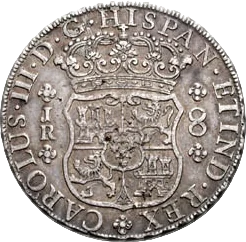
Let's take one coin from the database of actual objects for this course. It is an 8 reales silver coin minted in 1768 in Potosí (present-day Bolivia). This is the silver coin that crossed the oceans during the Age of Discovery, which people called the 'pillar dollar' (columnario). We will examine it in numerical order.
Diagram A-1: Reading this coin. ① Crown ②③ Pillars of Hercules ④ Two hemispheres ⑤ Date and mint mark ⑥ Corded edge (the edge is the side) — Explanations for the numbers are in the table below.
① Crown
A crown at the very top. This communicates to even those who cannot read that the issuing authority of this silver coin is the 'Spanish Crown'.
②③ Pillars of Hercules
The legendary pillars of the Strait of Gibraltar. Placing symbols of the 'ends of the earth' on both sides — a declaration that this silver coin is a currency that will reach beyond the seas.
④ Two hemispheres and the inscription VTRAQUE VNUM
The two globes of the Old World and the New World. The inscription means 'Both are one' — an imperial self-introduction stating that the two worlds are under one crown.
⑤ Date and Mint
1768, struck in Potosí. The mechanization of the Potosí mint was in 1767 — this piece was struck the following year.
⑥ Corded edge (edge marking)
This is not just a decoration. In the era of cob coins, silver coins had their edges shaved to remove small amounts of silver (clipping). With a marked edge, any shaving is immediately obvious. This is a security technology that put an end to the long-standing practice of clipping.
⑦ Weight (in hand)
Standard: 417.6 grains = 27.06 grams. The weight is a figure stipulated by law, and also physical evidence that can be measured.
Diagram B-1: Close-up — The contour of the edge. Notches continue regularly along the outer circumference of the coin's face. This regularity itself is an inspection device — if even one spot is shaved, the line is disrupted and it's immediately obvious. What looks like just a 'pattern' in a full photo can be read as a mechanism when magnified.
The reeding on the edge is not a decoration, but a security device. The reeding on modern coins is a remnant of the 300-year-old battle against thieves who clipped cob coins.
3-2 What can be 'said' from this one coin
We convert observations into testimony. There is much that this single coin can tell us on its own.
Technological testimony. A perfect circle, uniform thickness, impressions from machine striking. Decrees in 1728 and 1730 ordered colonial mints to transition to machine striking, and in 1732 the Mexico City Mint struck the first pillar dollar — the very 'regularity' of this coin is physical evidence that this technology transfer reached Potosí.
Economic testimony. Silver with a standard weight of 27.06 grams. This served as the standard currency across the Atlantic and Pacific Oceans. In 1792, the newly independent United States, through the Coinage Act, based its own dollar on the 'Spanish milled dollar then in circulation'. This silver coin was the standard for the American dollar.
Political testimony. The inscription VTRAQUE VNUM and the two hemispheres. How the colonial empire wanted to present itself — a primary self-declaration, solidified without editing.
3-3 What cannot be 'said' from this one coin
At the end of the observation, we make a list of what cannot be said. Up to this point is what is called observation in source criticism.
What cannot be said
Why this one coin was made (the motivation for that year's mintage is the domain of another historical source, the mint records).
What cannot be said
Through whose hands this one coin passed (its provenance remains silent unless there are excavation records or collection records).
What cannot be said
At what value this one coin was used (the face value of 8 reales and its actual market value are separate matters. Prices are the domain of ledgers).
What cannot be said
How people perceived this design (the issuer's intent can be engraved, but the receiver's heart cannot).
A single coin speaks of technology, standards, and self-declaration, and is silent about motivation, provenance, and reception. Carry both the breadth of what it can say and the breadth of its silence at the same time. This is how to handle physical evidence.
Let's practice turning observations into judgments in a table. There are three judgments: can be confirmed from the actual object / requires external sources / cannot be said from this individual piece alone.
Observation/Claim
Judgment
The date '1768' is engraved
Can be confirmed from the actual object
The mint mark indicates Potosí
Can be confirmed from the actual object (reading the mark requires cross-referencing with ledgers/catalogs)
The weight conforms to the standard of 27.06 g.
Can be confirmed from the actual object (if you have a scale)
It was struck during the reign of Charles III
Requires external sources (cross-referencing with a timeline of his reign)
This standard was the benchmark currency across the oceans
Requires external sources (e.g., the 1792 U.S. Coinage Act)
It was widely used at the time
Cannot be said from this individual piece alone (one coin does not speak to circulation volume)
It was treasured by its owner
Cannot be said from this individual piece alone (wear speaks of use, but not of emotion)
How to use this tableIn this textbook, we first divide claims into three categories: "Can be confirmed from the physical object," "Requires external historical sources," and "Cannot be determined from this specimen alone." For the initial observation, these three categories are sufficient. A claim that cannot be directly confirmed from the physical object is not an observation, but rather a task for other historical sources and inference. For claims that do not fit into any of these categories, refer to the conventions on phrasing discussed in Chapter 2.
The silver coin called the 'Spanish dollar' that became the standard for the American dollar, and the 'pillar dollar' told from the side of the Potosí mines, are one and the same piece. Depending on which shore you view it from, the same physical evidence becomes the protagonist of a different story.
Key points of this section A single coin is honestly silent about motivation, provenance, actual value, and reception. The observation is complete only when a list of what cannot be said is also made.
3-4 Applying the same procedure to another coin — Reading the Wadōkaichin
A procedure is a tool only if it can be transferred. Let's apply the same steps ①-⑦ to the Wadōkaichin from the prologue.
① Inscription. The four characters "Wadōkaichin" are arranged top, right, bottom, left. ② The controversial character. The character *Chin* at the bottom right — is it a variant of the character for "rare", or an abbreviation for "treasure"? (Prologue). ③ Hole. A square hole in the center. This is a definite observation, but we cannot say why it is square from this single coin — this goes in the "what cannot be said" column. ④ Manufacture. Whereas the Pillar Dollar was machine-struck, this coin was cast — a method where copper is poured into a mold. ⑤ Dimensions. Diameter approx. 24 mm. ⑥ Edge. There is no reeding. Edge lettering as an anti-counterfeiting technique was invented a thousand years after this coin. ⑦ Material. Copper — and as we saw in Chapter 1, its lead isotope ratio tells of its origin.
What becomes clear when they are placed side by side is that although the framework for observation is the same, the fields that are filled and those that are left empty differ for each coin. The pillar dollar has extensive entries in the fields for standards and technology, while the Wadōkaichin has extensive entries for materials and silence. The empty fields are not failures. They are a map of the 'yet-to-be-investigated areas' of that coin.
Key points so far
Observation is done by numbering and examining every corner. The design speaks of politics, the standard of economics, and the edge of the struggle between technology and crime.
What can be said from one coin: technological level, standard, and the issuer's self-declaration. When linked with other historical sources, like the 1792 U.S. Coinage Act, its scope extends even further.
What cannot be said from one coin: motivation, provenance, actual value, and reception. The observation is complete only when a list of what cannot be said is also made.
Applying the same steps ①-⑦ to another coin changes which fields are filled and which are left empty. The empty fields are a map of the 'yet-to-be-investigated areas'.
In a nutshell Physical evidence is eloquent, and yet it is honestly silent. Record the scope of its silence as well.
Source — Catalogue for the "Pillar Dollar" in the Real section (columnario, CNG, CC BY-SA 3.0) / The specifications of 417.6 grains = 27.06 g, the edicts of 1728 and 1730, the first striking in 1732, the mechanization in 1767, and the United States Coinage Act of 1792 are based on the entries in this catalogue.
CHAPTER 4
Questioning numbers — Trust the order of magnitude, not the last digit
This chapter in 3 lines
There are two types of numbers in monetary history: measured numbers and estimated numbers.
Estimated numbers have a family tree — trace back what they were born from, and by what they were divided.
A number with a range is not necessarily a weak number.
4-1 Measured numbers and estimated numbers
Let's start with an example. An English silver penny. The standard of 1247 was: weight 1.446 grams, fineness 0.925. The resulting pure silver is 1.337 grams. These are the specifications written in the mint accounts, and are measured numbers that can be verified with a scale (the 417.6 grains = 27.06 grams of the pillar dollar from the previous chapter are in the same category). This much is verifiable.
Diagram H-2: The content of a silver penny. The length of the bands represents grams on the same scale for both fine silver and gross weight. Both the gross weight and the fineness are recorded values from mint accounts = measured numbers, and the fine silver is a calculated value from them. By including the formula, the reader can verify the calculation. Source: England Section Chronology (The Course of the Pound), recorded values from various mint accounts
On the other hand, a figure like 'the mintage for this year was approximately three million coins' is usually an estimated number. The surviving record might be something like 'the total amount of silver input'. The number of coins is then calculated by dividing that total by the weight per coin. If the total amount before division is an estimate, then the resulting number of coins is also an estimate.
This is how you should read it. Trust the order of magnitude, not the last digits. 'Three million coins' should be read as 'not hundreds of thousands, nor tens of millions'. Even if it is written as '3,024,000 coins', you must separately verify whether the final 'four thousand' is meaningful. However, 'trust the order of magnitude, not the last digits' is an initial habit for questioning a number's precision, not a rule. Sometimes the order of magnitude itself depends on an estimation.
Diagram G-6: How to read numbers. '3,024,000' and 'approximately 3 million' make the same claim about the order of magnitude. The only difference is whether the final 'four thousand' is meaningful — and that cannot be known from the number's appearance. One must trace its family tree (next diagram).Diagram G-7: A number's family tree. The single number '3 million coins' is born from the division of a record (with omissions) by a regulation (verifiable). A number's reliability inherits its parents' reliability.
Key points of this section Distinguish between measured numbers (standard, verifiable) and estimated numbers (children of division). A number's reliability inherits that of its parents.
4-2 Four types of ranges
Historical numbers have at least four types of ranges. We will list them with actual examples from this school's materials. This is not an exhaustive list of four, but rather recurring types.
Range of conversion. The copper for the Great Buddha of Tōdai-ji is recorded in the "Tōdai-ji Yōroku" as "739,560 kin of refined copper." This number, written out to the last kin, has the appearance of precision. However, when converted to modern units, it can only be stated as "approximately 500 tons," and moreover, this is the total amount used in casting, not the weight of the statue itself. The case of gold is even more extreme. The record states "a little over 10,400 ryō of refined gold"—there are theories of a "small ryō" and a "large ryō" for conversion, leading to a range from about 150 kilograms to about 440 kilograms, a difference of more than double. Even if the record is precise, the conversion creates a range.
Range in records. The gold recovered from the ruins of Osaka Castle is recorded as both 18,000 and 28,060 pieces. This range will be the main topic of Chapter 6.
Wide type
Example from this book
Handling
Range of conversion
kin→ton, ryō→kilogram (Tōdai-ji)
Remember that numbers that have been converted between units carry a range
Range of records
Gold from Osaka Castle: 18,000 / 28,060
Maintain the range as is and ask 'why the discrepancy?'
Range of aggregation
Military expenses for the Satsuma Rebellion
Quote the disclaimer from the person who did the counting, including the range.
Range of dates
First year of issue for the dinheiro
Sometimes, not settling on a single year is closer to the truth.
Range in aggregation. Keishitsu Teisei, who calculated the military expenses of the Satsuma Rebellion as just over 41,560,000 yen, himself added the disclaimer that 'this figure varies considerably depending on the source material.' The total changes depending on the method of aggregation. The person who did the counting knew this best, which is likely why he could state the range.
Range in dates. No contemporary minting records survive for the dinheiro, the first coin struck by the Kingdom of Portugal. The period can only be inferred from the inscriptions on extant coins. While some sources state 1128, the prevailing view is that it was after 1179, when papal recognition was received. The textbook states it this way. Not settling on a single year is closer to the facts. The only certainty is that silver was struck in the king's name. Sometimes, even dates should be held as a range.Source: Escudo's Voyage, 'From County to Kingdom' stop
Ranges are not just a matter of old records. They also exist in modern research. How much silver from the New World ultimately flowed into China? Some studies suggest around one-third, while other researchers believe it exceeded 40%, leaving a significant range in the figures even today. Nevertheless, the textbook states what can be asserted outside this range: the overall direction was singular—the world's silver flowed towards China. Differentiating between the numbers within the range and the conclusion outside the range is a fundamental stance when reading research.Source: Peso's Voyage, 'Chop Marks' stop
Diagram E-2: Schematic of silver flows. The thickness of the arrows or the exact routes cannot be drawn—only the 'direction' can be depicted. Diagrams, too, depict only what can be stated. Even if the numbers have a range, the direction can be asserted. This asymmetry directly informs how the diagram is drawn.
A number with a range is not necessarily a weak number. A range may remain as a result of stating the extent of what is unknown. Someone who knows only a single number carries it without knowing the range. There is one rule for reading: quote numbers with ranges as they are, and for numbers where the range has disappeared, ask 'who erased it?'
'739,560 kin'—a precise number written to the last digit becomes 'approximately 500 tons' the moment it is converted. Precision can only exist within its unit. A number that crosses units carries a range with it.
4-3 Graphs are also edited representations
A skeptical eye for numbers should also be turned to graphs. This is because a graph is a 'way of showing' numbers, and different impressions can be created from the same data. We will draw the fineness of the denarius from Diagram H-1 (from the 90% range down to around 50%) using two different axes.
Diagram H-3: Same numbers, two axes. Both ways of drawing have their uses; neither is a 'lie'. The problem is that the reader receives an impression without being conscious of who chose the axis. When you see a graph, first look at the axis's starting point—this is the graph version of a number's family tree (Diagram G-7).
4-4 Numbers come alive through ratios
Let's add one more basic principle for reading numbers. The absolute value of historical monetary amounts does not connect with meaning for modern readers. Hearing 'military expenses of 41,560,000 yen' doesn't tell us if it's high or low. Ratios create meaning. In the same paragraph, the textbook adds that the government's tax revenue around the same time was approximately 48,000,000 yen. The civil war, lasting just over half a year, consumed nearly 90% of tax revenue. The moment they become a ratio, the numbers begin to have meaning.
The same applies to the 'total of 2.6 million people' mobilized for the Great Buddha. This number comes to life only when placed against the yardstick of 'a world where a day's wage was one to ten mon.' It was not a scale that could be paid in cash coins. This national project operated outside the cash coin economy. A number in isolation is a fragment of fact; it becomes testimony only when it finds something to be compared with.
NOMISMA MEMO — A quick way to remember fineness and weightWeight is the 'weight of one coin'; fineness is the 'proportion of precious metal within it'. Weight × Fineness = Actual silver content. When reading descriptions of recoinage, check which of the two was changed. A recoinage that reduces weight and one that increases alloys are different policies.
Key points so far
Distinguish between measured numbers (standard, verifiable) and estimated numbers (children of division). A number's reliability inherits that of its parents
Trust the order of magnitude, not the last digits. Read '3 million' as a claim that it is 'neither hundreds of thousands nor tens of millions'
There are four types of ranges: conversion, record, aggregation, and date. Quote numbers with their ranges, and for numbers where the range has disappeared, ask 'who erased it?'
Numbers come alive through comparison. Military expenditure becomes evidence only when set against tax revenue, and mobilization figures only when set against daily wages.
The same applies when you write. Do not present an estimated number with the face of a measured number
How would you think about it?
If you see the figure 'average life expectancy in the Edo period was in the thirties,' what is the parent of this number? In an era with high infant mortality, what does an 'average' reflect and what does it hide?
To the next chapter
After numbers, a more difficult subject—what is not written. Proceed to the next chapter with three entry points for reading what is 'absent.'
Sources — English Edition Chronology (Weight and fineness of silver pennies = recorded values from each mint account) / School E1 Lecture 3 (Digits and Last Digits) / Voyage of the Zeni: 'The Copper that Cast the Great Buddha,' 'The Satsuma Rebellion and Inflation' / Voyage of the Escudo: 'From County to Kingdom' / Voyage of the Peso: 'Chopmarks'
CHAPTER 5
How to Read What Is 'Not Written' — Three Entry Points for Reading Silence
This chapter in 3 lines
The most difficult subject in source criticism is what is not written.
Three ways of reading that repeatedly appear in monetary history — due to being self-evident, due to intention, and due to a lack of means.
It is impossible to exhaustively classify silence. However, if you read with entry points, silence too can speak.
First, let's pause at the entrance. When we say 'there are no records,' three different states are mixed together. Was it never written down in the first place? Was it written but lost? Or has it simply not been found yet?
Diagram G-8: The entry point for 'absent.' Absence of evidence is not evidence of absence—the true meaning of this saying lies in the existence of the two branches on the right (lost, undiscovered). After confirming the branches at the entry point, we proceed to this chapter's theme: 'what was not written.'
This chapter deals with how to read the silence of what was not written. It is impossible to exhaustively classify silence into three types. The reasons for not writing are endless: it was forbidden, the medium was different, only oral tradition remains, and so on. Here, we will take up three ways of reading that repeatedly appear in monetary history.
5-1 The 'Absence' of the Self-Evident
The reading of Wadōkaichin is not written in the official histories. It is possible that for the people of that time, the reading was too obvious to require explanation. As we saw in the prologue, this too is speculation. However, if a certain silence is truly 'due to being self-evident,' then we can read the common sense of the time from it. What was so commonplace that no one bothered to write it down is precisely the atmosphere of that era. We can only conclude that it was 'self-evident' when other reasons, such as intention or loss, have been eliminated.
5-2 The 'Absence' of Intention
The United States Constitution was silent on the federal government's own issuance of paper money. It was not an oversight. This silence is not a void, but a space for future generations to contest. Even in what is not written, there is an author.
In fiscal history, there is a textbook case of this type. In February 1781, the French Director-General of Finance, Necker, published his financial report to the king. It was the first document in French history to publicly disclose the royal finances. The report stated a surplus, with ordinary revenue exceeding expenditure by over ten million livres. Twenty thousand copies were printed and sold out in a few weeks.
However, there was a trick to this surplus. The report only listed the current accounts, leaving out extraordinary expenditures like war costs. The debt from the American war was hidden in that blank space. The illusion that 'the finances are sound' made the subsequent collapse all the more dramatic. The conclusion of this textbook is also the conclusion of this chapter. The unlisted extraordinary column was the most eloquent. One should not only verify what is written. The question to ask is, 'What accounts are not listed in this table?'Source: Franc's Voyage, 'Louis XVI and the Reformers' stop
Coins also have intentional silences. A state that debased its coinage through recoinage did not inscribe this fact in the legend. Even when the silver content of the denarius dropped from ninety to fifty percent, the emperor's face on the obverse remained, and the coin stayed a white, silvery color. Among the things not inscribed are the things they most wanted to hide.
Key points of this section Even in what is not written, there is an author. Like Necker's surplus, the unlisted columns can be the most eloquent.
5-3 The 'Absence' from Lack of Means
The third is when there is no way to verify it. Why are the personifications on coins female? Neither this textbook nor this school has an answer that can be verified. The proper approach in this case is not to fill the gap with imagination, but to state that 'we do not have an answer.'
Diagram G-9: Three entry points for reading silence. 'Absence of evidence is not evidence of absence'—but there is more to it. Absence has types, and what can be read differs for each type. These three do not exhaust all possibilities, but they are three that repeatedly appear in monetary history.
A state that reduced the silver in its coinage through recoinage does not inscribe this on the coin. The face of a coin is a 'list of things to say,' and at the same time, if you flip it over, it is also an 'absence list of things they didn't want to say.'
Key points so far
Three entry points for reading 'absence' — due to being self-evident (read common sense), due to intention (read motive), due to lack of means (write 'we don't have it'). These three are not exhaustive.
Misdiagnosing the type leads to accidents. Do not read the silence of the self-evident as concealment, nor the silence of intention as an oversight.
Among the things not inscribed are the things the issuer most wanted to hide.
Read account books down to the 'unlisted columns.' Necker's surplus hid the collapse in the blank space of extraordinary expenditures.
Sources — School E1 Lecture 7 (The Three Silences) / Franc's Voyage 'Louis XVI and the Reformers' (Financial Report) / The debasement and the silence of the inscription are from Lira's Voyage, Fineness stop
CHAPTER 6
If different people write about the same event — The gold of Osaka Castle
This chapter in 3 lines
When multiple historical sources contradict each other, it is a stroke of luck for source criticism.
A discrepancy should not be interpreted as 'which one is a lie', but should first be accepted as a range.
If you can establish a different system of measurement, the range can be cross-checked.
6-1 Accounting for Gold in the Ruins
On May 8, 1615, Osaka Castle fell. Gold and silver were dug up from the ruins of the burnt storehouses. From this point, the records diverge. One account states 18,000 gold pieces and 24,000 silver pieces, while another claims 28,060 gold pieces. This school's teaching materials present both accounts side-by-side, without deciding between them.
One is tempted to ask, 'Which one is correct?' The answer from the perspective of source criticism is, first of all, not to decide. Having two records side-by-side is a far more fortunate situation than having only one. If there were only one, there would not even be a clue to doubt it.
The cause of the discrepancy is not just lies. The timing of the count was different (the excavation continued for many days). The scope of the count was different (was it only gold, or were bankin and koban counted separately?). The position of the counter was different (was it the side that recovered the treasure, or was it hearsay?). By closely examining the nature of the range, one can narrow down the possible reasons for the discrepancy.
Key points of this section Conflicting records are a stroke of luck. First, ask not “which one is a lie” but “why do they differ” (timing, scope, position).
6-2 Establishing a Different System of Measurement
There is a yardstick to verify this incident: the 'Ledger of Gold and Silver Received at the Kunōzan Treasury', created in the following year, 1616, upon the death of Ieyasu. This is not hearsay, but a practical document of the handover. It states a total of 1,931,150 ryō in gold and silver. It says that this was divided among the Gosanke and Hidetada, and the remainder was deposited in the treasury at Kunōzan.
The numbers from the burnt ruins of Osaka (records including hearsay) and the numbers from the Tokugawa treasury (practical receipt books). Two historical sources of different origins illuminate the scale of gold and silver of the same period from different angles. Even among primary sources, ledgers and chronicles have different characteristics. This is a situation where we use the 'distance' ruler from Chapter 2.
The Toyotomi exchanged gold for soldiers and lost; the Tokugawa exchanged gold for institutions and endured.— From the “Price of the Realm” stop, The Course of Coin
Diagram F-2: The Cross-Referencing Model. Do not discard conflicting records; retain them as a range. If you can establish sources from different systems (hearsay records vs. practical ledgers), you can verify the scale from outside the range.Source: “Gold in the Ruins” stop, The Course of Coin
COLUMN — The Style of a Receipt Book The “Kunōzan Treasury Gold and Silver Receipt Book” contains no narrative. A total of 1,931,150 ryō in gold and silver. Divided among the Gosanke and Hidetada, with the remainder stored in the treasury — that is all. The strength of a receipt book is not its lack of narrative. It is that the purpose for which the document was created—what was to be counted—is relatively clear. Of course, ledgers cannot be trusted unconditionally either. One must examine what was included in the count, to whom it was submitted, and what was excluded from the accounting — Necker's report in Chapter 5 was an example of how a ledger could be used to create such an impression.
6-3 Dissecting a Legend
This incident has another embellishment that makes it suitable for a textbook: the story that 'the gold from Osaka Castle was transported to the Tada silver mine, where it lies dormant as a hidden treasure.' The textbook debunks this in a single line. This story relies on a document from the early Shōwa period and lacks supporting evidence.
A document that appeared 300 years later is, by the measure of distance from Chapter 2, a far-distant tertiary source. This is a living specimen of 'How Popular Beliefs Grow', which we will see in Chapter 7.
The source of the legend of buried treasure at Osaka Castle is not even from the Edo period, but a document from the early Shōwa era. Legends can be newly born even 300 years after an event. An “old story” is not necessarily an old record.
Reading the Same Event Through Four Vessels — The Case of the Osaka Castle Gold
Records including hearsay
18,000 / 28,060 gold pieces — Diverges based on timing, scope, and position of the count. Retain as a range.
Business Ledgers
Kunōzan Treasury Gold and Silver Receipt Ledger (the following year, 1616) — It is clear what this document was intended to count. It serves as a yardstick for cross-checking.
Documents from 300 years later
The story of the buried treasure at the Tada silver mine (early Shōwa period) — Very distant on the distance yardstick. Lacks supporting evidence.
Modern teaching materials
This school's stop — A secondary source that dissects and rearranges the three above. This textbook itself is also an object of source criticism for the reader.
The four vessels are not competing to determine 'which one is correct'. It is about discerning what kind of source each one is, and what can be learned from it. That is what it means to 'read' them.
Vessel
Strong
Weak
Records including hearsay
Preserves what people at the time perceived and how.
The writer may not have seen it firsthand. Numbers get inflated.
Business Ledgers
Strong on quantities and transfers. The purpose of the count is clear.
Context and emotions are not recorded. What was excluded from the account must be verified separately.
Later compilations and documents
May organize multiple sources.
Mixes in later interpretations and purposes. The distance is great.
Modern teaching materials and research
Can use verification tools (isotope ratios, statistics).
It is itself a secondary source — also an object of verification.
6-4 Collating the “it is said that” accounts — Shinzei's constructions
The object of cross-referencing is not limited to numbers. A person's reputation can also be cross-referenced.
In the second year of the Hōgen era (1157), Shinzei, a close retainer of Emperor Go-Shirakawa, began the reconstruction of the burnt palace. The textbook states the following: Shinzei was skilled in arithmetic. It is said that he personally calculated the expenses, allocated them to the various provinces, and completed the reconstruction in less than a year. The sentence ends with 'it is said'.
Then the textbook immediately applies a yardstick. Recent research suggests that what was rebuilt at this time was a limited area centered on the Chōdō-in and Suzakumon, in order to be ready for Emperor Nijō's enthronement ceremony the following year. The entire palace was not reconstructed. The reputation of a “genius who rebuilt the palace in less than a year” reverts to that of a life-sized “excellent administrator” once one learns of the limited scope and the deadline.
Tales of competence grow even after the person's death. Trimming away the grown parts is not to belittle the person. It is to restore the outline of what was actually done.Source: “Coin, Comes Again” stop, The Course of Coin
Key points so far
Discrepancies in records are a stroke of luck. A single record gives no clues to even doubt it.
The true nature of a range is often a difference in timing, scope, or position of the count. “Which one is a lie?” is the last question.
Use sources from different systems (hearsay records and practical ledgers) to cross-check the scale.
Dissect a “legend” born 300 years after the event using the “distance” yardstick.
A person's reputation is also an object of cross-referencing. A tale of competence “said to be” returns to life-size when the scope and circumstances are examined.
In a nutshell Two conflicting records tell more than a single, consistent one.
How would you think about it?
If a participant's diary, the next day's newspaper, and a memoir from ten years later all conflict on the same event, in what order would you trust them? Would that order change depending on the type of event (monetary amounts, emotions, causality)?
To the next chapter
The tools are all here: distance, numbers, silence, and cross-referencing. To finish, we will use this complete toolkit to see how a famous explanation becomes “common knowledge.”
Sources — The Course of Coin: “Price of the Realm” (Osaka Castle gold, Kunōzan Treasury Gold and Silver Receipt Book, Tada Silver Mine), “Coin, Comes Again” (Shinzei)
CHAPTER 7
How do famous explanations become “common knowledge”?
This chapter in 3 lines
The more famous the story, the more it needs its source checked.
There are three steps to the inspection: Who wrote it? Did the person themselves write it? When did it develop?
Many popular fallacies are not that “the event is a lie,” but that “the source of the words is weak.”
7-1 “Money Arose from Barter”
This is an explanation that usually appears in the first few pages of economics textbooks. The first person to write this theory was Adam Smith (1776, “The Wealth of Nations”), and he cited no historical sources. When we open the oldest records, we do not find a society of barter. What we find are temple ledgers, records of debt inscribed on clay tablets detailing who owed how much to whom.
For two hundred years, this theory was repeatedly cited. Each time it was cited, it seemed to become more certain. However, citation is not verification. Even if a hundred people cite it, if the primary sources do not increase, the basis remains the same as it was at the beginning. Anthropology has also provided verification that “no example of a pure barter economy has ever been described” (Humphrey, 1985).
What we must be careful about is not to declare that 'therefore, barter did not exist.' That is jumping to the opposite conclusion. All we can say is that no primary sources have been found to support this theory, and that is all.
7-2 'Bad money drives out good'
Gresham's Law. However, Gresham himself never wrote down this formula in this form. It was the economist Macleod who gave it its name three hundred years later, in 1858. Moreover, the law itself does not always hold true; there are conditions under which it applies.
Verifying a famous quote is a separate task from verifying its content. 'Did bad money actually cause good money to be hidden?' is a historical question. 'Did Gresham say so?' is a question of origin. Many popular fallacies collapse on the latter.
Moreover, if you dig deeper, more will emerge. Precedents for the same observation can be found in the works of Oresme in the 14th century and Copernicus in the 16th century. The phenomenon has existed for a long time, but the name came much later. The textbook captures this inversion in a single line.
The name of the law is also like a coin that was reminted in a later age.— From the 'Gresham and Recoinage' stop on the Pound Sterling course
7-3 'Coinage is that which is made by the state; even if it were made of rubble...'
This is known as a famous quote by Ogiwara Shigehide, the finance commissioner who planned the Genroku recoinage. It is recorded in an anonymous book called 'San'ō Gaiki,' and there is no way to confirm if he actually said it. Another example: many of the anecdotes from the tulip mania, such as 'a single bulb for a house,' were not from transaction records but were rumors originating from moralizing pamphlets printed immediately after the crash.
The tulip anecdote even shows us the manufacturing process of a popular fallacy. What was printed immediately after the crash were moralizing pamphlets warning against speculation. Morals require extreme examples. 'A single bulb for a house' was a rumor that arose and spread not from transaction ledgers, but from the demand for such a moral. Stories grow in the direction of those who need them. This is the driving force behind how popular fallacies develop (Diagram G-10).
Famous story
The vessel containing it
Weakness of the source
Money arose from barter
Textbooks since 'The Wealth of Nations' (1776)
Two hundred years without citation of primary sources
Bad money drives out good (Gresham's Law)
Named by Macleod (1858)
He himself did not write down this formula
'Coinage is that which is made by the state...' (Ogiwara Shigehide)
'San'ō Gaiki'
Author unknown. Cannot be confirmed if they were his own words.
A single bulb for a house (Tulip mania)
Moralizing pamphlets from immediately after the crash
Rumor, not transaction records. Fostered by the demand for a moral.
What can we learn from this table? The weaknesses of the four popular fallacies all seem different, but they are unlocked by the same single question: 'Where is that written?' The moment you check the vessel (which document contains it), all four descend to their proper step on the staircase of certainty (Diagram G-4).
Just to be clear, this does not mean the stories themselves are false. Ogiwara did in fact carry out the recoinage, bad money did in fact cause good money to be hidden, and the price of bulbs did in fact go wild. What is weak is not the events, but the origin of the words.
Key points of this section What is weak is not the events, but the origin of the words. By checking the vessel (which document contains it), the four popular fallacies are unlocked by the same single question.
7-4 Questioning 'the first person who said it'
The archaeology of a name has a sequel. Even if you strip away the naming and return to the person themselves, that person may not be the first.
In 16th-century France, there was a debate over soaring prices. In 1566, Malestroit argued that 'the price increase is merely apparent—it is only that the metal in the livre has been reduced.' In 1568, the jurist Jean Bodin countered that 'the main cause lies in the abundance of gold and silver flowing in from the Americas.' This is often described as the moment that first linked the quantity of money to the price level, the seed of the later quantity theory of money. The textbook immediately adds a line: Bodin was not the first in the world. A Spanish scholar had stated almost the same thing twelve years earlier.
Just as Oresme and Copernicus came before Gresham, a Spanish scholar came before Bodin. The title of 'the first person who said it' recedes further back each time you dig. Let's add a fourth item to our checklist: Who wrote it? Did the person themselves write it? When did it develop? And was there anyone before them?Source: 'The Silver Century and the Price Revolution' stop on the Franc course
Diagram G-10: How popular fallacies grow. The more a ball rolls, the bigger and smoother the story becomes, but the total amount of evidence remains the same as at the start. This is a diagram of the mechanism from Chapter 1: 'The ease of being passed down and correctness are different properties.'
It was an economist, about three hundred years after Gresham's death, who named 'Gresham's Law.' Famous quotes are often delivered to the person after their death.
Key points so far
The barter origin theory — cited for two hundred years, but no primary sources have been found to support it. However, one should not jump to the conclusion that 'it did not exist.'
Gresham's Law — separate the question of content from the question of origin. The formula is not in his own words.
Ogiwara's famous quote is from an anonymous book, and the tulip anecdote from a moralizing pamphlet. What is weak is not the events, but the origin of the words.
Four-point checklist: Who wrote it? Did the person themselves write it? When did it develop? Was there anyone before them?
In a nutshell A single primary source is worth more than two hundred years of citations.
References — Smith, 'The Wealth of Nations' I.iv (original text read) / Humphrey 1985 (bibliography checked) / Selgin, EH.Net (read, Macleod 1858) / Pound Sterling course 'Gresham and Recoinage' (Oresme, Copernicus) / School E1 Lecture 5 (Ogiwara, Tulip) / Franc course 'The Silver Century and the Price Revolution' (Bodin)
CHAPTER 8
How to check for yourself — Four habits
This chapter in 3 lines
Source criticism is not knowledge, but a habit. It is perfected when it is integrated into daily practice.
Just four: Look up, cross-reference, mark, and write.
This school is also a training ground for that.
8-1 Look up
When you encounter a word you don't know, look it up in the dictionary (glossary) on the spot. If you read about recoinage without a clear distinction between fineness and weight, you will not see the difference between 'reducing the gold content' and 'making the coin lighter'. The precision of the words directly translates to the precision of your understanding. The denarius fineness curve in Chapter 1 and the 27.06 grams in Chapter 3 were both based on the distinction between these two words.
You can try the search right here. For example, 'touchstone' — if you enter a word you're interested in into this school's cross-catalogue search, you will get a list of all occurrences of that word from the texts of all the school's voyages, over three thousand stops. How the same word is used in different eras and different countries is displayed on a single screen — looking up a word and collecting usage examples are done at the same time.
8-2 Cross-reference
After reading one account, cross-reference it with information from a different line of evidence. After reading a document, look at the actual object (Object Database). After looking at the object, return to the document. This is a repetition of what we did with the Wadōkaichin in Chapter 1: the official historical account, the actual coins, and the lead isotope ratios. No matter how much you read within a single line of evidence, you are only listening to the same testimony over and over. A cross-check only occurs when you switch to a different line of evidence.
Key points of this sectionVerification is required only when changing the system. After reading the literature, examine the actual specimen. After examining the specimen, return to the literature.
8-3 Mark
As you read, use different marks for assertions and for reservations. When you find the six types of reservations from Chapter 2, such as 'it is said that...', 'approximately', or 'there are various theories', mark them. People who read with marks and those who read without them take away information in different forms from the same book. Those who don't mark take away a 'string of facts' with the reservations stripped away. As we saw in Chapter 7, the place where reservations are stripped away is the very birthplace of popular fallacies.
8-4 Write
Finally, write. When you try to rewrite what you think you've understood from reading in your own words, your hand may stop where your understanding is vague. This hesitation is quite useful, because the place where you stopped is the next thing you need to investigate. In each subject at this school, there are 'six questions' that cannot be graded by a machine. These are questions where you don't choose an answer, but answer in your own words.
To 'writing', let's add one rule: document the scope of your research. There is no exhaustive way to check prior work. You might read ten sources, and the eleventh could say the same thing. All we can do is record 'how far we have searched'. But if you don't record it, the next person will dig in the same spot. The list of sources at the end of this textbook is not for decoration; it is a demonstration of this practice.
8-5 And, Don't Forget the Actual Objects
The four habits are all tasks involving text. Finally, let's add one step that goes beyond text: looking at the actual objects. If possible, holding them in your hand.
Books tell history, ruins show history. But coins—they let you hold history in the palm of your hand.— From Currency's Voyage, 'Biography of a Single Coin' stop
Coins were not made for decoration. They are tools that have actually passed from hand to hand as someone's salary, as someone's payment. This school's database of actual objects contains photographs of the coins you have read about in the text. Reconfirming with the actual object what you have confirmed in writing—this is the daily practice of what we learned in Chapter 1: 'documents and objects are separate witnesses'.
Diagram G-11 The cycle of the four habits. The point where you stop at ④ returns to ①. This is why source criticism is not 'knowledge to be learned once' but a 'habit to be continuously practiced'.
Key points so far
Look up — The resolution of words is the resolution of reading. Distinguishing between fineness and weight determines the interpretation of a recoinage.
Cross-reference — Verification only occurs when you switch between types of sources. A back-and-forth between documents and actual objects.
Mark — Mark the six types of reservations. Because the places where reservations are peeled away are where popular fallacies are born.
Write — The point where your hand stops is the next place to investigate.
Sources — School E1 Lecture 8 (The Four Habits, Searching for Touchstones) / Lectures E9 & E10 (Documenting the Scope of Research) / Currency's Voyage 'Biography of a Single Coin'
EPILOGUE
To hold on to what is unknown, as it is
Let's return to the question from the prologue. Is Wadō-kaichin read 'wadō-kaichin' or 'wadō-kaihō'? Now that you have read this textbook to the end, has an answer emerged?
It has not. And that is fine.
In terms of the types of reservations from Chapter 2, this is classified as 'alternative theories exist', and it will remain so unless a decisive historical source appears. What we were able to do was: ① confirm why it is unknown (no surviving sources directly confirm the reading—and the reason for that is also unknown), ② list what evidence each theory is based on, and ③ consider what kind of source would be needed to settle the matter.
Diagram to return to here The Ladder of Certainty (Diagram G-4, Chapter 2). The four labels this textbook has used in every chapter—Confirmed facts, Prevailing theories, Alternative theories, Unknowns—are the names of the rungs on this ladder. The reading of Wadō-kaichin remained on the second and third rungs to the very end.
To doubt is not to deny. There is a wide middle ground between 'unconfirmed' and 'false'. The first trap that people new to source criticism fall into is to leap over this middle ground and cast everything to the 'false' side. That is as crude a reading as believing everything.
Trained doubt works like this: when you see an assertion, you ask for its basis. If the basis is weak, you don't discard the conclusion, but rather change its certainty label and hold onto it. 'Confirmed facts', 'Prevailing theories', 'Alternative theories', 'Unknowns'. The four labels this textbook has used in every chapter were tools for this purpose.
To hold on to what is unknown in its precise form, without resolving it. This means enduring the discomfort of being in limbo. But because there were people who accurately preserved this uncertainty, the question was still alive when a new measuring stick called lead isotope ratio analysis arrived.
There is a place where the textbook demonstrates this attitude directly. In the monetary history of India, a weight of 3.4 grams appears twice, separated by two thousand years—why? The textbook, knowing it would be neat to write 'a tradition was passed down', closes the chapter without writing it, because there are no records to support it.
The outline of what is unknown can only be drawn on the outside of what is known.— From Rupee's Voyage, 'A Rare Coin' stop
How the Wadō-kaichin was read is still unknown.
Therefore, this question is not over.
If a new historical source is found, the answer might change. If not, it may remain unknown.
Either is fine.
Reading history, I believe, is not about rushing to fill in the answers, but about preserving the line between what is known and what is not.
The tools used in this textbook—distance, reservation, range, silence, cross-referencing—are prerequisites for all six questions of this school. The continuation is in the review questions and the six questions of Course E1.
Sources — Zeni's Voyage 'Wadō-kaichin' (The reading controversy) / Rupee's Voyage 'A Rare Coin' (3.4 grams)
WORKBOOK
Trying Out Source Criticism
From here on is the exercise book. Please open it as if it were a separate volume from the main text. We have selected 15 'voyages' from this school—texts from actually published teaching materials—and will analyze them using the tools from this textbook. There are 5 beginner-level texts to be read with a single tool, 5 intermediate-level texts using a combination of tools, and 5 advanced-level texts for reading beyond current events and records. Each is accompanied by an entry point to the original text. Read the quotation, read the analysis, and then reread the original text from the beginning. If the way you make marks has changed between the first and second reading, you have acquired the tools.
Beginner Level — Reading with a single tool
CASE 01 / Counting reservations
Three marks in one sentence — The Mongol Invasions
The soldiers are said to have numbered between approximately twenty-seven thousand and forty thousand, and the ships approximately nine hundred. The numbers differ depending on the historical source.
This is the original text for the triple reservation seen in Chapter 2. If you read it all the way through, you will find even more places to mark. The passage revealing that the source of 'vanished in a single night' is the *Hachiman Gudōkun*—a document compiled in the first half of the 14th century by a temple-shrine complex to convey the power of its deity—is a prime example of a writing style that declares distance and motive at the same time. Furthermore, the reasons for withdrawal cited by modern research (provisions, arrows, command conflicts, the winter sea) show how tradition and commentary can coexist separately.
Try it out Read the original text through and count the marks of reservation (six types). You should find at least two more besides those mentioned in this analysis.
Tools to use — Chapter 2 (The six types of reservation, Distance) / Chapter 4 (Range)
CASE 02 / Separating tradition from physical evidence
The Greek king said to have converted to Buddhism — Menander
The Greek king Menander is said to have converted to Buddhism. On his coins, Greek script and Indian script were inscribed on both sides.
A single paragraph contains two claims of different certainty. 'Converted' is tradition ('is said to have'). 'Two scripts on both sides' is physical evidence—the actual coins still exist. The material does not mix the two. Even if the truth of his conversion is undetermined, the form of rule that spoke to two civilizations in two scripts is testified to by the coins themselves. This is a direct demonstration of the distinction between 'what can be said / what cannot be said' from Chapter 3.
Try it out Make your own list of 'what can be said / what cannot be said' about this king. In which column does his conversion go?
Tools to use — Chapter 2 (Tradition) / Chapter 3 (The scope of physical evidence)
CASE 03 / Bringing tales of competence back down to life size
Did he build the palace in less than a year? — Shinzei
It is said that he calculated the expenses himself, assigned them to the various provinces, and completed the construction in less than a year.
This is the original text of the passage dissected in Chapter 6. The key point is how the material alternates within the same paragraph between tradition (less than a year, 'it is said') and research (reconstruction was limited to the Chōdō-in and Suzakumon, deadline for the enthronement ceremony). Furthermore, the description of the system—a financial source called 'jōgō' where provincial governors (*zuryō*) used their private funds in exchange for official posts—is written as a statement of fact. The anecdote about the person is presented as tradition, while the system is stated as fact. This use of different sentence endings serves as a declaration of certainty.
Try it out Write out all the sentence endings from the original text and color-code them into three categories: assertion, tradition, and research.
Tools to use — Chapter 6 (Cross-referencing) / Chapter 2 (The contract of sentence endings)
The phenomenon has existed for a long time; the name came much later.
This is the original text for the main topic of Chapter 7. The person himself, who did not write down the formula (Gresham); the one who gave it the name three hundred years later, Macleod (1858); and the predecessors, Oresme in the 14th century and Copernicus in the 16th century. The original text lays out this complex genealogy one step at a time, without rushing. Verify the correctness of the content and the correctness of the label separately—a pattern that can be used whenever you encounter a famous saying.
Try it out Pick a 'So-and-so's Law' you have recently encountered and look up the person who named it and the year. Was it the person themselves?
The numbers differ between records; one states 18,000 pieces of gold and 24,000 pieces of silver, while another lists 28,060 pieces of gold.
This is the main topic of Chapter 6. There are three techniques to check in the original text. ① Present the conflicting numbers as a range (without deciding on one). ② Introduce a different kind of yardstick: the *Kunōzan Okura Kingin Uketorichō* (Receipt Book for Gold and Silver from the Kunōzan Treasury) from the following year. ③ Dissect in a single line the story of the buried treasure at the Tada Silver Mine, stating, 'it relies on a document from the early Shōwa era and lacks corroboration.' It avoids making decisions where none should be made, but states with certainty what can be stated (the Toyotomi exchanged gold for soldiers and lost, while the Tokugawa exchanged gold for institutions and endured).
Try it out Based on the two figures for the amount of gold, formulate three questions other than 'Which one is correct?' (e.g., timing, scope, and standpoint of the count).
Tools to use — Chapter 6 (Cross-referencing) / Chapter 4 (The range of records)
Intermediate Level — Combining tools
CASE 06 / Writing about an absence as an absence
No one is left who can pronounce it correctly — Wadō Kaichin
The state that issued it did not leave a record of its pronunciation. There is no one left who can pronounce the name of this coin correctly.
The original text for the main topic of this textbook's prologue. The point that the textbook reading 'kaichin' is 'not because it was decided, but because it has been called that way without a decision,' and the parallel mention of the theory that 'Wadō' is an auspicious term—this is a prime example of writing that accurately describes an unsettled question as it is, without settling it. Absence (Chapter 2) and silence due to self-evidence (Chapter 5) intersect on a single coin.
Try it out Classify the last sentence of this stop using the types of reservation (Chapter 2).
Tools to use — Chapter 5 (Types of silence) / Chapter 2 (Absence)
CASE 07 / Sources from below
A 900-year-old demand letter — A letter on tree bark
It is from an anonymous person to another anonymous person. It says: 'So-and-so owes a certain amount. Repay by a certain date.'
This is the original text for the 'height of historical sources' mentioned in Chapter 2. With only 'sources from above' such as royal edicts, mint ledgers, and chronicles, it is impossible to write a history of the people who used currency. The Novgorod birch bark is a rare piece of physical evidence that fills this missing half. If you are surprised that a 900-year-old demand letter is written in the same way as a modern one, consider the nature of your surprise—we read with the unconscious assumption that 'people in the past were different.'
Try it out Read your payment history for today through the eyes of a 'historian 900 years from now' and list what cannot be said from it.
Tools to use — Chapter 2 (The height of historical sources) / Chapter 1 (The bias of what survives)
It is closer to the facts not to settle on a single year. The only certainty is that silver was struck in the king's name.
This is the original text from Chapter 4, "A Range of Dates." The date of a coin with no contemporary issuance records can only be inferred from the inscriptions on existing specimens. While presenting both the description of 1128 and the influential view that it was after papal approval (1179), the material asserts only one certain point—that silver was struck in the king's name. Because it grasps the core of what can be said, it avoids saying what cannot. The order is not reversed.
Try it: "It is closer to the facts not to settle on a single year"—find one contemporary topic where this attitude can be applied.
Tools to use — Chapter 4 (Range) / Chapter 3 (What Physical Evidence Can Tell Us)
CASE 09 / The Courage Not to Write
Not explaining what cannot be explained — The mystery of the 3.4 grams
One could write that "the tradition was passed down." It would make for a neat story. However, there are no records to support it.
This is the full text of the material cited in the epilogue. The material does not explain why the weight of 3.4 grams appears twice, two thousand years apart. After revealing the temptation to write a neat explanation, it refrains from doing so. This passage is like a final exam in source criticism—when faced with a choice between a text that satisfies the reader and one that is faithful to the facts, which do you choose?
Try it: Try to recall if you have recently written an "explanation that you were tempted to write because it was neat" somewhere.
Tools to use — EPILOGUE (Holding on to What Is Unknown) / Chapter 2 (Omission)
CASE 10 / Why the Physical Object?
Placing history in the palm of your hand — The biography of a single coin
The metal that knew the air of the day Caesar fell warms slightly with the temperature of your hand.
Finally, this is about motivation, not tools. The reason I wrote "don't forget the physical object" in Chapter 8 is all here in this stop. Books tell history, ruins show history, and coins place history in the palm of your hand. And not as ornaments, but as tools that have actually passed through human hands—as wages, as payments. Source criticism is a technique of doubt, but its fuel is this sense of wonder, spanning two thousand seven hundred years.
Try it: Choose a coin from the physical database and, without filling in the "hands it passed through" with imagination, write down only what can be verified.
Tools to use — Chapter 8 (The Physical Object) / Chapter 1 (The Coin as an Exception)
Advanced — Reading Beyond the Records, and the Present
Only one thing is certain: a single phrase, absent from the parliamentary records, became etched in the national memory.
The phrase that Greek Prime Minister Trikoupis is said to have uttered in parliament cannot be found in the official records or contemporary newspapers. The sole source is a single memoir, written by someone who claimed to have "heard it there." Later verification even pointed out that the date of the speech linked to the recollection differs from the day it is remembered to have occurred. All the techniques from Chapter 7 can be applied: who wrote it (the author of the memoir), did he actually say it (unverifiable), and when did it develop (research suggesting that political opponents and newspapers crafted it into a "declaration of bankruptcy from the podium"). Famous quotes evolve in the direction of those who need them.
Try it: Choose a famous historical quote you know and check if it exists in primary records. You will likely find that many are sourced only from memoirs.
Tools to use — Chapter 7 (Origin and Development) / Chapter 2 (Distance)
CASE 12 / Anger Is Also a Historical Fact
"The Crime of 1873" — The fervor carried by a name
The political fervor carried by the word "crime." The anger over a single clause, intense enough to divide the nation, was undeniably there—that in itself is an irrefutable historical fact.
People called the clause that removed the silver dollar a "crime." There was the claim that it was secretly inserted through a bankers' conspiracy, and the counterargument that it was a normal legislative procedure—historical research has, through repeated verification, leaned toward the latter. What the material shows here is an advanced technique of source criticism: while shelving the conspiracy theory as a popular myth, it picks up the anger generated by that myth as a first-rate historical fact. Even a "false belief," if people actually believed it and acted upon it, becomes a fact that moved history.
Try it: Give one contemporary example of something that is "weak as a fact, but the belief in it itself moved history."
Tools to use — Chapter 7 (Verifying Popular Myths) / Diagram G-4 (The Ladder of Certainty — Don't Get Off on the Wrong Rung)
CASE 13 / The Continuation of the Story of the Edge
The national settlement for clipped silver coins — The Great Recoinage of 1696
Since the clipped and lightened silver coins were to be accepted at face value, the state would have to bear the loss from the reduced weight.
This is the "prehistory" of the edge markings (a countermeasure against clipping) we read about in Chapter 3. The old hammered coins were clipped, worn, and significantly underweight—the degradation of the physical evidence undermined the credibility of the currency itself. In 1696, the state embarked on a major project to recall the old coins at face value and restrike them as new, machine-made coins. The difference was borne by the state. The sum of small crimes of clipping arrived as a bill on the scale of the national budget. And the unexpected figure who took charge of this operation was the scientist Isaac Newton. Physical evidence (the lightened silver coins) forced a policy—this was a case where the material did not just speak, but commanded.
Try it: Summarize the edge markings on the pillar dollar (Chapter 3) and this Great Recoinage in one sentence each, as "two solutions to the same problem."
Tools to use — Chapter 3 (The Edge and Technology) / Chapter 1 (What the Material Tells Us)
CASE 14 / The Present Is Also an Object of Source Criticism
Only two years can be confirmed — The digital yuan
From this point on, the story is ongoing, so in this section, we will clearly state the time frame and mention only what can be confirmed.
Source criticism is not a technique just for ancient documents. Ongoing events are the most difficult subject. Regarding the digital yuan, the material presents only two dates as verifiable facts—the start of research (2014) and the start of trials (between 2019 and 2020)—and draws a line, stating, "It is not the job of this school to speak of what comes next." When there is little material to write about, one writes with what little there is. How many writers can maintain this discipline in the flood of news?
Try it: Choose one piece of economic news from this week and divide the text into two parts: "facts that can be verified with a time stamp" and "observations about what comes next." What was the ratio?
Tools to use — Chapter 2 (The Contract of Endings) / EPILOGUE (Holding on to What Is Unknown)
CASE 15 / The Warning Was in the Records
Distinguishing hindsight from contemporary warnings — Triffin
The creaking of the anchor was not just imagination. It was written into the very blueprint of the system.
It is easy to say "that was inevitable" after a system has collapsed—hindsight is always 20/20. That is why Triffin's warning, issued in the US Congress in 1960, has special historical value. This is because it remains in the public record in a verifiable form, from before the collapse. The more liquidity a country supplies to the world, the more confidence in its own currency erodes—the lineage of this observation, which would "later be called the Triffin dilemma," is the exact opposite of CASE 11 (Aphorisms not found in records). The aphorism was not in the record; the warning was. On the ladder of certainty, the two stand on different rungs.
Try this Choose one historical account that states "~ was inevitable," and research whether anyone pointed out this inevitability "in advance, in the public record."
Tools to use — Diagram G-4 (The Ladder of Certainty) / Chapter 7 (Sources)
On to the next courses The tools used here are a prerequisite for all courses at this school. If you found the original texts in the workbook interesting, please try walking that voyage from the first chapter — the first chapter of each voyage is open without registration.
SUMMARY — 10 Key Points of This Book
Historical "common knowledge" includes stories that have been cited for two hundred years without anyone verifying them. Citation is not verification.
The past does not survive intact. What remains is biased, and coins in particular are historical sources that are melted down, recoined, and sometimes "executed."
Documents and artifacts are two witnesses that can be verified separately. When the official history says "from Chichibu" and lead isotope ratios point to a different mountain, a question arises.
The distinction between primary and secondary sources is not one of "superiority" but of distance from the event. Primary sources are also distorted; they are just distorted differently.
Reservations have patterns—"it is said that," "approximately," "there are various theories." Read by marking them. Where reservations are stripped away is where popular fallacies are born.
A single coin speaks of its technology, standard, and self-declaration, but is silent about its motivation, provenance, and reception. The observation is complete only when a list is made of what it cannot say.
Numbers can be measured or estimated. Question the order of magnitude; don't trust the last digit. A number with a range is not necessarily a weak number.
Three ways to approach reading what is "not written"—because it is self-evident, intentional, or due to a lack of means. Decide on the approach, then read only that much into it.
Conflicting records are a stroke of luck. Retain the entire range of discrepancy and cross-check with different kinds of yardsticks (e.g., account books and chronicles).
Source criticism is not knowledge but a habit—consult, compare, mark, write. And hold on to what you don't know in its precise, unresolved form.
ONE SENTENCE — The Book in One Sentence
The power to know the past is the power to carry with you what has been verified and what has not yet been verified, while keeping them distinct.
OBJECTS — Artifacts Featured in This Book
Wadōkaichin (from 708)
The first coin to be widely circulated in Japan. Its reading is still debated as either "kaichin" or "kaihō"—an embodiment of this book's theme.
Collection of the Tokyo National Museum (excavated from the Sōfuku-ji temple ruins)・ColBase E-8770 / CC BY 4.0
→ Object Database
Fuhonsen (c. 683)
The 1998 excavation at the Asukaike ruins rewrote the established theory of "Japan's first coin." New evidence can appear at any time.
Collection of the Tokyo National Museum・ColBase E-2625 / CC BY 4.0
→ Object Database
EID MAR Denarius (43–42 BC)
A tangible political statement issued by the assassin himself. A "survivor that escaped execution," having evaded being melted down by the victors.
Public domain (Wikimedia Commons)
→ Object Database
Pillar Dollar (1768, Potosí)
Standard 417.6 grains = 27.06 g. The corded edge engraving ended the era of clipping, and it became the standard for the United States dollar in 1792.
CNG / CC BY-SA 3.0
→ Object Database
PEOPLE — People Featured in This Book
WHO IS?Adam Smith The father of economics who wrote in *The Wealth of Nations* (1776) that "money arose from barter." There is no citation of a historical source in that passage. The two-hundred-year chain of citation began here (Chapter 7).
WHO IS?Thomas Gresham A sixteenth-century figure to whom the saying "Bad money drives out good" is attributed. However, he himself never wrote down this formula in this form. His name became attached to it roughly three hundred years after his death (Chapter 7).
WHO IS?H. D. Macleod A nineteenth-century economist. In 1858, he was the one who named the aforementioned phenomenon "Gresham's Law." When tracing the lineage of famous sayings, one often arrives not at the originator but at the person who named it (Chapter 7).
WHO IS?Ogiwara Shigehide The finance magistrate who led the Genroku recoinage. He is known for the famous quote, "Currency is that which is made by the state; even if it be tile and pebble...," but this appears in the *San'ō Gaiki*, a work of unknown authorship. It is impossible to verify if these were his own words (Chapter 7).
WHO IS?Shinzei An advisor to Emperor Go-Shirakawa. Skilled in arithmetic, "it is said that he completed the construction of the palace in less than a year" in 1157 (Hōgen 2). Recent research suggests the scope of the rebuilding was limited—a case study in cutting a tale of competence down to size (Chapter 6).
WHO IS?Keishitsu Teisei He calculated the military expenses of the Satsuma Rebellion to be just over 41.56 million yen and added the disclaimer, "this figure varies considerably depending on the source." A model of the practice where the person who did the counting also states the range (Chapter 4).
WHO IS?Necker A financier who served Louis XVI. In 1781, he published a financial report to the king—the first public disclosure of royal finances in French history. However, its surplus was only for the current accounts—the unlisted extraordinary column was the most eloquent (Chapter 5).
WHO IS?Jean Bodin A sixteenth-century French jurist. In 1568, he attributed the primary cause of soaring prices to gold and silver from the New World—a nascent form of the quantity theory of money. However, he was not the "first in the world." A Spanish scholar had preceded him by twelve years (Chapter 7).
WHO IS?Isaac Newton A scientist. He took up his post as a surprising figure on the front lines of the Great Recoinage of 1696 (CASE 13). A national settlement of clipped silver coins—a scene where physical evidence compelled policy.
WHO IS?Menander A Greek king who advanced into India. It is said that he converted to Buddhism. Greek and Indian scripts on the two sides of his coins—the conversion is tradition, the bilingual rule is physical evidence (CASE 02).
The proportion of a precious metal, such as gold or silver, in an alloy. The fineness curve of the denarius testifies to the state's financial situation (Chapter 1).
A metal tool used to strike a design onto a coin. The fact that thousands or tens of thousands of coins can be struck from the same die gives rise to the strength of coins as a source that 'survives in large numbers' (Chapter 1).
A group of coins buried together and found together. The Frome Hoard consists of 52,503 coins (Chapter 1).
TIMELINE — Years mentioned in this book
43–42 BCThe EID MAR denarius is issued. After the Battle of Philippi in 42 BC, the victors order the coins to be melted down.
c. 683Minting of the Fuhonsen coin (a fact established only in 1998).
708Issuance of the Wadōkaichin. In the first month, native copper is presented from Chichibu District, Musashi Province, and the era name is changed to 'Wadō'.
From 746Casting of the Great Buddha of Tōdai-ji begins. Copper from the Nagatoko mine is used.
After 1128/1179Portugal's first coin, the dinheiro — for the first year of minting, 'it is closer to the truth not to settle on a single year'.
1157Shinzei oversees the construction of the imperial palace. 'It is said to have been completed in less than a year' — recent research suggests the scope was limited.
1247English silver penny — Weight 1.446 g, Fineness 0.925 (value from mint accounts)
1274 & 1281The Mongol invasions of Japan (Genkō). The number of soldiers was 'approximately 27,000 to 40,000' — the range itself is what has been transmitted.
1551The fineness of the silver penny drops to 0.25. The pure silver content is about 1/12 of that of a coin from 1247.
1566 & 1568The price debate between Malestroit and Bodin. The seeds of the quantity theory of money — though a Spanish scholar had preceded them by twelve years.
1615The fall of Osaka Castle. The gold from the ruins is recorded as either 18,000 or 28,060 pieces, depending on the source.
1616The Kunōzan Treasury Receipt Book — a total of 1,931,150 ryō in gold and silver.
1696The Great Recoinage in England. Clipped old coins are recalled at face value — the state bore the loss from the shortfall.
1732The Mexico City Mint strikes the first pillar dollar (milled coinage).
1768The coin featured in this book (struck in Potosí. Mechanisation at that mint occurred the previous year, 1767).
1776Adam Smith's *The Wealth of Nations* — he writes about the barter origin theory without citing historical sources.
1781Necker's financial report. The first-ever public disclosure of royal finances — extraordinary expenditures were not included.
1792The United States Coinage Act. It establishes the Spanish milled dollar as the standard for its own dollar.
1858Macleod coins the term 'Gresham's Law' (about 300 years after Gresham's death).
1873The silver dollar is removed from the United States Coinage Act. People later called this the 'Crime of '73'.
1960Triffin warns the U.S. Congress — his observation, later known as the 'Triffin dilemma', is entered into the public record.
1877 (Meiji 10)The Satsuma Rebellion. Military expenditures were over 41,560,000 yen — the person who calculated it noted a margin of uncertainty.
1985Humphrey examines anthropological records — 'No example of a pure barter economy has ever been described'.
1998Excavation of the Asukaike archaeological site. The established theory on 'Japan's first coin' changes.
2010Discovery of the Frome Hoard (52,503 coins).
2014 / 2019–20Digital Yuan — research begins and trials start. 'Only these two dates can be confirmed'.
1.446 × 0.925 — adding the formula allows the reader to verify it
Pillar Dollar 417.6 grains = 27.06 g
Measured value
Specifications in minting ordinances
Soldiers in the Mongol invasions: 'approx. 27,000 to 40,000'
Tradition with a range
Varies by historical source — the range itself is what is transmitted
Refined copper: 739,560 kin (Tōdai-ji)
Precise facial records
*Tōdai-ji Yōroku* — the conversion is 'approx. 500 tonnes', and moreover, this was the total amount invested
Gold from Osaka Castle: 18,000 / 28,060 pieces
Range of records
Varies by record (time, scope, and perspective of the count)
Kunōzan Receipt Book: 1,931,150 ryō
Number of administrative documents
A transfer ledger (1616)
Satsuma Rebellion military costs: over 41,560,000 yen
Range of aggregation
Calculation by Keishitsu Teisei — he himself noted that 'it varies considerably depending on the source'
Military costs ÷ tax revenue for the same period (approx. 48 million yen) ≈ 90%
Ratio
Only as a ratio does the scale become meaningful (Chapter 4)
Kōan War: approx. 140,000 men and 4,400 ships
Tradition + Various theories
The textbook itself adds the caveat: 'There is a view that these figures are inflated, and various theories exist'
Great Buddha mobilisation: over 2,600,000 man-days in total
Tradition
'It is said'. To be read alongside the yardstick of a daily wage of 1 to 10 mon.
First year of minting for the dinheiro: after 1128/1179
Range of dates
No contemporary minting records exist. 'It is closer to the truth not to settle on a single year'.
What can we learn from this table?
That a number's 'face' (how precise it looks) and its 'upbringing' (where it came from) are two different things. The Tōdai-ji figure, written out to the last kin, acquires a range upon conversion, while the 'approximate' figure for the Mongol invasions honestly declares its range. It is the origin, not the face, that determines the degree of confidence we can have.
QUESTIONS — Review questions
The distinction between primary and secondary sources is not one of 'superiority', but of what? In what situations can a secondary source be more useful? (Chapter 2)
Coins are a type of historical source that is 'less likely to survive' than documents. State the reason for this, and then list the three reasons why they are nevertheless an exceptionally strong type of source (Chapter 1)
When you encounter the figure "The number of coins issued this year was approximately 3,000,000," what is the first question you should ask? (Chapter 4)
Describe the three types of "absence of records," using examples from this book. What kind of misinterpretations can occur if the type is misdiagnosed? (Chapter 5)
When you encounter two conflicting records about the same event, the first question to ask is not "Which one is false?". What is it? (Chapter 6)
Regarding "Bad money drives out good," answer the question of its content and the question of its origin separately. (Chapter 7)
To turn "military expenditure of 41,560,000 yen" into meaningful information, what should it be compared with? Also, if 2,600,000 people were mobilized for the Great Buddha, what should that be compared with? (Chapter 4)
Why did the material for CASE 09 not state that "the tradition was passed down"? Describe what would be lost if it had been written that way. (EPILOGUE)
DRILL — Verify by doing
Observation. Take a coin from your wallet and analyze it using points ① to ⑦ from Chapter 3. Create a list of "what cannot be said."
Marking. For one article you read today, mark the sentence endings using the reference table from Chapter 2. Count what percentage were assertions.
Range. Find one number "with a range" that you have seen this week. If you cannot find one, choose a number where the range has been removed and trace it back to its source.
You can check your understanding of this textbook on the school's course page. Reread the lectures, answer the review questions, and finally, answer the "Six Questions" in your own words.
→ NOMISMA SCHOLA Course E1 Historical Criticism Look up terms: Glossary / Compare with actual objects: Object Database
SOURCES
Presented by category. The level of verification (read in full, bibliography only, or via course materials) is also specified—as an exercise for Chapter 8, "Documenting the Scope of Your Research."
Primary Sources (mentioned in the text; referenced via citations and descriptions in this school's materials, not by reading the original documents)
*Shoku Nihongi* — Account of the presentation of Wadō copper (January 11, 708).Based on the entry in Zeni's Course, "Wadō Copper of Chichibu" stop
“Tōdai-ji Yōroku” — A record of the materials (refined copper, refined metal) for the Great Buddha. Based on the entry in the section “The Copper Used to Cast the Great Buddha” of the same work.
“Kunōzan Okura Kingin Uketorichō” (1616) — A total of 1,931,150 ryō in gold and silver. From the “Tenka no nedan no tei” entry in the same document.
Hachiman Gudōkun (first half of the 14th century) — The source of 'disappeared overnight.' Based on the entry in the 'Mongol Invasions' stop of the same work.
“San'ō Gaiki” (author unknown) — The source of Ogiwara Shigehide's “famous quote”.According to School E1 Lecture 5
Birch bark manuscripts from Novgorod (approx. 900 years ago). Based on the description in the "Letters in the Mud" stop of the Ruble Voyage.
Research Papers and Institutions
Caroline Humphrey, “Barter and Economic Disintegration,” Man 20 (1), 1985. Bibliography confirmed (doi.org/10.2307/2802221). As the full text requires a subscription, referenced within the scope of the abstract.
George Selgin, “Gresham's Law,” EH.Net Encyclopedia. Read in full. Source for the naming of "Gresham's Law" by Macleod (1858).
Classics and specialized books
Adam Smith, An Inquiry into the Nature and Causes of the Wealth of Nations (1776), Book I, Chapter IV. Original text read in full (Econlib edition). Confirmed in the text that there is no citation of historical sources for the description of the origin of barter.
Image Sources (Photographs of actual objects — Ledger of collection, identifiers, and licenses)
Image
Collection/Provider
Identifier
License
Wadōkaichin (obverse/reverse)
Tokyo National Museum (excavated at the Sōfuku-ji temple ruins) / National Institutes for Cultural Heritage ColBase
E-8770
CC BY 4.0
Fuhonsen
Tokyo National Museum / National Institutes for Cultural Heritage ColBase
E-2625
CC BY 4.0
EID MAR Denarius (obverse/reverse)
Wikimedia Commons
—
Public domain
Pillar Dollar (obverse/reverse)
CNG — Classical Numismatic Group
This school's object ledger real/columnario
CC BY-SA 3.0
Photographs are from this school's object database (the same source is credited on each image page). Diagrams (SVG) are produced by this school; the sources for the numerical data used are listed in each caption and in the end-of-chapter references.
Course Material Sources (This school's stops and lectures — All figures and descriptions in this book have been cross-referenced with the following actual data)
Coin Voyage — Stops in the "Wadōkaichin" chapter (Wadō Copper from Chichibu, Nagatō Copper Mine, Pronunciation Debate) / "Copper Used to Cast the Great Buddha" / "Mongol Invasions" (Bun'ei, Kōan) / "Price of the Realm" (Gold from Osaka Castle, Kunōzan Receipt Book, Legend of the Tada Silver Mine) / "Satsuma Rebellion and Inflation" / "The Return of the Coin" (Shinzei)
Ruble Voyage — "Letters in the Mud" (Birch Bark Manuscripts) / Rupee Voyage — "A Rare Coin" / Escudo Voyage — "From County to Kingdom" (Dinheiro)
Pound's Voyage — 'Gresham and the Recoinage,' 'Newton's Great Recoinage' / Franc's Voyage — 'Louis XVI and the Reformers' (Financial Report), 'The Silver Century and the Price Revolution' (Bodin Controversy)
Dollar Voyage — "The Crime of 1873," "The Squeaking Anchor" (Triffin) / Drachma Voyage — "We Are Bankrupt" (Trikoupis) / Yuan Voyage — "Banknotes That Are Not Paper" / Peso Voyage — "Chop Marks" (The Destination of Silver)
Coinage Voyage (COIN) — EID MAR stop, Denarius Fineness stop, "Hellenism" (Menander), "Biography of a Single Coin"
Real Section — 'Pillar Dollar' (columnario): Types and Specimen Ledger
Pound Voyage — Great Britain Edition Chronology (weight and fineness of silver pennies are the values recorded in each mint account)
NOMISMA SCHOLA — Course E1 Lectures 1–8, Glossary, Object Database
Images — National Institutes for Cultural Heritage ColBase (CC BY 4.0) / CNG (CC BY-SA 3.0) / Wikimedia Commons (Public domain)
REVISION HISTORY — Record of Revisions
2026-08-23v1 Sample Draft — PROLOGUE and Chapter 1
2026-08-23v2 — Expanded to double the density, 4 diagrams, 5 object plates, new "Alternative Theory" label
2026-08-24v3 — All chapters completed (Chapters 2–8, EPILOGUE, end matter). 12 diagrams, 7 plates of 4 object types
2026-08-24First Edition — Fully expanded and published on the school website. Table of Contents, Map (Journey of Copper), Ladder of Certainty, Chain of Information, Magnified Views, How to Read Numbers, "Absence" Entry Flowchart, Quick Reference for Phrasing, 10 Case Studies, 7 PEOPLE, expanded Chronology and Sources
2026-08-24Rev 1.1 — End-of-section key points for all 34 sections. Observation checklist (confirmable from the object / requires external sources / cannot be determined from this specimen alone), "Graphs are also edited expressions" (two axes for the same numbers), table of strengths and weaknesses for each vessel, SOURCES reorganized by type (Primary Sources / Research / Specialized Books / Image Source Ledger). Reading chrome (fixed table of contents, current position, furthest point reached saved)
2026-09-03Rev 1.2 — Editorial review. Reduced end-of-section key points from 35 to 8, eliminated 'Fun Fact' cards and integrated them into the main text, varied the standard end-of-chapter format (In a nutshell / How would I think about it? / To the next chapter) for each chapter, rewrote the introduction, and gave the epilogue a quiet closing. Corrected overstatements in source criticism — reasons why the reading of Wadōkaichin was not written down (specified as speculation), the issue of presentation records and copper for mass production are separate questions, primary sources are also distorted (in a different way), ledgers are not to be trusted unconditionally, a numerical range is not necessarily a weak number, changed 'will definitely stop you' to 'may stop you', and framed the three classifications as an 'entry point to reading'. Renamed CASE STUDIES to WORKBOOK (Beginner, Intermediate, Advanced)
2026-09-03Rev 1.3 — Revised the text of all chapters to be readable as a book. Removed bolding from key phrases (bolded items in the main text reduced from 219 to approx. 100) and rewrote conversational expressions in a declarative style. Clarified that "the six types of reservation" and "the four types of range" are classifications for convenience. The facts remain unchanged.
2026-09-06Rev 1.4 — Two numerical updates: Scope of the cross-catalogue search from "All 18 volumes, over 2,800 stops" to "All the school's voyages, over 3,000 stops" (to a wording that does not fix the ever-increasing number), and at the end of the workbook, "On to the next 41 courses" to "On to the next courses". The facts in the main text remain unchanged. The original text links for all 15 CASEs, and the figures in the chronology and DATA at the end of the volume, were cross-checked against the main text of the stops, the real object ledger, and the fineness table of the Pound volume; no discrepancies found.
2026-09-07Rev 1.5 — Corrected an outdated number in "This volume in 3 minutes": "All 51 subjects of this school" → "All subjects of this school" (The ledger lists 68 subjects. When two instances were corrected in Rev 1.4, this one was missed). The facts in the main text remain unchanged. Additionally, a new automated check (gate: check:counts) was created to verify that the counts mentioned in the textbook body match the ledger.
From here on
This is where the free reading ends
Enrolment opens 19 textbooks, 68 courses, 587 check questions and the routes — 19 editions, 3,033 stops — with no expiry.