Modern money:
Whose liability is it?
Reading Money from Balance Sheets — From a 10,000-Yen Note in Your Wallet to the Central Bank's Ledgers
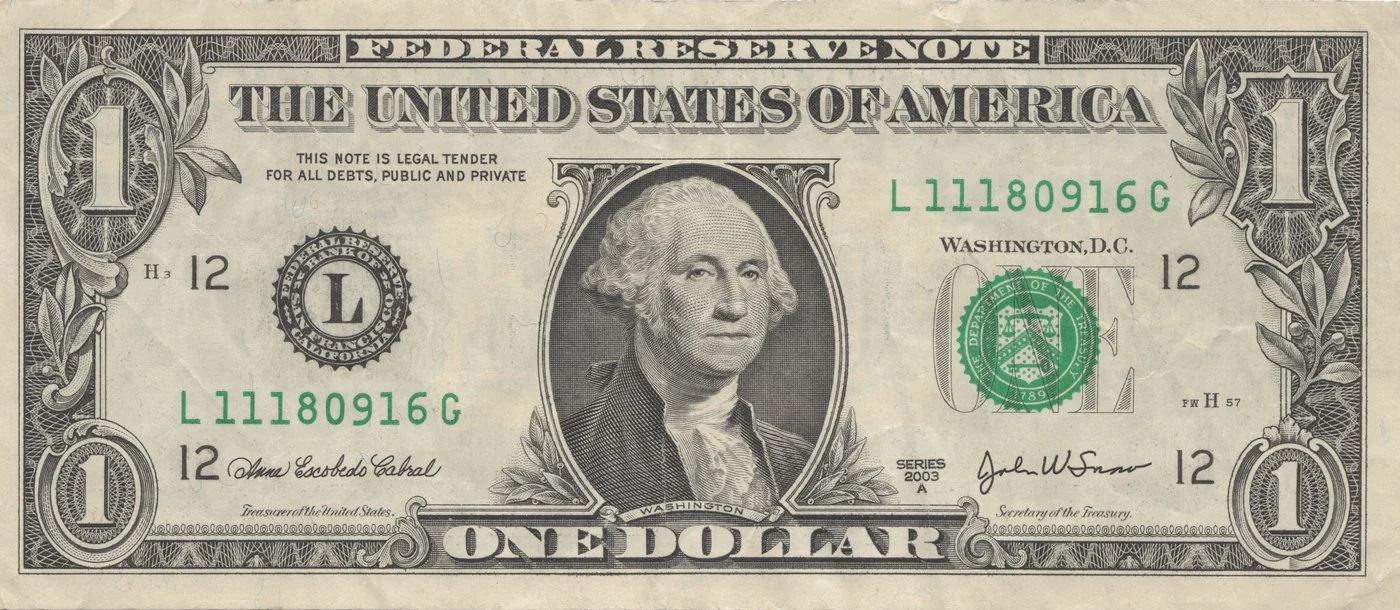
1 dollar Federal Reserve Note (current issue). In the Federal Reserve's weekly H.4.1 report, Federal Reserve Notes are listed on the liability side—averaging 2,426.4 billion dollars for the week of August 26, 2026. This single note illustrates the starting point of this book: that the banknotes in your wallet are a liability of the central bank.
Source: Public domain (from the school's specimen ledger, dollar/frn_one)
A 10,000-yen note in your wallet and 10,000 yen in your account:
Are they the same money?
This Book in 3 Minutes
- A 10,000-yen note in your wallet is a liability of the Bank of Japan; 10,000 yen in an account is a liability of a commercial bank. The face value is the same, but the debtor is different (Chapter 1).
- Money in the UK consists of banknotes and coins 3%, reserves 18%, and bank deposits 79% (2019). Most of the money you handle is a liability of banks (Chapters 1 and 2).
- Lending creates deposits. Deposits are not the source of funds for lending. When a loan is repaid, the corresponding deposit is destroyed (Chapter 2).
- However, banks cannot create money indefinitely. They are constrained by profitability, capital regulations, payments to other banks, borrower repayments, and the central bank's interest rate (Chapter 2).
- The Bank of Japan's operational target has shifted over time: from interest rates → to current account balances → back to interest rates → to the monetary base → to long- and short-term interest rates → and back to interest rates (Chapter 3).
- Government bonds are a liability of the state and an asset for the holder. At the end of March 2026, the largest holder was the Bank of Japan (42.2%)—a result of purchases from the market, not direct underwriting (Chapter 4).
- Government bonds are not a means of settlement, but they can be quickly converted into settlement assets through sale, repo, or collateralization. The US overnight Treasury repo market exceeds $8 trillion per day (Chapters 4 & 5).
- Before 2008, dollars were created outside the US, mortgages were turned into securities, and a financial system parallel to and as large as the banking system had emerged outside of it (Chapter 6).
- What increased with QE was mainly a central bank liability called reserves, not banknotes. The question of "money printing" can be broken down into three parts: which money increased, whose balance sheet changed, and what was exchanged for what (Chapter 7).
- Bitcoin solved the problem of establishing order without a third party. Stablecoins are a liability of their issuer. In Japan, the issuance of a CBDC has not yet been decided (Chapter 8).
Table of Contents
- PROLOGUEFrom Metal to Balance Sheets
- 1Modern Money — Why are the numbers in a bank account money?
- 2Banks — Why does bank lending increase deposits?
- 3The Central Bank — What does the bankers' bank do?
- 4Government Bonds — What role does national debt play in the financial system?
- 5Repo and Collateral — Why are government bonds used as collateral in financial markets?
- 6What changed before 2008?
- 72008 and QE — What did central banks do when the financial system neared collapse?
- 8Digital — Bitcoin, stablecoins, and CBDCs: What they change and what they don't
- EPILOGUEUpon a Chain of Liabilities
- WORKBOOKOpening the Ledgers Yourself (6 cases)
- BACK MATTERSUMMARY / OBJECTS / PEOPLE / GLOSSARY / TIMELINE / DATA / SOURCES
From Metal to Balance Sheets
In ancient times, we would ask: How many grams does this silver coin weigh? Who struck it? Today, we ask: Whose liability is this deposit? Who created this balance? Only what we look at has shifted, from metal to balance sheets; the form of the question remains the same.
With metallic currency, weight and fineness could be measured from the physical object. To understand modern central bank money, one must look at the central bank's balance sheet. The Bank of Japan discloses, in figures, what it owes and the assets that back it every ten days. This book begins by reading that statement.
The eight chapters start with a single banknote and proceed to commercial bank ledgers, central bank ledgers, national debt, collateral markets, the periods before and after 2008, and finally to digital forms. In each chapter, the inquiry is divided into three questions: Which money increased? Whose balance sheet changed? And what was exchanged for what?
The figures presented are only those that could be confirmed by directly reading the primary sources listed in the evidence ledger (Archives). Values that could not be read have been omitted. The figures are accompanied by a year and a country. This is why we repeatedly caution not to apply them to different years or different countries.
Modern Money — Why are the numbers in a bank account money?
- A 10,000 yen banknote in your wallet is a liability of the Bank of Japan; 10,000 yen in your account is a liability of a commercial bank. Even with the same face value, the obligor is different.
- The power of a banknote lies not in the paper but in statute — its unlimited force as legal tender (Bank of Japan Act, Article 46) and the promise of price stability.
- The Bank of Japan publishes its balance sheet every ten days. Its assets, government bonds and loans, support its liabilities, current account deposits and banknotes issued.
A 10,000-yen note in your wallet and 10,000 yen in your account: Are they the same money?
Present day, Tokyo and London
A 10,000-yen note in your wallet is a banknote issued by the Bank of Japan. Ten thousand yen in your account is a deposit owed to you by a commercial bank. Even if the face value is the same, their origins are different. One is a liability of the central bank, the other a liability of a private commercial bank.
The Bank of Japan provides two types of assets that can be used for settlement: banknotes, used by many individuals, and current account deposits at the Bank of Japan, used by financial institutions. Both are considered credit-risk-free assets provided by the central bank. Payments between banks are settled by transferring these current account deposits. When you transfer money to an account at another bank, it is not your deposit that moves, but the current account deposits between the banks.
Looking at the proportions makes this difference clear. In a 2019 explanation, the Bank of England showed the composition of money in the UK as 3% banknotes and coin, 18% reserves (the central bank's electronic money), and 79% bank deposits. The paper in your wallet is only a small fraction of all money.
In ancient times, we would ask: How many grams does this silver coin weigh? Who struck it? Today, we ask: Whose liability is this deposit? Who created this balance? Only what we look at has shifted, from metal to balance sheets; the form of the question remains the same.
Compare through recurring structures → P02 Creating money with credit・P10 The shifting center of gravity of what underpins value
Why can't the receipt of banknotes be refused?
Present Day, Tokyo, Bank of Japan Act, Article 46
Can you use any number of 10,000 yen notes for payment? The law stipulates that you can. Article 46, Paragraph 2 of the Bank of Japan Act states that banknotes issued by the Bank of Japan "shall circulate without limit as legal tender." The Bank of Japan explains that this power means any number of banknotes can be used at one time. When paying a yen-denominated debt, the recipient cannot refuse repayment with banknotes on the grounds of the number of notes. The Bank of Japan calls this unlimited compulsory circulation power.
Coins are different. Article 7 of the Act on Currency Units and Coinage Issue stipulates that coins are legal tender up to twenty times their face value. If you try to pay 1,000 yen with one-yen coins, the other party can refuse from the twenty-first coin onwards. The paper and metal in the same wallet have different legal powers.
What this article determines is the scope of circulation as legal tender. These two articles and the Bank of Japan's explanation do not cover the freedom of a store to decide in advance which payment methods it accepts. The very existence of stores that do not handle cash is a separate issue from the compulsory circulation power we have read about here.
The power of a banknote lies not in the paper, but in the law. Bank of Japan notes are a liability of the Bank of Japan, and the Bank of Japan is supported by law. Article 1 defines the purpose of the Bank of Japan as issuing banknotes, regulating currency and finance, and ensuring the smooth settlement of funds among financial institutions. Article 2 places the principle of this regulation on price stability. Behind the paper that circulates without limit in number lies the promise to maintain prices so that one is not troubled by paying with that paper.
On many ancient coins, the stamp was a state guarantee of the metal's weight and purity. Modern statutes do not guarantee the value of the material. They guarantee the obligation to accept it and the stability of prices. The stamp guaranteed the content; the statutes guarantee its circulation and prices. What they guarantee is different.
- Similarities
- The state's mark serves to reduce the suspicion of the receiver. Both the Lydian stamp and Article 46 do the same job.
- Differences
- The stamp guaranteed the content of the material. The law does not guarantee the material, but guarantees circulation and prices.
- Applications
- When in doubt about whether something is money, check the law to see who mandates its acceptance and what the limits of that obligation are.
- Limitations
- Compulsory circulation power concerns the extent to which yen-denominated debts can be repaid with legal tender. This legal basis does not cover a store's freedom to decide payment methods in advance, nor the freedom to use foreign currency or set prices. The twenty-coin limit for coins is a value set by Japanese law; it differs in other countries.
Read this comparison across different eras → P05 The system hides good money・P10 The shifting center of gravity of what underpins value
How do banknotes get out into the world?
Present Day, Tokyo, Bank of Japan counter
Printed banknotes do not go directly from the printing press to the streets. According to the Bank of Japan, the issuance of banknotes occurs when financial institutions withdraw them from their current accounts at the Bank of Japan and receive them at the Bank's counter. Banks reduce their account balances and take home bundles of paper in return. After that, when we withdraw our deposits, they finally enter our wallets.
The amount issued is not determined by the Bank of Japan, but by public demand. Demand increases when shopping and small transactions increase. As an asset with no interest but extremely high safety and liquidity, it is also affected by the yields on other financial assets and the state of the financial system.
Let's look at the scale. In the year 2025, the total payment and receipt of banknotes through the Bank of Japan's counters amounted to 18.2 billion notes, worth 120.9 trillion yen. On New Year's Eve of the same year, the banknotes held over by households, companies, and financial institutions amounted to 120.6 trillion yen, or 18.32 billion notes.
The monopoly on issuance did not exist from the beginning. In 1868, the new government issued government notes, the "yen" was born with the New Currency Act of 1871, and under the National Bank System of 1872, private national banks issued banknotes, reaching 153 banks by 1879. The Satsuma Rebellion of 1877 led to an over-issuance of paper money, causing severe inflation. The need to centralize the issuance of paper money was recognized, the Bank of Japan was established in 1882, and the first Bank of Japan notes were issued in May 1885.
A single banknote represents a liability of the Bank of Japan that has been converted from the form of a bank's account balance to a paper form. Even in paper form, the party to whom the liability is owed does not change.
Reading the Bank of Japan's Balance Sheet
August 31, 2026, Tokyo, Ten-Day Report
The Bank of Japan publishes its balance sheet every ten days. It is called the Ten-Day Report. Let's open the statement as of August 31, 2026. Total assets are 644.6620 trillion yen. Of this, government bonds amount to 519.9277 trillion yen, all of which are long-term government bonds; treasury discount bills are zero. Loans are 71.8577 trillion yen, and gold bullion is 441.3 billion yen.
On the liabilities side, there are two main items for this subject. Banknotes in circulation are 114.8673 trillion yen, and current accounts are 424.3220 trillion yen. Both the 10,000 yen note in your wallet and the balance a bank holds at the Bank of Japan are liabilities for the Bank of Japan. The capital is 100 million yen, one of the smallest items on the statement.
There is one way to read this. The assets, government bonds and loans, support the liabilities, banknotes and current accounts. When the Bank of Japan buys government bonds, the current account of the selling bank increases, and liabilities increase. When a bank withdraws from its current account, the current account decreases and banknotes in circulation increase, changing the composition of liabilities. The issuance seen in "How do banknotes get out into the world?" is this reclassification on the liability side of the balance sheet. The purchase and sale of government bonds and collateralized lending are listed as the Bank of Japan's regular business in Article 33 of the Bank of Japan Act.
For metallic currency, weight and fineness could be measured from the physical object. To read modern central bank money, one must look at the central bank's balance sheet. The Bank of Japan shows in numbers every ten days what it owes and the assets that back it.
Compare with a repeating structure → P10 The center of gravity of what underpins value shifts
Related reading — How do banknotes enter circulation?
What does "settlement" settle?
Present-day Tokyo: Three means of settlement
The moment you promise to buy a car, the buyer has an obligation to pay, and the seller has a right to receive payment. The obligation is called a debt, and the right is called a claim. Settlement is the act of actually paying and receiving money to extinguish this claim and debt. Until the money moves, the promise remains on the books.
The Bank of Japan explains money as "something that everyone would be willing to accept in exchange for goods and services." There are three types of money in a broad sense: cash currency (banknotes and coins), demand deposits held by individuals and corporations at banks, and current accounts held by financial institutions at the Bank of Japan. Cash currency has legal tender status, finality of payment (settlement is complete the moment it is paid), and anonymity (it is not known when or for what it was used). Demand deposits allow for remote and large-value settlements while avoiding the risks of transporting and theft of cash, and under the Japanese system, they also have finality of payment. Current accounts at the Bank of Japan, as a means provided by the central bank, have extremely high creditworthiness, liquidity, and neutrality.
There are also ingenious ways to extinguish debts. At the beginning of 2001, the Bank of Japan switched the settlement of current accounts and government bonds from a system of settling only the net differences at a specific time to a Real-Time Gross Settlement (RTGS) system, where instructions are executed one by one immediately upon receipt. This allows for the immediate identification of which payment has failed in the event of a single non-payment, without halting other settlements. For government bonds, since April 1994, a Delivery versus Payment (DVP) system has been in place, which links the delivery of securities to the payment of funds, thereby preventing "settlement risk" where one party delivers but does not receive.
With cash, settlement is complete the moment it is handed over. Most modern settlements are transfers of numbers in accounts, and can be considered complete only when the balance has moved through a means with finality of payment.
Compare with a repeating structure → P14 Prices are not always written on the surface
If a bank fails, what happens to the deposits?
Present-day Tokyo: The Deposit Insurance Corporation
Ten thousand yen in an account is a liability of the bank. If the bank fails, this liability may not be repaid as promised. To address this concern, Japan has a deposit insurance system. When a deposit is made at an eligible financial institution, an insurance relationship is automatically established between the depositor, the financial institution, and the Deposit Insurance Corporation under the Deposit Insurance Act. No procedure is required on the part of the depositor.
The scope of protection depends on the type of deposit. Deposits for payment and settlement, such as current accounts and non-interest-bearing ordinary deposits, are fully protected as they meet three conditions: they can provide payment services, can be withdrawn at any time, and bear no interest. For interest-bearing ordinary deposits and time deposits, the principal up to ten million yen per depositor per financial institution, plus interest accrued up to the failure date, is protected. Any amount exceeding this may be paid out depending on the financial situation of the failed institution, and a portion may not be returned. Foreign currency deposits and negotiable deposits are not covered.
The Corporation explains that the purpose of the system is to maintain the stability of the financial system by protecting depositors and ensuring the smooth settlement of funds. The failure of one bank to make payments can spread through its failure to pay other banks. The Bank of Japan calls this systemic risk and gives an example where a single failure to pay one billion yen can halt subsequent payments. Deposit insurance protects not only your balance but also the chain of payments.
How depositors are treated when their depository institution fails has varied with the times and systems. Modern Japan draws the line in advance: full protection for settlement deposits, and up to ten million yen for others.
Compare with a repeating structure → P06 The monetary system collapses・P13 Who guarantees 'safety'?
Measuring the amount of money with two yardsticks
Present-day Tokyo: Monetary base and money stock
When we speak of the "amount of money," there are two different figures. One is the monetary base. It is described as the money directly supplied by the Bank of Japan to the world, and is the sum of banknotes in circulation, coins in circulation, and current accounts at the Bank of Japan. It is an indicator that combines cash currency and current accounts at the Bank of Japan, corresponding to the sum of two items on the liability side of the balance sheet seen in "Reading the Bank of Japan's Balance Sheet," plus coins issued by the government.
The other is the money stock. This is the total amount of currency supplied from the financial sector to the entire economy, and it aggregates the balances of cash currency and deposit currency held by general corporations, individuals, and local governments. The amounts held by financial institutions and the central government are excluded. What is included as currency varies by country and era, and Japan publishes four indicators according to the breadth of the scope: M1, M2, M3, and Broadly-defined Liquidity.
The two yardsticks measure different things. The monetary base is the amount of cash currency and current accounts at the Bank of Japan, while the money stock is the amount of cash and deposits held by entities other than financial institutions and the central government. When the Bank of Japan buys government bonds, the monetary base increases. How the money stock moves depends on who it buys from. If it buys from a bank, government bonds are simply replaced by current account deposits in the bank's assets, and deposits do not increase. If it buys from a non-bank entity like a pension fund, the seller's deposits increase, and the money stock increases by that amount. "What actually increased with QE?" cannot be understood without distinguishing between these two.
To see how much households hold, there is a third set of tables. The Flow of Funds Accounts record the financial assets and liabilities of financial institutions, corporations, and households for each product, such as deposits and loans. The household sector also includes pension entitlements and settlement funds of sole proprietors.
Related reading — Reading the Bank of Japan's Balance Sheet / What Actually Increased with QE?
What kind of accounts are current accounts at the Bank of Japan?
Present day, Tokyo, BOJ-NET
Banks hold accounts with the Bank of Japan. These are the Bank of Japan current accounts. The Bank of Japan lists three roles for these accounts: as a settlement instrument for financial institutions to transact with other financial institutions, the Bank of Japan, and the government; as payment reserves for cash currency paid to individuals and corporations; and as reserve deposits for financial institutions subject to the reserve deposit system.
There is no need to open a separate account for reserve deposits. For financial institutions that have a current account, the balance of that account is counted as their reserve deposit. Some institutions that are not subject to the system, such as securities firms and money market dealers, also hold accounts for settlement purposes.
Transfers between accounts are conducted through BOJ-NET, operated by the Bank of Japan. It has two systems: one for funds transfers (current accounts) and one for Japanese government bonds (JGBs). Transactions in the short-term money market, fund settlements for JGB transactions, and the final settlement of payments for private-sector clearing systems such as the Zengin System and the Bill and Cheque Clearing System are completed through these transfers. The new BOJ-NET was launched in two phases, in January 2014 and October 2015, and in February 2016 its operating hours were extended to 9:00 PM to increase the overlap with settlement times in overseas markets.
Ensuring the smooth settlement of funds among financial institutions is one of the objectives stipulated in Article 1 of the Bank of Japan Act. The Bank of Japan not only provides settlement instruments itself but also conducts oversight to monitor the design and risk management of private-sector financial market infrastructures.
The lecture, which began with 'Are the ten thousand yen in your wallet and the ten thousand yen in your account the same money?', now moves up a level. Your bank account sits on top of the Bank of Japan's accounts.
Compare with a repeating structure → P07 New Technologies Change Money
Related reading — Are the ten thousand yen in your wallet and the ten thousand yen in your account the same money?
Key points so far
- Three types of money — banknotes (liabilities of the Bank of Japan), demand deposits (liabilities of banks), and current accounts at the Bank of Japan (liabilities of the Bank of Japan). Coins are issued by the government.
- Settlement is the act of extinguishing claims and obligations by actually moving money. It can be said to be complete when the balance is moved using a means that has payment finality.
- The amount of money is measured by two yardsticks (monetary base / money stock), and an increase in one does not necessarily mean an increase in the other.
Open to enrolled students
Ahead: Banks — Why does bank lending increase deposits?, The central bank—the bankers' bank. What does it do?, Government Bonds — What role does national debt play in the financial system?, Repo and Collateral — Why do government bonds serve as collateral in financial markets?, What had changed before 2008?, 2008 and QE — What did central banks do when the financial system was on the brink of collapse?, Digital — What do Bitcoin, stablecoins, and CBDCs change, and what do they not change?, In the chain of liabilities, Open the ledgers yourself — and the reference section (timeline, people, sources).
Already enrolled? Log in. Free sample: Vol. 1, Source Criticism (free in full).