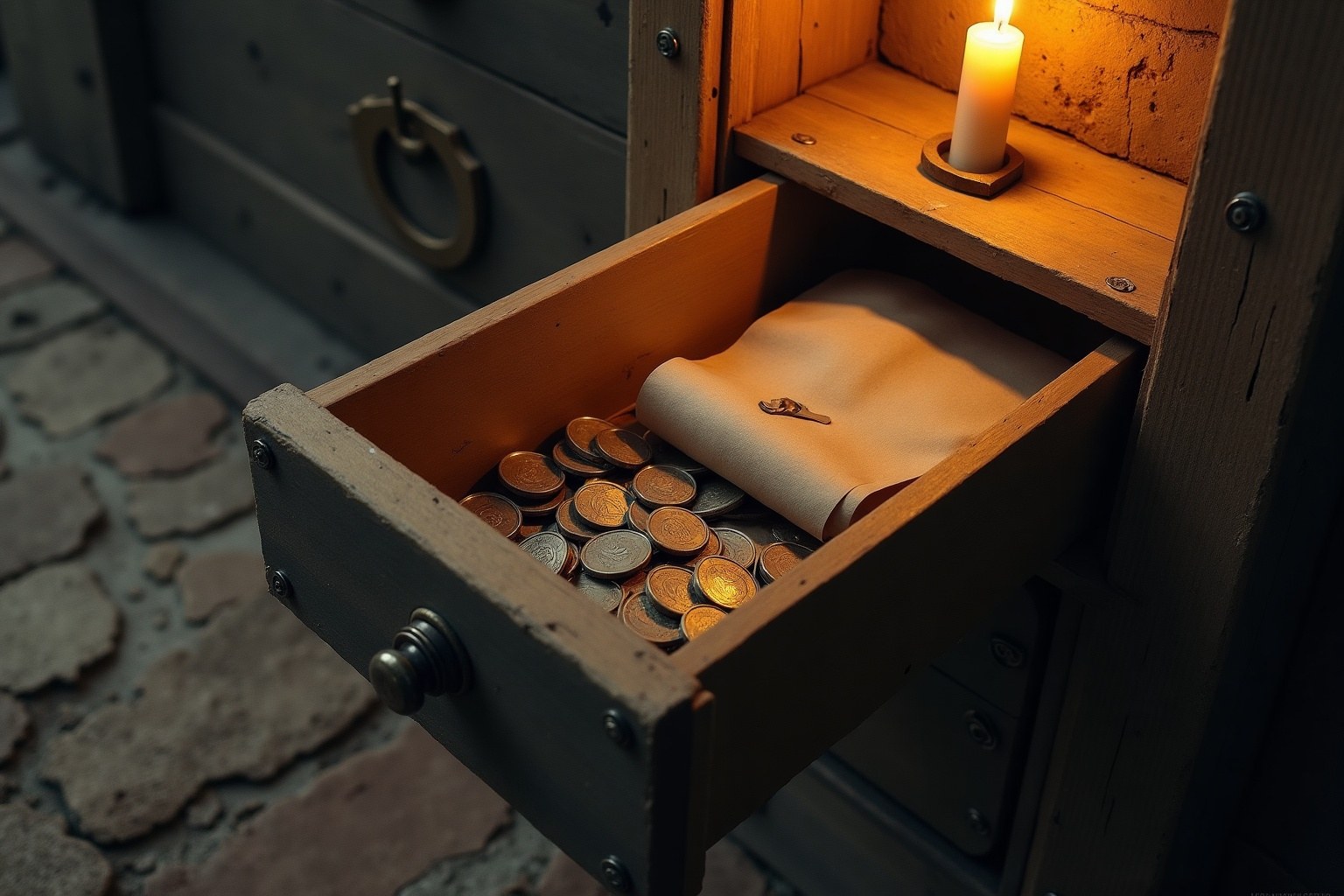
What happens when money of different intrinsic values is used at the same face value? We will learn the conditions and history of this law.
Time to read the text: about 8 min The review questions are optional and not included in this time. What you can read: the course opening and contents are free; the full text is for those who have purchased After purchase, you can read the full text once your access starts.
Sometimes, good money and bad money can be used for the same face value.
For example, a coin with more silver and one with less silver.
2 / 8
People will keep the good one and spend the bad one first.
Because you get the same value for either one.
3 / 8
So, only the bad money ends up circulating around town.
This is 'bad money drives out good money'.
4 / 8
405 BC
This was already described in an ancient Athenian comedy.
The audience members were holding actual bad coins.
5 / 8
From 1792
America set the ratio of gold to silver by law. The undervalued gold flowed out of the country.
15 to 1
The legally set ratio of gold to silver.
6 / 8
1560
The 'driving out' stops if you collect the bad money and re-mint it.
It won't happen if they aren't forced to have the same value.
7 / 8
1858
The name 'Gresham's Law' was given to it much later.
Gresham himself never wrote it down in this form.
8 / 8
When you hear a name like this, think about when it happened versus when it was named.
The more famous a saying is, the more its original conditions get left out.
2In numbers
1858year
The year the law got its name. The phenomenon had been seen since ancient times.
3What would you do?
You have two coins in your wallet, both usable for the same amount. One has more silver, the other has less. Which one do you spend at the store?
Pick one
Spend the one with less silver.
That's what most people do. If both are treated the same, you keep the better one. As a result, only the bad coins circulate around town.
Spend the one with more silver.
That would also make sense if the coin with more silver was accepted for more than its face value. You wouldn't lose anything by spending it, so there's no reason to keep it.
This law only works when there's a rule forcing both types of money to be accepted at the same value. It's important to remember the conditions.
If you want to know more about checking sources (optional)
Is It Really True? Checking History We re-examine the origins of money and famous anecdotes, comparing them with historical records and actual artifacts.
Assessment
9 exercises in this course (7 check, 0 compare, 2 written). Progress is recorded by self-assessment.
The 8 chapters of this course
The name came last of allThe phenomenon was visible from antiquity. The name was attached in 1858. Do not reverse the order.
What Gresham actually had to do with itGresham did not discover the law. He was a practitioner working where bad money actually circulated.
Why does the same thing happen again and againThere is only one condition: that both stand at the same face value. That is why it recurs in any age or place.
Knowing when it fails is knowing the lawDrop the condition and the law becomes a proverb. Proverbs cannot be tested. Carry the condition with it.
The First Observers — Oresme and CopernicusA fourteenth-century bishop and a sixteenth-century astronomer both observed and wrote about the same phenomenon.
A theologian twelve years earlier — AzpilcuetaThe quantity theory of money was born in Spain. Twelve years before Bodin, and yet his name was not remembered.
The Man Who Rediscovered the System's Flaw — TriffinThe observation of the key currency's fate also became a named insight. A warning is at the forefront of rediscovery.
The Namer — Macleod and the Dynamics of a NameA name becomes a vessel to carry an observation and, simultaneously, a lid that stops the examination of its contents. Naming is a double-edged invention.
Readings (14)
London, and a study of a later age Britain Gresham and the recoinage 1560–1858 §1. The backbone of the course. It is written here who gave it the name.
Britain Overview: the world the 16th century Gresham's Law §1. A case where the law is explained as "human nature." Read watching how strongly it asserts.
The Great Debasement Britain 1544–1551 An English town §2. The scene where debasement looks like success in the ledger.
The queen's court Britain Gresham and the recoinage about 1560 §2. Gresham as an adviser in the queen's service.
The London mint Britain Gresham and the recoinage 1560–1561 §2. The remedy of calling in and restriking.
London, the Royal Exchange Britain Gresham and the recoinage 1571 §2. What he left behind besides advice.
The Coinage Act of 1792 United States 1794 The striking room of the mint §3. The scene where the same thing happened in the New World. The ratio is set at fifteen to one.
The price revolution Spain 1556 Salamanca, the lecture hall of the school Section 6. The theologian who was twelve years too early. The asymmetry of a name's fate.
The anchor groans United States 1960 Washington, the Congress Section 7. A modern example of something named after its observer.
The century of silver and the price revolution France 1566–1568 A study in the Parlement of Paris A counterpart to Section 6. The record from the side whose name was carried by the controversy.
Debased Coinage Greece 405 BCE Theatre at the Lenaia festival This is the first observation, more than two thousand years before the law was named. Please verify in the original text the passage where the chorus in the comedy 'The Frogs', performed at the Lenaia festival in 405 BC, sings that good coins are hoarded while only the base copper coins with the worst impressions circulate in the market.
The Tilting Scales Austria 1621–1623 The Money-Changer's Table This text describes the physical actions people took when this law was in effect. The action of tilting a scale to sort out good coins is *wippen*, and these two verbs gave the "Kipper- und Wipperzeit" its name. Please observe the process by which the sorted silver was melted in a furnace and returned as debased coinage.
August 1914 Russia 1914 The city This passage explains the same law as a matter of rationality, not human nature. It is written after correcting the common misconception that gold coins disappeared because the government recalled them, when in fact it was because people hoarded them.
References
Monetae cudendae ratio (On the Striking of Coin). — IntraText Digital Library (original Latin text with concordance). Copernicus's treatise on money. Full text in Latin (approx. 3,008 words). A primary source that stated the relationship between bad and good money before Gresham.
The books and materials referred to in this course.