Rice, Coins,
and Silver
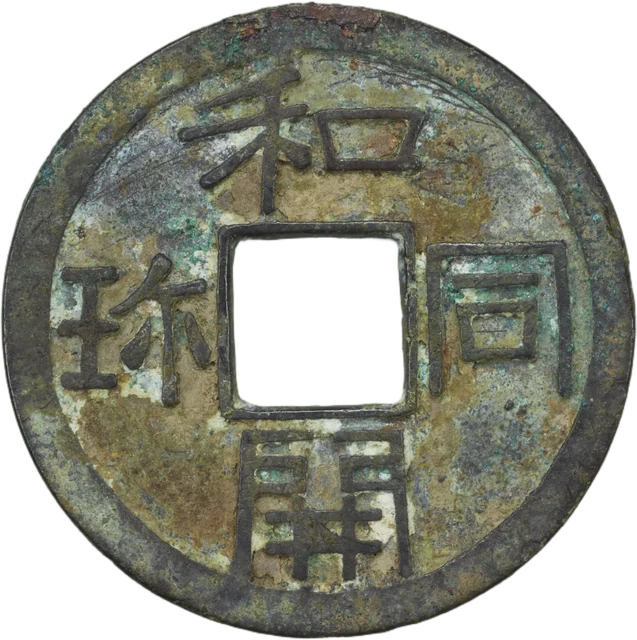
ColBase, National Institutes for Cultural Heritage (Tokyo National Museum E-8770, excavated from the Sōfukuji Temple ruins) / CC BY 4.0
Why did this island welcome from the sea and re-excavate from the mountains the coins that the state had stopped minting?
This volume in 3 minutes
- On an island without coins, only interest existed beforehand. The 'suiko' system lent rice to be returned in autumn. Rewards for the Jinshin War were paid in rank and rice paddies, as the state had no coins.
- In 708, the Wadōkaichin. Minting them did not ensure their circulation; a law to entice use with court ranks failed over 89 years, and private minting became punishable by death in three years.
- The Great Buddha could not be built with state funds alone. An edict declared that even a handful of soil was welcome, fundraising was entrusted to a once-banned monk, and the Buddha was erected with copper from Chōto and gold from Mutsu.
- The market rejected the pretense of making one new mon equal to ten old mon for twelve years, and it was the state that yielded first. After the Kengen Taihō of 958, the imperial court did not mint coins for 678 years.
- An era without coins was not an era without finance. Silk and rice served as measures of value, vouchers ordered payments from storehouses, both Masakado and Sumitomo rose up over taxes, and rewards were still paid in official ranks.
- It was not the court but the sea merchants of Hakata who brought back coins. Kiyomori built a port, the capital recorded the 'illness of coins,' and in 1226 the shogunate chose Song coins.
- The system of favor and service revolved around land, and defensive wars left no land to distribute. The burden of the Mongol invasions was not two battles but decades of duty, and a victory without rewards led to moneylending and debt cancellation edicts.
- Ships went to sea to build a temple, and one sank with eight million coins. Bowing one's head brought in coins; defending one's name meant losing them. The balance of the tally trade swayed in the capital.
- Temples were the banks. 'Shidōsen' funds were not erased even by debt cancellation edicts, the shogunate's pillar was taxes from moneylenders, and their collection was entrusted to the moneylenders themselves.
- In an age of 'erizeni,' where merchants flicked coins at their storefronts, the Ōuchi clan and the shogunate set completely opposite values for the same coin. As imported coins dwindled, people began to pay in silver, and the mountains of Iwami shone.
- Nobunaga did not eliminate bad coins but assigned them a value. Hideyoshi displayed gold. Ieyasu institutionalized a system of gold by count and silver by weight. In 1670, coins other than the Kan'ei Tsūhō were banned, ending 700 years of imported currency.
- The Genroku recoinage was for seigniorage. The Shōtoku era restored good currency but constricted the economy. The Genbun era added a premium and remained stable for 80 years. The Nanryō Nishu Gin changed silver by weight to silver by count.
Table of Contents
- IntroWhat changed about money in this era?
- 1Before Coins — Rice, cloth, interest, and the Jinshin War
- 2Wadōkaichin — To mint was not to circulate
- 3The Copper that Cast the Great Buddha — Not by the state treasury alone
- 4The Twilight of the Twelve Coins — The state that insisted one new mon was ten old mon
- 5The Country that Abandoned Coins — Silk, rice, and rewards paid in rank
- 6Coins Come Again — From Hakata's Chinese quarters to the 'illness of coins'
- 7Fighting with Rice — From the Jishō-Juei War to the Jōkyū War
- 8The Shogunate Chooses Coins — Tax payment in coin, moneylenders, Mongol invasions, and debt cancellation
- 9Coins Across the Sea and Coins of War — From the Kenmu Restoration to the Ōnin War
- 10When Temples Were Banks — Rice loans, temple funds, pawnbrokers, and uprisings
- 11From the Age of Coin Culling to the Land of Silver — Bitasen, Iwami, firearms, Nobunaga, and Hideyoshi
- 12The Three-Coinage System and the Century of Recoinage — Gold by count, silver by weight, and the Kan'ei Tsūhō
- OutroWhat was left for the next era?
- EndSUMMARY / GALLERY / PEOPLE / TIMELINE / DATA / QUESTIONS / DRILL / SOURCES / REVISION HISTORY
The history of money on this island is made of four verbs: to mint, to abandon, to welcome, and to dig. In the 7th century, the state minted round copper discs modeled on Tang coins, and stopped minting in the 10th century. In the 12th century, sea merchants brought in Song coins, and for the next 700 years, this island lived on coins from across the sea. In the 16th century, silver gushed from the mountains of Iwami, and the island transformed from a country that imported coins to one that exported silver. Then in the 17th century, Ieyasu institutionalized a system of gold by count and silver by weight, and Iemitsu minted the domestic Kan'ei Tsūhō, closing the era of imported coins.
This volume repeatedly encounters two patterns. The first is that a state without coins can only pay rewards in rank and land, and when the land runs out, the system collapses. This pattern appears four times: in the Jinshin War, the Bandō Rebellion, the Jōkyū War, and the Mongol invasions. The second is that even if the state declares a face value, the market only looks at the intrinsic content. The 8th-century court, which set one new mon to ten old mon, yielded in twelve years; 15th-century merchants flicked coins at their storefronts; and the 17th-century shogunate removed the source of conflict by distributing enough good coins. With these two patterns, we move on to the Bakumatsu period in General History ⑧.
Before Coins — Rice, cloth, interest, and the Jinshin War
There were no coins yet. On this island, what was called wealth was rice, and the number of rice bales stacked in a high-floored storehouse was the measure of a family's power. Taxes were also in kind. Silk, thread, and cloth were paid as 'chō,' and cloth as 'yō.' Cloth was counted in 'tan' and silk in 'hiki,' and they became a means of payment. This chapter explores what existed and what did not on the island before the arrival of coins.
Only interest existed beforehand
There was a system called 'suiko.' Rice was lent in the spring and returned with interest in the autumn. The interest on public 'suiko' lent by the state was 50% per year, later reduced to 30%. Private 'suiko,' according to the Yōrō Code, could be up to 100% per year. On an island without coins, only interest already existed. Note that there is no evidence that shells circulated as money on this island. Kanji characters containing the radical for 'shell' refer to stories from across the sea.
In 621, Emperor Gaozu of the Tang dynasty had a new coin minted: the Kaiyuan Tongbao. It had a diameter of about 24 mm and a weight of 3.75 g. The weight of this single coin would eventually become the unit of weight in East Asia and the origin of the word 'monme.' A round shape with a square hole. The cosmology that heaven is round and earth is square is held in the palm of one's hand. From 630, Wa (Japan) began sending missions to Tang China, and the students who stood in the markets of Chang'an learned the sound of bronze coins jingling in their pouches, and brought back the form of the coin and its ideology.
In 663, Wa (Japan) was defeated by Tang and Silla at the Battle of Baekgang. The capital was moved to Ōtsu in Ōmi Province, and around that time, un-inscribed silver discs began to be used in the Kinai region and Ōmi. These are the Mumon ginsen (unpatterned silver coins). One piece found in Kyoto has a diameter of about 31 mm, weighs 9.5 g, and has a silver purity of 94.9%. About 120 of these coins have been unearthed from 17 sites nationwide. Their weights vary, ranging from less than 7 g to over 35 g, and there were examples where small pieces of silver were added to adjust the weight. It was weighed money, not counted money. It is still unknown who issued them.
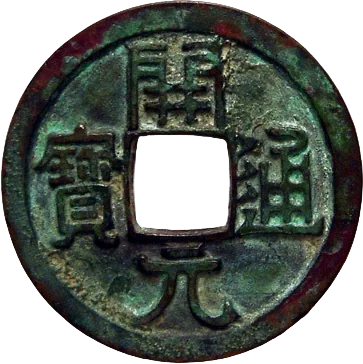
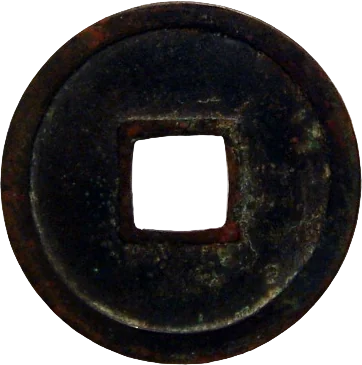
What to look for: The arrangement of the four characters and the square hole. Compare it with the KEY OBJECT in Chapter 2 to confirm that the Wadōkaichin, 87 years later, copied the dimensions and layout of this coin.
CZDK (talk) / CC BY-SA 3.0 (Wikimedia Commons) → Object Database
Counting People
The defeat in war forced the state to count its people. In 670, a nationwide family register was created. This was the Kōgo-nenjaku. It was a ledger established to define clan and family names and to be preserved forever. However, the original documents have not survived. Counting people meant counting how much rice, cloth, and labor could be collected from them. At this point, the wealth of the state was rice, cloth, and people. It was not coin.
The First Step of the Rebellion Was Rice
In 671, Emperor Tenji, on his sickbed, tried to entrust the future to his younger brother, Prince Ōama, but the prince declined and retired to Yoshino. Yoshino was a place for those who had nothing. There were no soldiers. There were no storehouses. All that remained in the prince's hands was the income from his Yūmoku'yū, the private domains of the imperial family, in Mino and Ise. A Yūmoku'yū was not a territory to be governed, but a domain from which one only received the tax revenue.
On June 24, 672, the prince left Yoshino. The next day, the 25th, in Kuwana district, his party encountered 50 packhorses carrying rice from his Ise Yūmoku. The prince had all the rice unloaded onto the ground and placed his retainers, who were on foot, on the backs of the empty horses. The first step of the rebellion was not soldiers, but rice. The uprising was supported not by state granaries, but by the rice from his own private domains and the horses that carried it. On June 27, the governor of Owari Province surrendered with a force of 20,000 men. This number is from the Nihon Shoki, and the actual figure cannot be confirmed. In May of that year, the Ōmi court had conscripted laborers from Mino and Owari and armed them, under the pretext of building Emperor Tenji's burial mound. The people gathered under the guise of constructing a tomb became an army. This reflects an era when labor and military service came from the same people.
The Fuwa road is the throat of the Tōsandō highway. By blocking it, the Ōmi court would lose its route to call for soldiers, horses, and provisions from the eastern provinces. War is about cutting off the enemy's circuits of wealth and people that can be mobilized. In a country without coin, blocking a road was a direct economic blockade. On July 22, the Ōmi army collapsed at the bridge of Seta, and the next day, Prince Ōtomo hanged himself. It had been one month since the war began.
The rewards were court rank, fiefs, and land.
So, what was paid to the winning side? Court rank, stipend fiefs, and rice fields. Because the state had no coin, rewards could only be paid in rank, people, and land. No historical records remain that list what each individual received. In 675, Emperor Tenmu ordered the abolition of the kakibe (private retainers) granted to various clans, reclaiming the private subjects of powerful families for the state. The hand that had regained control of the circuits of wealth would eventually reach for copper discs. And this method of paying with rank because there was no coin would survive for over two hundred years, even for the rewards in the Bandō rebellion.
In April 683, Emperor Tenmu issued an edict: "From now on, use copper coins, and do not use silver coins." This is a single line remaining in the Nihon Shoki. What was forbidden were those Mumon ginsen. What were the copper coins mentioned here? The Nara National Research Institute for Cultural Properties suggests they were likely Fuhonsen. Coinage appeared as a declaration of the state.
The Day the Textbooks Were Rewritten
In the summer of 1998, about 40 Fuhonsen coins were excavated from the Asukaike site in Asuka village, Nara Prefecture. Not just coins, but also molds, crucibles, files, and unfinished pieces with casting flash. An entire workshop lay dormant in a stratum from the second half of the 7th century. The announcement in January of the following year is called "the day the textbooks were rewritten." They have a round shape with a square hole. To the left and right of the two characters for "Fuhon" is a Shichiyōmon pattern of seven stars. It was an alloy of copper and antimony.
So, were Fuhonsen actually used? The issue is not settled. The theory that they were amuletic coins is based on examples unearthed from the Daigokuden-in of Fujiwara Palace, where they were buried as ritual objects for groundbreaking ceremonies. The theory that they were circulating currency is based on the mass-production system at Asukaike and Emperor Tenmu's edict. Currently, the prevailing view is that they were issued as currency but saw little actual circulation, and were also used for ritual purposes. The same coin could be a payment in one person's hands and a prayer in another's. From the very beginning, this coin embodied the essence of money: that value is created through belief.
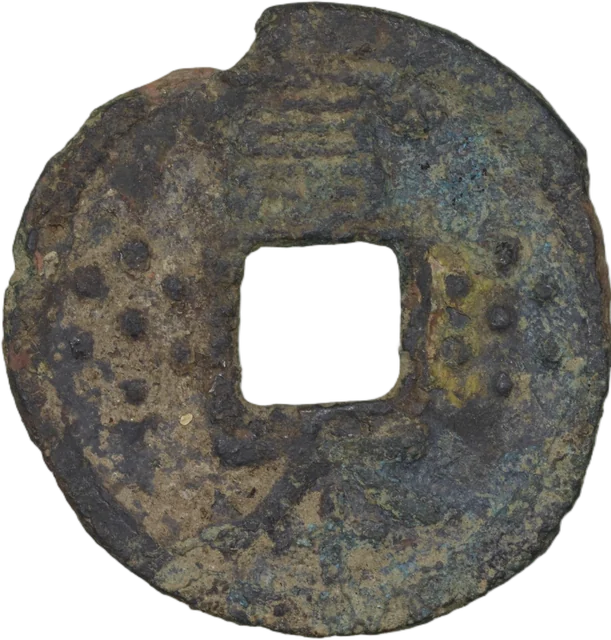
What to look for: The two characters for "Fuhon" and the seven stars. Keep it as an open question whether this coin was the "copper coin" mentioned in Emperor Tenmu's edict.
National Institutes for Cultural Heritage, ColBase (Tokyo National Museum E-2625) / CC BY 4.0 → Object Database
- Confirmed Facts
- Interest on public loans was 50% per year (later 30%), and on private loans up to 100% per year under the Yōrō Code. The Kaiyuan Tongbao was first cast in 621, with a diameter of about 24 mm and a weight of 3.75 g. About 120 Mumon ginsen have been found at 17 sites. The Kōgo-nenjaku was compiled in 670. The Jinshin War began on June 24, 672, with the Battle of Seta on July 22. Emperor Tenmu's edict was issued in April 683. Fuhonsen were excavated at Asukaike in 1998.
- What is not known
- Who issued the Mumon ginsen. The actual number of soldiers in the Jinshin War (20,000 and 'tens of thousands' are expressions from the Nihon Shoki). Whether Fuhonsen were circulating currency or ritual objects. A complete list of rewards.
- What happened in that era
- On an island without coin, only interest existed first. The state counted people, a rebellion began with rice and horses, and rewards were paid in rank and fields. The state, modeling itself on Tang coinage, introduced its own coins as a declaration.
- The underlying mechanism
- As long as wealth consisted of rice, cloth, and people, the state could only pay with rank, land, and people. War was about cutting off the circuits of wealth and people, and blocking roads was a blockade.
- Questions that remain relevant today
- Does currency begin with a state's declaration, or does it begin with belief? The fact that Fuhonsen were used for both payment and prayer brings us back to the question in Theme 1: currency is an agreement. → P01 Believing in the Mark
- Points of difference
- The 7th-century state counted people and rice before minting coins; coins came last. The modern state first holds currency as a liability on its books, and the counting comes later. → P11 The link to gold is broken
- See — Open the Kaiyuan Tongbao and the Fuhonsen side-by-side in the object database.
- Observe — The square hole and the arrangement of the four characters. Confirm that the Fuhonsen's Shichiyōmon pattern is not on the Kaiyuan Tongbao.
- Search — Consider the reason why the weight of Mumon ginsen varies from less than 7 g to over 35 g, based on the term "weighed money."
- Look up — Look up Interest, Weighed money, Nengu (Land tax), and Mint in the glossary.
- Answer — Write a single sentence explaining "The first step of the rebellion was not soldiers, but rice," using the term Yūmoku'yū.
Open to enrolled students
Ahead: The Copper that Cast the Great Buddha — The State Treasury Alone Was Not Enough, The Twilight of the Twelve Coins — The State that Insisted One New Mon was Ten Old Mon, The Country That Abandoned Coinage — Rewards Paid in Silk, Rice, and Court Rank, Coins Return — From Hakata's Tōbō to the Coin Sickness, Fighting with Rice — From the Jishō-Juei War to the Jōkyū War, The shogunate chooses coins — daisen'nō, kashiage, Mongol invasions, tokusei, Coins that Crossed the Sea, Coins of War — From Kenmu to Ōnin, Temples were banks — Suiko, shidōsen, dosō, ikki, From the Age of Erizeni to the Land of Silver — Bitasen, Iwami, Firearms, Nobunaga, and Hideyoshi, The Reign of Three Currencies and the Century of Recoinage — Gold by count, silver by weight, and the Kan'ei Tsūhō — and the reference section (timeline, people, sources).
Already enrolled? Log in. Free sample: Vol. 1, Source Criticism (free in full).