The Debasement of Currency
Fineness and Recoinage — The Temptation States Repeatedly Succumbed to, and the Art of Detection
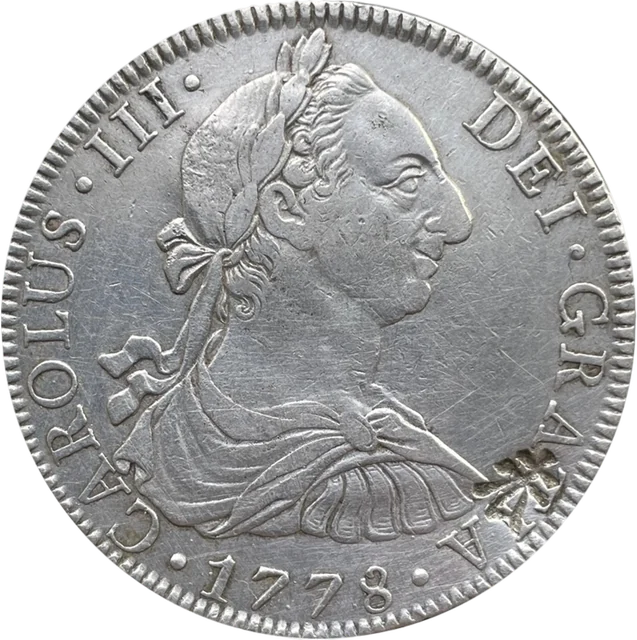
Bust Dollar, 1778, Mexico City Mint. The king's face is a design that proclaims, "I am the guarantor of this coin." Yet around 1772, at the very time of the transition to this bust type, the fineness was debased another step, without public announcement. The face spoke of credit, while the content quietly diminished—this single coin embodies the theme of this volume.
Source: Windrain / CC BY-SA 4.0 (from the school's object ledger peso/busto_1772)
The coin in your hand—
how far can you trust it?
This Volume in 3 Minutes
- Debasement is the most repeated failure in monetary history. This book dissects the methods, the costs, and the techniques for seeing through it.
- Debase in stages (to avoid detection), restore all at once (to regain trust)—England reduced fineness from 0.925 down to 0.25 in steps, then restored it in a single stroke nine years later.
- The market notices. Good coins are hidden, bad coins go on a journey — widespread circulation is not proof of quality.
- The same word "recoinage" refers to two opposite actions: debasement and restoration. Each time you read it, check which one is meant.
- Rome could not recover for over two hundred years, while England did so in eighteen. The time from the start of the debasement to the recovery determines the magnitude of the cost.
- When the debasing authorities begin to compete, the slope becomes a cliff (Kipper und Wipper). "A little at a time" was the luxury of a monopoly.
- There is a cost for the restorer, too. Good money is scarce—in Shōtoku era Japan, restoring quality led to economic contraction.
- This history is paralleled by the history of the art of detection. From the touchstone to the milled edge—hundreds of years of struggle remain on the edge of today's coins.
- That is why this book always begins each chapter by looking at an actual object. Color, weight, edge, punch marks—the coin in your hand is the primary source.
Table of Contents
- PROLOGUEThe Unannounced Debasement
- 1Debasing in Stages—Never All at Once
- 2Bad Money Travels the World Because It Has No Home
- 3The Troubles a Debasing Nation Faces Afterward
- 4Rome — The Long Slope of Over Two Hundred Years
- 5Kipper und Wipper—The Time of the Tipping Scales
- 6Genroku and Shōtoku—The Justification for Debasement, the Cost of Restoration
- 7The Same Mistake: Where and How Many Times?
- 8The Art of Detection—From Touchstone to Milled Edge
- EPILOGUENeither Is Called "Correct"
- BACK MATTEROBJECTS / PEOPLE / TIMELINE / DATA / SOURCES
The Unannounced Debasement
- Let's look again at the coin from the cover. The king's bust—a design with a face that says, "I am the guarantor."
- The legend, date, and mint mark—all are engraved clearly and legibly.
- So, where is the fineness engraved? Try to find it.
It is not engraved anywhere.
The fineness of the eight-real coin had been set at 134/144 by a royal ordinance of 1497. In 1728, this was lowered to 11/12. Then in 1772—at the very same time as the transition to the bust type on the cover—it was lowered another step. Moreover, this debasement was not publicly announced and is said to have been carried out in stages thereafter.
| Year | Fineness of the 8-real | Announcement |
|---|---|---|
| 1497 (Royal Ordinance) | 134/144 | Promulgated as standard |
| 1728 | Lowered to 11/12 | — |
| 1772 | Lowered another step | Not announced. Said to have "proceeded" in stages thereafter. |
Behind the scenes, while the world continued to trust in the same fineness, only the proportion of silver quietly decreased. The royal house, which should have been minting credit, was beginning to lean on that very credit.
This is the theme of this book. Debasement—the most repeated failure in monetary history. The content of the "same coin" quietly diminishes. By the time you notice, it's too late to go back.
The first four chapters examine the structure: in what order debasement occurs, how the market detects it, and what difficulties the debasing state faces. The latter four chapters cover specific cases and techniques: Rome, which could not recover for over two hundred years; Germany, where competition turned a slope into a cliff; Japan, which shows the price paid for restoration; and the identification techniques that developed in tandem with debasement.
This is a TYPE B—Object Observation—book. At the beginning of each chapter is a "First, a Look" box, and at the end is a one-line "Check the Object in Your Hand." Look before you read, and look again after you read. That is how to read this book.
The coin in your hand—how far can you trust it?
Debasing in Stages—Never All at Once
- In the graph below, note the steps on the downward slope—pay attention to the height of each step.
- And then the vertical wall from 1551 to 1560. Why are the shapes of the decline and the recovery so different?
For a long time, English silver coinage had maintained the sterling silver standard—92.5 percent silver. Its purity was debased during the reign of Henry VIII. Not all at once, however. One step, and then another.
Why in stages? The reason is simple: to avoid detection. If the fineness were quartered all at once, anyone would notice. A little at a time, and neither the color nor the weight changes much. The debasement did not stop after Henry VIII's death; during the reign of his son, Edward VI, the silver in silver coins finally fell to twenty-five percent in 1551. The silver and gold that were removed went straight into the royal coffers as profit. The course material states it in a single line: the mint had transformed from a place that struck coins into a machine that shaved off credit and turned it into profit.
And now, look at the pattern of the restoration. Queen Elizabeth I restored it all at once, not in stages. When debasing, it's gradual; when restoring, it's all at once. This is a rule of thumb from the English example, not a law — the process you don't want noticed and the process of regaining trust take opposite forms.
There must have been a way to restore it in stages. Why was it done all at once? This is worth considering. If it were restored little by little, the suspicion toward "the coin of today" would not be dispelled.
Open to enrolled students
Ahead: Bad money wanders the world because it has no place at home, The trouble a country faces after debasement, Rome — The Long Slope of Over Two Hundred Years, Kipper- und Wipperzeit — The Time of the Tilting Scales, Genroku and Shōtoku — The Justification for Debasement, the Cost of Restoration, The same failure: where and how many times did it occur?, Techniques of authentication — from the touchstone to the reeded edge, Neither is called "correct" — and the reference section (timeline, people, sources).
Already enrolled? Log in. Free sample: Vol. 1, Source Criticism (free in full).