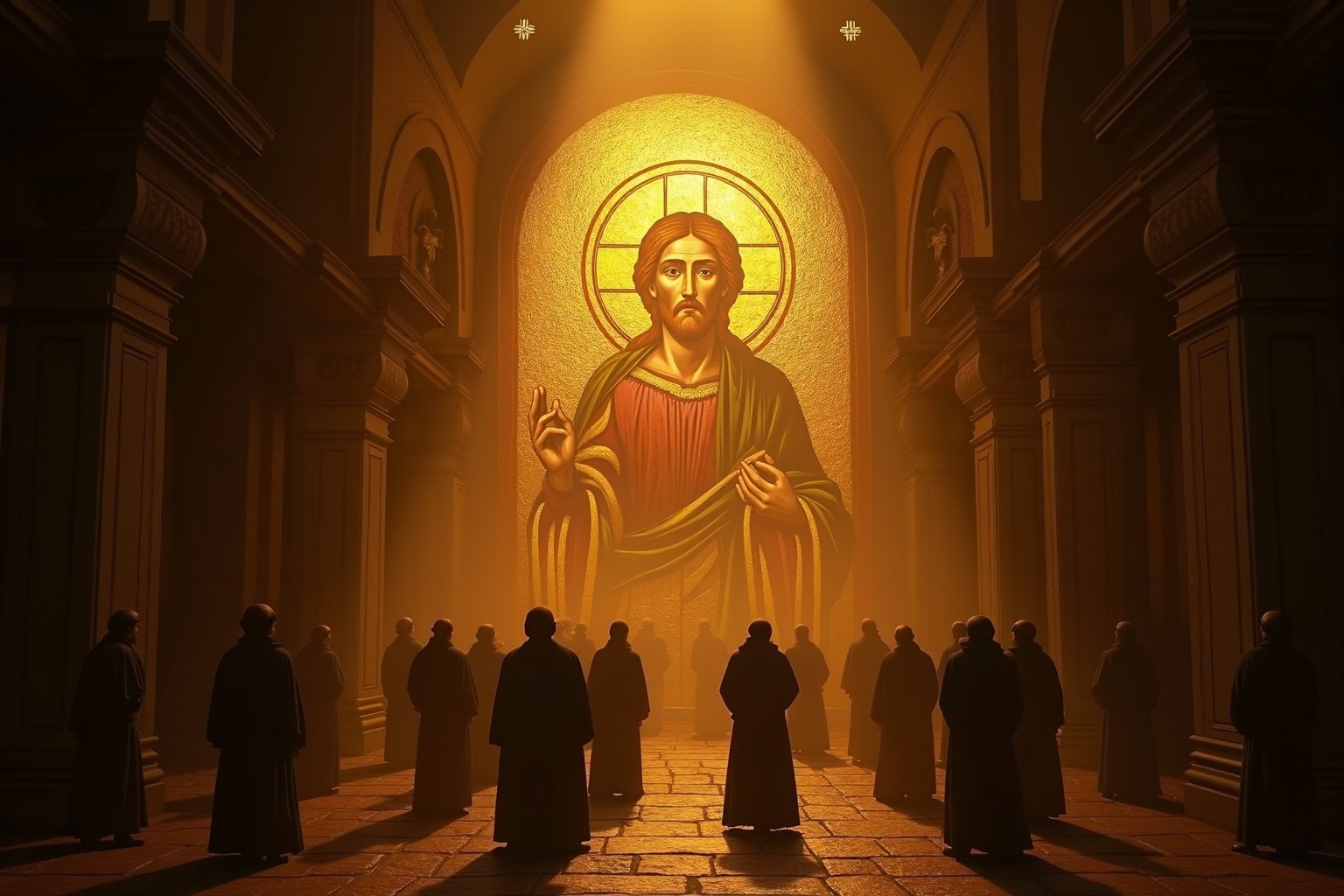
English 'money', French 'monnaie', German 'Münze'. All derive from the name of the temple of the goddess Juno Moneta on a Roman hill.
Time to read the text: about 8 min The review questions are optional and not included in this time. What you can read: the course opening and contents are free; the full text is for those who have purchased After purchase, you can read the full text once your access starts.
The word 'money' comes from the name of the temple of the goddess Juno Moneta.
There was a mint next to the temple.
2 / 8
Temples were the first banks. They held deposits, kept records, and guaranteed value.
Later, deposits and records went to banks, and guaranteeing value went to the state.
3 / 8
Nara period
The copper for casting the Great Buddha and the copper for coins. It became a scramble for the same metal.
At the time, they were dealing with plagues and rebellions. We don't see it as wasteful spending.
4 / 8
The one who guaranteed money shifted from gods to kings, and from kings to the state.
Even today, dollar bills are printed with 'In God We Trust'.
5 / 8
From the late Kamakura period
Temples were also moneylenders. Interest was 48% to 72% a year.
The best tool for collecting debts was the borrower's faith.
6 / 8
12th century
The Knights Templar made it possible to withdraw money in Jerusalem that you deposited in Paris.
Because they were a religious order, they were trusted across borders.
7 / 8
1517–1571
Selling salvation slips, destroying holy statues, and burning down temples continued.
These were also money-related incidents disguised as matters of faith.
8 / 8
Tenbun 9
The custom of offering that year's rice to gods and buddhas became the monetary offering (saisen).
They started getting money from people's visits, not just from the land.
2In numbers
About 25%
Percentage of stops in the Japan section that talk about temples, shrines, and money
Japan section (68 out of 269 stops)About 25%
General section (22 out of 242 stops)About 9%
500,000livres
Amount the Knights Templar lent to the King of France in 1299
3What would you do?
There are 68 stories about temples, shrines, and money in the Japan section, and 22 in the general section. Can we just say 'The writer simply focused more on the Japan section'?
Pick one
Yes, we can. The difference in numbers is just the writer's bias.
That doesn't fully explain it. If you divide by the number of stops, the Japan section is about 25% and the general section is about 9%. A difference remains even when you account for the total number of stops.
We should divide by the number of stops before we decide.
That's the right way to check. The Japan section has 68 out of 269 stops (about 25%), and the general section has 22 out of 242 stops (about 9%). There's a difference that can't be explained by the writer's bias alone.
A simple count can be misleading. It looks different when you turn it into a percentage. Always make sure you're comparing like with like.
You can describe how "the being that guarantees value" passed from god to state.
Can explain temple and shrine finance in medieval Japan (suiko, shidōsen, dosō), including interest rates and the agents involved.
Can interpret the conflict between faith and currency (indulgences, iconoclasm, arson attacks) from an economic perspective.
You can start this course without reading any other course.
Also worth reading, to see the connections (optional)
Deciphering the Images and Text on Coins What you learn: Looking at both faces of a coin, you can point to what lies in each part. The text refers to this course in section 3.
If you want to know more about checking sources (optional)
Is It Really True? Checking History We re-examine the origins of money and famous anecdotes, comparing them with historical records and actual artifacts.
Assessment
10 exercises in this course (7 check, 0 compare, 3 written). Progress is recorded by self-assessment.
The 8 chapters of this course
The temple was the first bankTemples were responsible for storage, record-keeping, and guarantees. Rather than settling on a single origin for coinage, we examine the connection between places of record-keeping and the system of coinage.
Spending for faith moves the systemReligious spending was a public work in its own frame. Do not file it as "waste" by today's judgement.
The guarantor moves from god to stateThe guarantor moved from god to king to state. What remains at the end is the act of believing.
Only the Japanese edition is strikingly thick hereA lopsided count shows a different face once turned into a ratio. Level the denominator before comparing.
Temples as Financial Institutions — From Suiko to DosōThe oldest moneylenders were temples. The best tool for collection was not violence, but faith.
The Knights' Bank — The Temple TowerA warrior order that protected the Holy Land became an early international financier, holding wealth across borders. Those who guard wealth become targets for those who desire it.
A Half-Century of Conflict — Indulgences, Iconoclasm, and ArsonIn the 16th century, the knot between faith and currency burned simultaneously in the East and West. The conflicts were also economic events with the face of faith.
The Archaeology of Saisen — From Sansen to SaisenSaisen are a memory of the first harvest offerings. They are the quietest witness to the transition from gaining revenue from the land to gaining it from the feet of people.
Readings (11)
The Roman Republic Overview: the world 269 BC The Temple of Moneta §1. Where the word moneta comes from. A short stop, but the core of this course.
The copper that cast the Great Buddha Japan 740–745 The Kuni, Naniwa, and Shigaraki Capitals §2. Check in the original the account of the capital moving four times in five years.
Gods and money Overview: the world General History From the Face of Gods to the Face of the State §3. A full circle in which the guarantor changes and returns at last to "In God We Trust."
Gold and invasion Japan 1597 before the Hokoji, Kyoto An example where a system of rewards moved people in a way apart from faith. Read it paired with §2.
Sakamoto, Omi Japan When temples were banks the later 13th century–the 16th century Section 5. "The best tool for collection was not violence, but faith." — The most incisive line in this course.
The counterfeiter king and the Temple France the 12th–14th centuries The Temple enclosure, Paris Section 6. A specific account of the king's treasure being held at the Temple.
Nobunaga Japan 1571 Mount Hiei in Omi Section 7. Arson attack = seizure of wealth. Read this while considering the discrepancies in historical sources regarding the death toll.
Before the halls of temples and shrines Japan When temples were banks the 15th–16th centuries Section 8. From scattered coins to offertory coins. The oldest record of an offertory box is also found here.
Paper carries the money Italy the 13th–14th centuries A church pulpit Under a doctrine that considers interest a sin, profit from currency exchange—rather than interest on loans—provided a way to reconcile faith and commerce. Please read through to the disclaimer, which states that it is an overstatement to call this a loophole.
The sink is in the house. India Present Southern Temple According to industry estimates, there are three to four thousand tons of uncounted gold stored in temple treasuries. The text explains its nature: since this gold was a votive offering, there is no one to whom it can be returned, and thus it remains immobile.
Coin famine China 845 An abandoned temple, its bell still in the hall This was the year the state confiscated copper used for Buddhist statues and bells and reminted it into coins. Please read to see what is written as the deciding factor when prayer and state finances compete for the same metal.