Waiting for the War to End, While Printing Counterfeit Money
Adolf Burger, a printer forced to forge British pound notes in a Nazi concentration camp. We trace the inside of Operation Bernhard through his own testimony and the records of museums and research.
Prisoner number 64401 was summoned to the commandant's office.
His number had been called at roll call in Auschwitz-Birkenau the day before. The order was to report to the commandant the next morning. In a later interview, Adolf Burger said that he was no hero. He was always terrified of typhus and of the selections. That night, too, he was afraid all night long, wondering why he had been summoned.
In the morning, he went up to the second floor of the only building in the camp and knocked on the door. Standing at attention, he shouted, "64401, reporting." He did not say his name. The rule was to identify yourself by your number.
But what he heard in the room was an unexpected form of address.
"Are you Mr. Burger?"
His name, not his number. And with a title of respect.
Burger described this scene in two interviews in 2007. He, a prisoner, was called "Mr." It was that strange an event in that place.
He was asked if he was a typesetter, and he said yes. He was then told that he would go to Berlin the next day to work in a printing factory. In his recollection, the words "you will work again as a free man" were even added.
Burger said he could not believe a single word of it.
His skills were needed.
However, he had no right to choose what he would print there.
The first thing he forged was not money
Before the war, Burger was a typesetter.
Setting type, printing on paper. Taking words someone wrote and putting them into a form someone else could read. That job began to take on a different meaning in Slovakia, where he lived.
The forced deportation of Jews had begun. An underground organization trying to help them escape deportation needed his skills.
What he made were false documents. He himself said that he printed false birth certificates and documents showing that people were Catholic as of 1938. An obituary from the World Jewish Congress also reports that he created false baptismal records.
The names and entries on the paper were used to save people's lives.
The forgery here was not for stealing money from someone else's wallet. It was to hide a person in an era when it was dangerous for their true identity to be known.
In August 1942, the organization was discovered, and Burger and his wife, Gisela, were arrested. According to Burger, it was the day before his 25th birthday, August 11. He was sent to Auschwitz, and Gisela was murdered in Auschwitz-Birkenau.
The skill of making documents was something he had used to help people. Still, it could not protect him and his wife.
Eventually, someone else appeared who wanted that skill.
This time, it was the side that had imprisoned him in the camp.
Making British money to attack Britain
Burger's new destination was the Sachsenhausen concentration camp near Berlin. He arrived in the spring of 1944.
What was underway there was Operation Bernhard. It was commanded by SS Major Bernhard Krüger. The operation was named after him.
The Nazis were trying to forge large quantities of British pound notes. In addition to the plan to disrupt the British economy, there was the objective of using the counterfeit money to fund intelligence activities. It was actually used to pay agents and informants and to purchase war materials.
Destroying weapons factories. Sinking ships. Cutting supply lines.
In war, there was another way: to attack the system by which the enemy uses money.
You don't know if the note you're given in payment is real. You don't know if the next person will accept the note you received. If suspicion spreads, it creates hassle and risk not only for the buyer but also for the seller.
What the Nazis tried to exploit was the fact that British money was widely trusted.
If it passed as a pound, they could receive goods and information from the other side with paper printed in Germany. The counterfeit money intended to damage Britain's credit was used by relying on Britain's credit. The operation had this twist.
According to an explanation by the Federal Reserve Bank of Cleveland, the operation did not succeed in undermining confidence in the pound and eventually shifted its focus to funding secret operations outside Britain. The explanation points out that this shift was possible precisely because the initial goal was not achieved.
The forgery plan itself had been in motion long before Burger arrived. According to the Sachsenhausen Memorial, a precursor plan began in 1939 under the name "Operation Andreas." The composition of the paper, the anti-counterfeiting features of the banknotes, and the numbering system were studied. To test the quality, an agent took forged notes to Switzerland, and the Bank of England reportedly authenticated them after checking the numbers. The memorial explains that after this test, printing presses for mass production were placed inside the camp.
It was for this mass production that Burger and others were gathered.
It was money that the state persecuting them would use to continue the war.
More food did not mean freedom
The secret factory was housed in two barracks inside the camp, isolated from the surrounding blocks. Krüger had Jewish prisoners with skills in printing, paper, and design sought from camps all over. The Sachsenhausen Memorial and the Bank of England Museum put the number at 142. Burger himself also spoke of 142 typesetters gathered from all over the world.
There, they were given more food than other prisoners and were allowed to wear civilian clothes and grow their hair.
To make them work, they had to be kept in a condition where they could work.
However, this did not mean that their lives had come to be respected. What they saw and heard in the factory was a secret that must not be taken outside.
In a 2007 radio program, Burger said that the windows were painted over so that no one could see inside from the outside. Once a week, when they were taken to wash, all the prisoners and SS guards in the camp were forced indoors. He said that not even the camp commandant was allowed to see them.
Their treatment changed only during work.
So, what would happen when the work was over?
According to the memorial's explanation, they knew that getting sick, failing at their work, or the end of the operation all meant their own death. An exhibition at the Fitzwilliam Museum introduces that they considered themselves 'dead men on holiday'. Burger himself later said that he thought he could somehow survive Auschwitz, but in Sachsenhausen, he was convinced he was as good as dead.
If they made the banknotes well, it would help the Nazis.
If they couldn't, they would no longer be needed.
A free craftsman can refuse a commission or leave a job. But here, that premise did not exist. Even if their food increased, the right to decide the course of their own lives had not returned.
The respect shown when his name was first called was not a promise that he could freely choose the work he would undertake.
The forgeries needed even the marks of wear and tear
A five-pound note remains in the United States Holocaust Memorial Museum. At the top is the name "Bank of England," in the middle "the Sum of Five Pounds," and at the bottom left "£ Five." At the bottom right is the signature of the "Chief Cashier." The same number, "A/294 47084," is printed in three places: the top left, top right, and bottom right of the note.
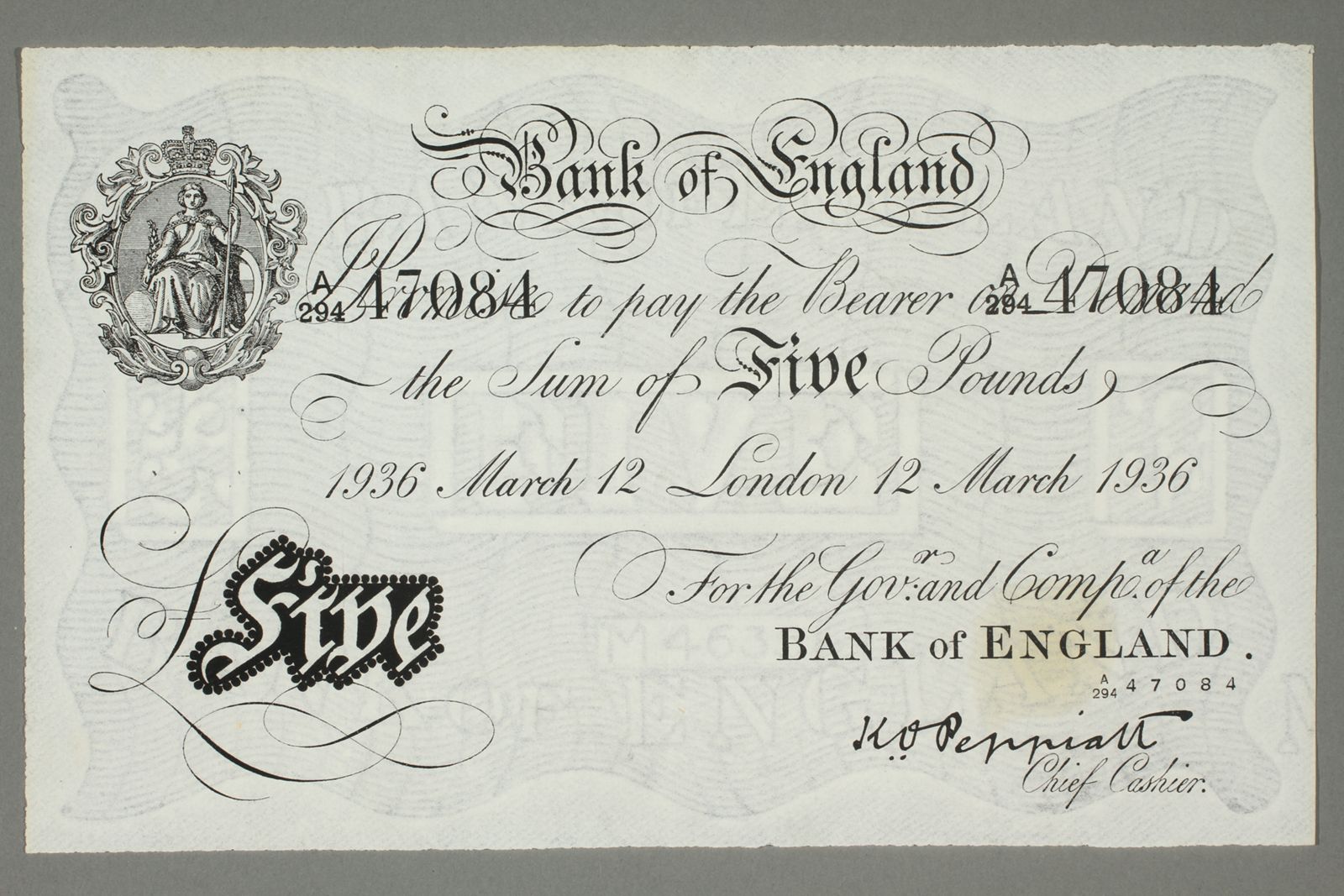

This note was not issued by Britain's central bank. The museum's catalog records it as a counterfeit note made in Sachsenhausen.
British banknotes of the time had a simple design, printed in black ink on one side of white paper. This did not mean they were easy to copy. According to the Bank of England Museum, the genuine notes had several small, deliberate flaws incorporated to detect forgeries. These were intentional nicks and irregularities that differed for each denomination. The prisoners examined large quantities of genuine notes, found about 150 such marks, and created plates for 5, 10, 20, and 50-pound notes.
The flaws the bank had included to prevent forgery became the model for the forgers.
The paper also had a watermark and a distinctive feel. The Nazis made repeated prototypes and created paper that looked and felt identical to the real thing. For the finishing touch, prisoners with dirty hands repeatedly rubbed and folded the printed notes to give them signs of use. The museum explains that the resulting notes were visually indistinguishable from genuine ones.
Intentionally damaging beautifully finished paper.
Giving a piece of paper passing into someone's hands for the first time a past, as if it had already passed through many hands. In addition to the banknote's design, it was a job of faking the journey the note should have traveled.
Was this note received at a bakery? Was it issued from a bank counter? Or was it made inside a concentration camp?
The answer is not written on the paper.
What a person receiving money usually sees is the single note handed to them at that moment. In that one note, they expect both that it was issued by the bank and that it has been accepted by others before.
The forgers prepared an appearance that met that expectation.
And the more authentic they became, the more valuable the hands of the prisoners working in the factory became to the Nazis.
His comrades sought a way not to finish the job
Next, they were asked for U.S. dollars.
Burger later spoke of Jacobson, a Dutchman who was his superior in the work detail. Jacobson had said that providing dollars would prolong the war. Entrusted with the gelatin used for photoengraving, he deliberately made it poorly. Even though the negatives were well made, the printed dollars were useless. Burger said that this was the only act of sabotage that took place in the factory.
This is not a story of destroying the factory and escaping.
Delaying completion in a place where it looked like they were working. Not producing the required results, while making it look like a technical problem to the guards. That was the form of resistance left to them.
People with technical skills have the power not only to make things well but also to know where the work will get stuck. They tried to use that knowledge to buy time.
However, time was not only on their side.
The Nazis did not wait forever. According to Burger's testimony, Krüger came to deliver a message from Himmler. If the dollars were not ready within a few weeks, they would all be shot.
Here, it was not a matter of one person taking responsibility for failure. The lives of the prisoners working next to them were also tied to the same order.
If they continued to resist, their comrades might be killed. If they complied with the demand, it would become funds for the side that imprisoned them.
It was not a place where one could say, "Just choose the right side."
In Burger's recollection, after this threat, Jacobson began to make proper gelatin. But it was too late. The Soviet army was 150 kilometers from Berlin, he said. The dollar forgery did not proceed to mass production.
What they were waiting for was not an evaluation of the finished banknotes.
It was the time when the very order that forced them to work would lose its power.
A note with the same number as a real one
Here, let us turn our eyes outside the secret factory.
In 1943, the year before Burger was transferred to Sachsenhausen, a counterfeit note that had passed through a British-affiliated bank in Morocco was discovered at the Bank of England.
According to the Bank of England Museum's explanation, the clue was the number. At the time, the numbers of notes withdrawn from circulation were recorded in leather-bound ledgers. The number on the note in front of them was already marked as "paid." A note with the same number had appeared again.
The forgers had created both the paper and the plates, but they could not fully decipher the banknote numbering system and were reusing real numbers.
A note authenticated by checking its number, and a note detected by a duplicate number. Both were the result of the same reuse. If you check only one note, the number matches a real one. The contradiction appears only when the same number returns to the bank a second time.
The feel of the paper and the printing were indistinguishable from the real thing.
However, the note did not have a history that could be explained as a genuine one.
No matter how similar its appearance, the contradiction of a note already withdrawn from circulation reappearing in payment from another place cannot be erased.
In 1943, the Bank of England detected forgeries through duplicated serial numbers. Notes of £10 and above were no longer newly issued, and in 1945 they ceased to be legal tender. The threat of forgery is considered one of the reasons.
The clue of two notes with the same number also appears in another case. In Portugal in 1925, banknotes printed by a legitimate printing company with genuine plates were introduced without the authority to issue them. This is the story of Two notes with the same serial number. There, both the paper and the plates were genuine; what was missing was the authority to issue. Burger's notes, in contrast, had counterfeit paper and plates, with only the numbers borrowed from genuine ones. Two counterfeit notes made in different ways conflicted with the records at the single point of having the same number.
The fact that a familiar name is written and the fact that it was really issued by that party are not the same. This difference exists in our lives today. The National Police Agency warns that even with emails claiming to be from real companies, it is difficult to judge their authenticity based on the displayed sender alone. What is recommended is to verify not through links in the email, but from pre-bookmarked official websites or official apps. However, the 1943 counterfeit notes were state-sponsored, and the target was a single country's currency. I do not mean to say it is the same crime as modern fraud. What is common is the single point that the truth is only revealed by checking against records that exist outside the appearance. The modern form of this name-borrowing technique is covered in Section 2 of the course "Fraud Techniques and How to Protect Yourself".
With the 1943 counterfeit notes, too, a contradiction appeared when they were checked against records not visible on the surface of the paper.
However, that did not stop the secret factory.
While the British side was proceeding with the change of notes, the prisoners did not have the freedom to stop their work.
Even when a document arrived, the gates did not open
In 1944, another piece of paper became involved with Burger.
This time, it was a document intended to rescue him.
People working to rescue Slovak Jews were trying to see if they could save people in Auschwitz using immigration permits to Palestine. Chaim Pozner of the Palestine Office in Geneva sent a confirmation of an immigration permit in Burger's name, dated August 25, 1944. The address was "Birkenau Labor Camp, near Neuberun."
At that time, he was already in Sachsenhausen. The document was forwarded to his new location.
He was summoned to the camp's political department and, after a brief interrogation, signed a paper stating that he had received the document. When the interrogation was over, an SS guard reportedly told him that leaving the camp was out of the question.
The research of historian Yehoshua Büchler traces this sequence of events from Burger's testimony and the confirmation letter that remained in his possession. Of the confirmation letters sent to Auschwitz, it is the only one found so far.
Büchler also notes another fact. The printing shop in Sachsenhausen, in addition to counterfeit notes, also produced letterhead printed with "Palestine Office in Geneva" in Hebrew and German. Büchler believes the design was likely copied from the confirmations Pozner sent to Bergen-Belsen, and also to Auschwitz. According to Burger, members of the Nazi side used this paper after the war to escape prosecution.
He had once made false certificates to help people escape.
This time, a document sent to help him reached his hands. In the same workshop, paper was being printed with the name of the office that had issued that document.
But the arrival of a legitimate document and the other party's recognition of its validity were two different things. If the one who controlled the camp did not open the gates, one could not get out just by holding a piece of paper.
The fake money is used for payments outside the factory.
Meanwhile, the real document meant to help him does not open the gate in front of him.
There were things that were not decided solely by what was written on the paper.
Who accepts the paper? Who has the power to refuse it? That difference kept his body inside the camp.
Burger did not let go of that confirmation letter. He kept it in Sachsenhausen and in the camps that followed.
Even after the war ended, the paper remained
In the final stages of the war, the prisoners involved in the forgery were moved from Germany to Austria. According to the Sachsenhausen Memorial's explanation, they were first sent to Mauthausen in February 1945, then to the subcamp of Redl-Zipf. There were plans to continue printing in Austria, but production was not resumed. The last place they were moved to was the Ebensee camp.
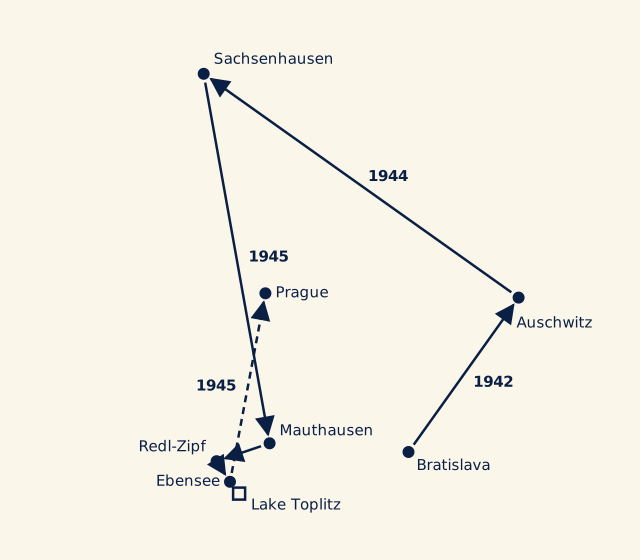
Scroll the diagram horizontally to see the full view.
As people who knew the secret, they were scheduled to be killed, according to multiple sources.
In Burger's memory, at 10:30 a.m. on May 5, 1945, the work detail entered the gates of the Ebensee camp. An armed prisoner at the gate saw the group with hair, clean clothes, and shoes, and did not believe they were prisoners. A comrade stepped forward, showed his sleeve, and pleaded that they were prisoners from Auschwitz, a special work detail from Sachsenhausen. When the gate opened, they all ran to the back of the camp. "The Americans had not yet arrived, but that was our liberation," he said.
The U.S. Army liberated Ebensee the next day, May 6.
Even though he survived the war, Gisela did not return. He could not simply go back to the life they had before their capture.
Meanwhile, the things made in the secret factory did not disappear the moment they were liberated.
In 1945, boxes of counterfeit notes and printing equipment were sunk in Lake Toplitz in Austria. From 1959 onwards, counterfeit notes and plates were recovered from the lake. The International Spy Museum has a printing plate for a 10-pound note recovered from the lake. It is the only known surviving plate.
The things sunk to the bottom of the water, and the people who came out of the factory alive.
Clues to trace the secret operation remained in both.
At the end of May 1945, the first place Burger went after returning to Prague was reportedly the police station. He reported what they had been forced to do in the camp. The police officers did not believe him at first.
Eventually, he came to tell the story of the forgery to executives of the national bank as well.
According to his recollection, when he finished speaking, the bank officials brought a large red ledger. It was written there that this was the first time a counterfeit note had been returned to its maker, and he signed it. Then, he was handed a counterfeit note. He kept that note for many years.
Once, that note had to be identical to a real one to hide where it was made.
This time, it passed into the hands of a person who could speak of where it was made.
Even if it was fake as money, it became evidence that conveyed what that person had experienced.
After the war, Burger worked in printing again in Prague. The title of his first book, published in the year of liberation, was 'Number 64401 Speaks'. He later became a journalist and wrote a book about the entire operation under his own name, 'The Devil's Workshop'. He visited schools in Germany and continued to speak to students.
The first false documents he made were to help people escape persecution.
The fake money he was forced to make in the camp was for the persecutors to use.
His printed words after the war became a way to pass on to later generations what had happened between those two.
Even for the same job of a printer, if the one who decides what to print changes, the role those hands are made to take on also changes.
In the commandant's office, he had to identify himself by his number. In the book from the year of liberation, the number still remained as the title.
After surviving, Burger returned to a place where he could once again choose the content of what he conveyed.
This time, under his own name.
Before and after this story
To read about this operation within the history of state-sponsored forgery, there is Section 3 of the course "History of Counterfeit Coins and Notes". A king debasing his own currency and copying and circulating another country's banknotes both exploit the difference between face value and intrinsic value. But the former is an act within the authority to issue, while the latter is an act outside it. What Burger and the others were forced to print was the latter.
In the "History of Counterfeit Coins" chapter of the Coins section, there is a story about this operation, "The Fake Pound Notes Printed in a Concentration Camp" (a chapter available upon subscription).
Sources and editorial notes
Conversations and descriptions of individuals are based on attributable later testimony that could be confirmed. Conversations not on record, weather, sounds, and personal feelings on the day have not been added. The testimony is mainly from interviews conducted more than 60 years after the events (2007), and details such as dates, numbers of people, and deadlines are written to the extent that they could be cross-referenced with other records. Discrepancies in numbers of people, total amounts, and the number of weeks for deadlines (5 weeks in his own interview, 6 weeks in a summary of a radio program from the same year) found in different sources, as well as anecdotes of resistance such as punching holes in banknotes, have not been included. Not all individual explanations within the testimony are treated as independently established facts. The film 'The Counterfeiters' has not been used as a source for the events.
- Interview with the subject (January 12, 2007, Prague): Memory of Nations, "Adolf Burger (1917–2016)". The scenes in the commandant's office, Jacobson's sabotage and the deadline, and the scene at the Ebensee gate are based on excerpts from the English translation on this page.
- Interview with the subject (first broadcast April 2007, rebroadcast 2008): Radio Prague International, "Ambitious Nazi counterfeiting plot recalled by Holocaust survivor". Types of false documents, date of arrest, painting of windows, Jacobson's origin.
- Recollection of the subject (return at the bank): Memory of Nations Sites, "One Third of the Money Was Counterfeit". The quantity "one third" and the assessment that it would not have been known to the world without him have not been included.
- Obituaries: Mauthausen Memorial, "Obituary for Adolf Burger" (2016). The original text's liberation year "1645" is a typo; 1945 was confirmed with sources such as the Bank of England Museum. World Jewish Congress, "Last Holocaust survivor forced to counterfeit banknotes for Nazis dies at 99" (2016). Baptismal records, statement about Sachsenhausen (JTA, 2008), title of his first book.
- Research: Yehoshua Büchler, ““Certificates” for Auschwitz,” Yad Vashem Studies XXX (2002). Pages 21–23 of the published version.
- Exhibitions and explanations: Sachsenhausen Memorial, "A Genuine Forgery". Bank of England Museum, "Operation Bernhard" (2024). Fitzwilliam Museum, "Defaced! Money, Conflict, Protest" exhibition large print labels (page 134 of PDF). International Spy Museum, "Operation Bernhard Printing Plate". German Spy Museum, "10 Pfund-Banknote Operation Bernhard" (referenced for treatment of prisoners only).
- Cessation of issue: Bank of England booklet 'Security by Design' (2007), timeline: "1943, issue of notes for more than £5 ceased to counter the threat of forgery." (At the time, the next note above £5 was the £10 note, so this refers to the same notes as "£10 and above" in the text.)
- Economic commentary: David E. Altig, Federal Reserve Bank of Cleveland, “Why Is Stable Money Such a Big Deal?” (2002). Referenced only for the outcome of the operation and the point about its shift in focus; estimated monetary values have not been included.
- Comparison with the present day: National Police Agency, "Phishing Countermeasures". The comparison is by the editorial department and does not claim that the crimes or damages are identical.
- Photograph of counterfeit note: United States Holocaust Memorial Museum, collection item 2015.586.9 (Donation of Alec Tulkoff. Catalog terms of use: "No restrictions on use").
More in Stories of money

The Wealth of the Realm, and a Handful of Earth
The edict declaring "All the wealth of the realm is mine" continues immediately with "even a handful of earth is welcome." In an age when the country was exhausted by plague and rebellion, copper was gathered to construct the Great Buddha.

The Day a Creditor Nation Became a Debtor
One hundred million guldens. That number, written on the treaty paper, summed up in a single line the fall of a nation that had once lent money to the courts of Europe.

The Mint Opened by a Usurper
In 2010, 52,503 Roman coins emerged from British soil. This enormous hoard tells the story of an era when a usurper used coinage as a tool of governance and opened the first mint in London.
If you would like to read on
The rest of the story is in the material of NOMISMA.
Read next
Man of Equations, Man of Evidence →Price
After purchase, the full courses, the illustrated books, every country’s story and the numismatics examination are open to you.
See the price →