Identifying
a single coin
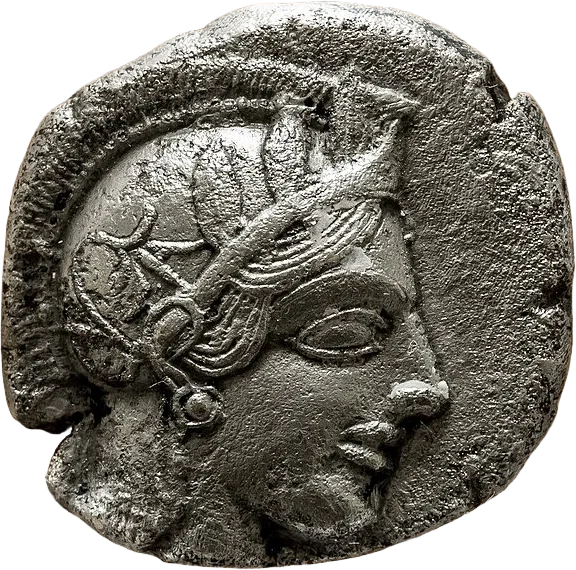
ArchaiOptix / CC BY-SA 4.0 (Wikimedia Commons)
Can you state for yourself what this one coin is?
This volume in 3 minutes
- Identification proceeds in three steps: looking (observation), deciding (identification), and writing (cataloguing). If you skip a step, the basis for your decision will not be recorded.
- All correct answers are the values from the actual item ledger: name, place of issue, date, material, shape, diameter, and collection. For values not in the ledger (weight, reverse side without a photo), the correct answer is "none".
- In the observation lesson, you will describe what you see in the photograph in words: the color of the material, the shape, how the mark was made, the iconography, and the inscription. You will distinguish between what is observation and what is interpretation.
- In the identification lesson, you will compare three similar coins, choose one, and write a single sentence stating which feature you used as the basis for your choice. An identification without a stated basis is not a true identification, even if it is correct.
- In the cataloguing lesson, you will transcribe the details of a single coin into seven fields. The first rule of cataloguing is to leave any field you cannot fill in blank.
- Three lessons × 24 exercises = 72 exercises. The 72 actual items were selected by machine from a ledger of 415 items.
Table of Contents
- IntroHow to use this workbook
- 1Lesson 1: Observation — From photograph to words
- 2Lesson 2: Identification — Choosing one from three and stating the basis
- 3Lesson 3: Cataloguing — Transcribing into seven fields
- OutroWhere to go from this workbook
- EndmatterSUMMARY / DATA / QUESTIONS / DRILL / SOURCES / INDEX / REVISION HISTORY
This is a workbook to help you learn to state for yourself what an actual item is when you see it. It is divided into three lessons. Lesson 1, "Observation," is practice in describing a photograph in words: material, shape, how the mark was made, iconography, and inscription. Lesson 2, "Identification," is practice in choosing one from three similar coins and writing down which feature you used as the basis for your choice. Lesson 3, "Cataloguing," is practice in transcribing the details of a single coin into seven fields.
At the beginning of each lesson, there is a section on "Procedure for this lesson." These are excerpts from the sections on Course E5 (Iconography), E6 (Inscriptions), E4 (Metrology), and E9 (Research Methods) that can be used as a procedure. The correct answer to the exercises is the value from the actual item ledger itself. For items not in the ledger (weight, reverse side without a photo, diameter not recorded), the correct answer is "none," and writing a plausible value is incorrect.
The procedure is the same for each exercise. Look at the photograph. Put it into words according to the questions. Open the page in the actual item database and compare it with the values in the ledger. If there is a discrepancy, note where you went wrong (was it an oversight or an interpretation?). It is more important that you can state your reasoning than whether you got the answer right.
Lesson 1: Observation — From photograph to words
Before reading the iconography, learn the names of the positions. It is enough to be able to point to them, not to memorize them. Two things are important. Do not look at only one side. The obverse and reverse create meaning as a pair; the obverse tells "who," and the reverse tells "by what." Also, read the blank space. An empty area is a trace of the choice not to cram in text or enlarge the image. An early Lydian coin had no iconography; its blankness was itself a record.
Separate observation from interpretation. "I see a lion" is an observation; "a symbol of the king's power" is an interpretation. In this lesson, you will write only observations. Describe the material by its color, the shape by its outline, how the mark was made by the traces on the reverse (punch mark, engraved die, or cast letters), the iconography by the name of what is visible, and the inscription by the letters you can read. If you cannot read the letters, write "illegible."
When you find something is "missing," turn it into a question rather than a statement. There are many reasons for something to be absent: it was forbidden, it was not needed, the technology did not exist, it wore away, or you have overlooked it. First, write down, "Is it really missing, and since when?"
- Specimens for this lesson
- 24 items (8 sets). 24 photos of the reverse, 24 records of diameter. Since there is no field for weight in the ledger, the correct answer for all items is "none."
- Source of the correct answers
- The values from the actual item ledger (coins) and the stops where the actual item appears. No other values are written.
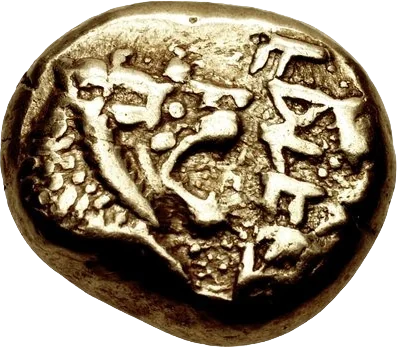
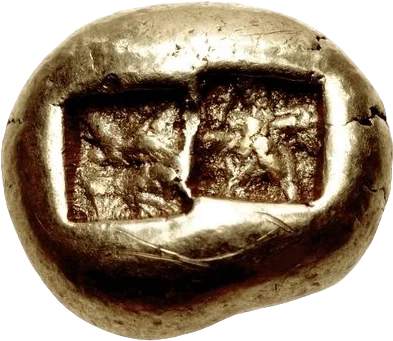
- State the material from its color (gold, silver, copper, bronze, paper...).
- State the shape from its outline (round, square, lump, oval).
- State the main subject on the obverse by its name (face, beast, letters, building...). Do not write interpretations.
- State how the reverse was made (punch mark, engraved die, cast letters, no photo).
- Read the inscription. If you cannot read it, write "illegible."
- Write one thing you noticed was "missing" in the form of a question.
- Name
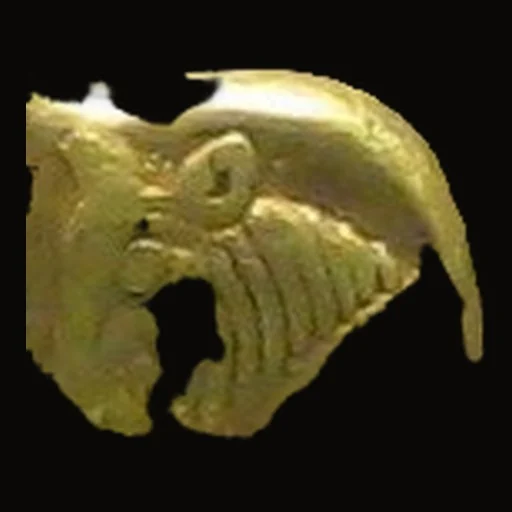
- Electrum trite
- Material and shape
- electrum・round
- Diameter
- diameter 13 mm
- Weight
- no field in the ledger
- Ledger entry
- On electrum — the natural, silver-bearing gold washed down the river Pactolus — Alyattes, king of Lydia, struck the mark of a lion. The state stands behind the weight and the purity: this is held to be the first piece of the invention we call money.
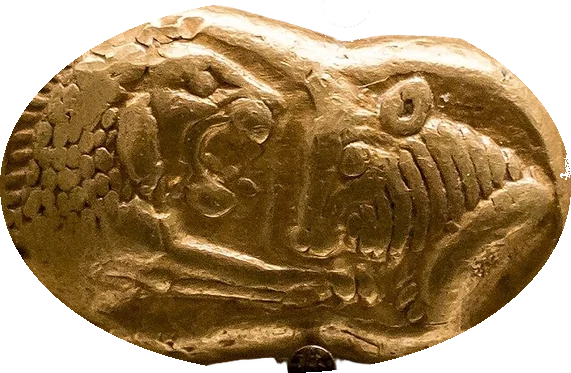
- State the material from its color (gold, silver, copper, bronze, paper...).
- State the shape from its outline (round, square, lump, oval).
- State the main subject on the obverse by its name (face, beast, letters, building...). Do not write interpretations.
- State how the reverse was made (punch mark, engraved die, cast letters, no photo).
- Read the inscription. If you cannot read it, write "illegible."
- Write one thing you noticed was "missing" in the form of a question.
- Name
- Croeseid
- Material and shape
- gold・round
- Diameter
- diameter 16 mm
- Weight
- no field in the ledger
- Ledger entry
- King Croesus gave up electrum and struck pure gold and pure silver as separate coins. The world's first gold-and-silver bimetallism. The phrase 'rich as Croesus' remains from it. The image is a lion and a bull facing one another.
- State the material from its color (gold, silver, copper, bronze, paper...).
- State the shape from its outline (round, square, lump, oval).
- State the main subject on the obverse by its name (face, beast, letters, building...). Do not write interpretations.
- State how the reverse was made (punch mark, engraved die, cast letters, no photo).
- Read the inscription. If you cannot read it, write "illegible."
- Write one thing you noticed was "missing" in the form of a question.
- Name
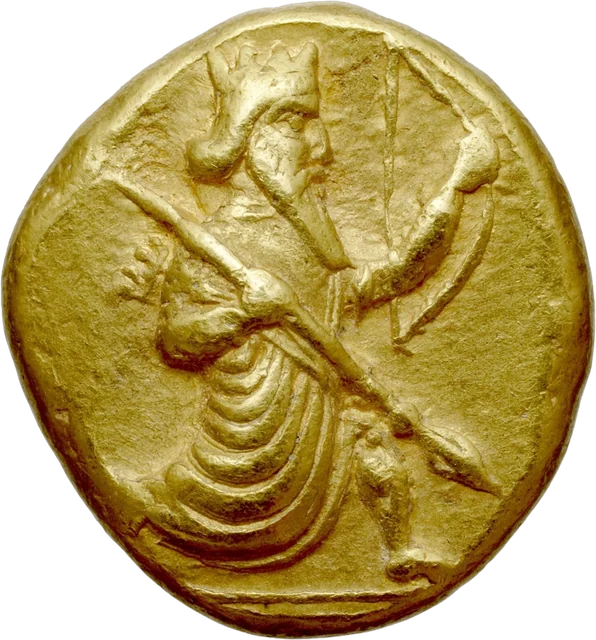
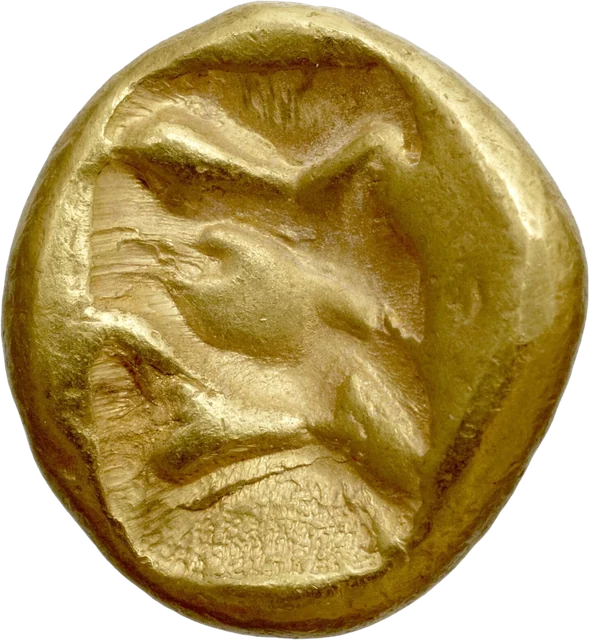
- Gold daric
- Material and shape
- gold・round
- Diameter
- diameter 15 mm
- Weight
- no field in the ledger
- Ledger entry
- The gold coin that Darius I established as the money of his empire. Metal of high purity carries a single image — the Great King running with bow and spear — and no inscription at all. Paid out in salaries, tribute and diplomacy, it earned a nickname among the Greeks: "the archers". A Spartan king is said to have remarked that he was driven out by archers. The design stayed almost unchanged for some two hundred years, until the conquest of Alexander.
- State the material from its color (gold, silver, copper, bronze, paper...).
- State the shape from its outline (round, square, lump, oval).
- State the main subject on the obverse by its name (face, beast, letters, building...). Do not write interpretations.
- State how the reverse was made (punch mark, engraved die, cast letters, no photo).
- Read the inscription. If you cannot read it, write "illegible."
- Write one thing you noticed was "missing" in the form of a question.
- Name
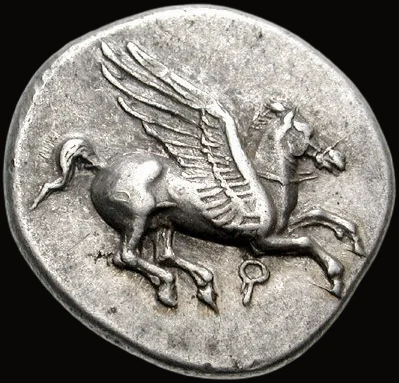
- Pegasos Stater of Corinth
- Material and shape
- silver・round
- Diameter
- diameter 21 mm
- Weight
- no field in the ledger
- Ledger entry
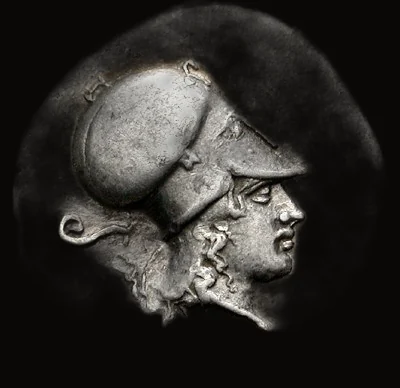
- A Corinthian stater, circa 400–375 BC. Diameter 21 mm, 8.54 grams. The obverse shows Pegasos in flight; the reverse, the head of Athena wearing a helmet. Corinthian coins were nicknamed "póloi" (foals). The standard was unique: a stater of about 8.6 grams was divided into three drachmas, not two. This was exactly half the weight of an Athenian tetradrachm, and the two currencies circulated concurrently. The same types were struck at the mints of the western colonies, spreading to Sicily and Southern Italy.
- State the material from its color (gold, silver, copper, bronze, paper...).
- State the shape from its outline (round, square, lump, oval).
- State the main subject on the obverse by its name (face, beast, letters, building...). Do not write interpretations.
- State how the reverse was made (punch mark, engraved die, cast letters, no photo).
- Read the inscription. If you cannot read it, write "illegible."
- Write one thing you noticed was "missing" in the form of a question.
- Name
- Alexander Tetradrachm
- Material and shape
- silver・round
- Diameter
- diameter 25 mm
- Weight
- no field in the ledger
- Ledger entry
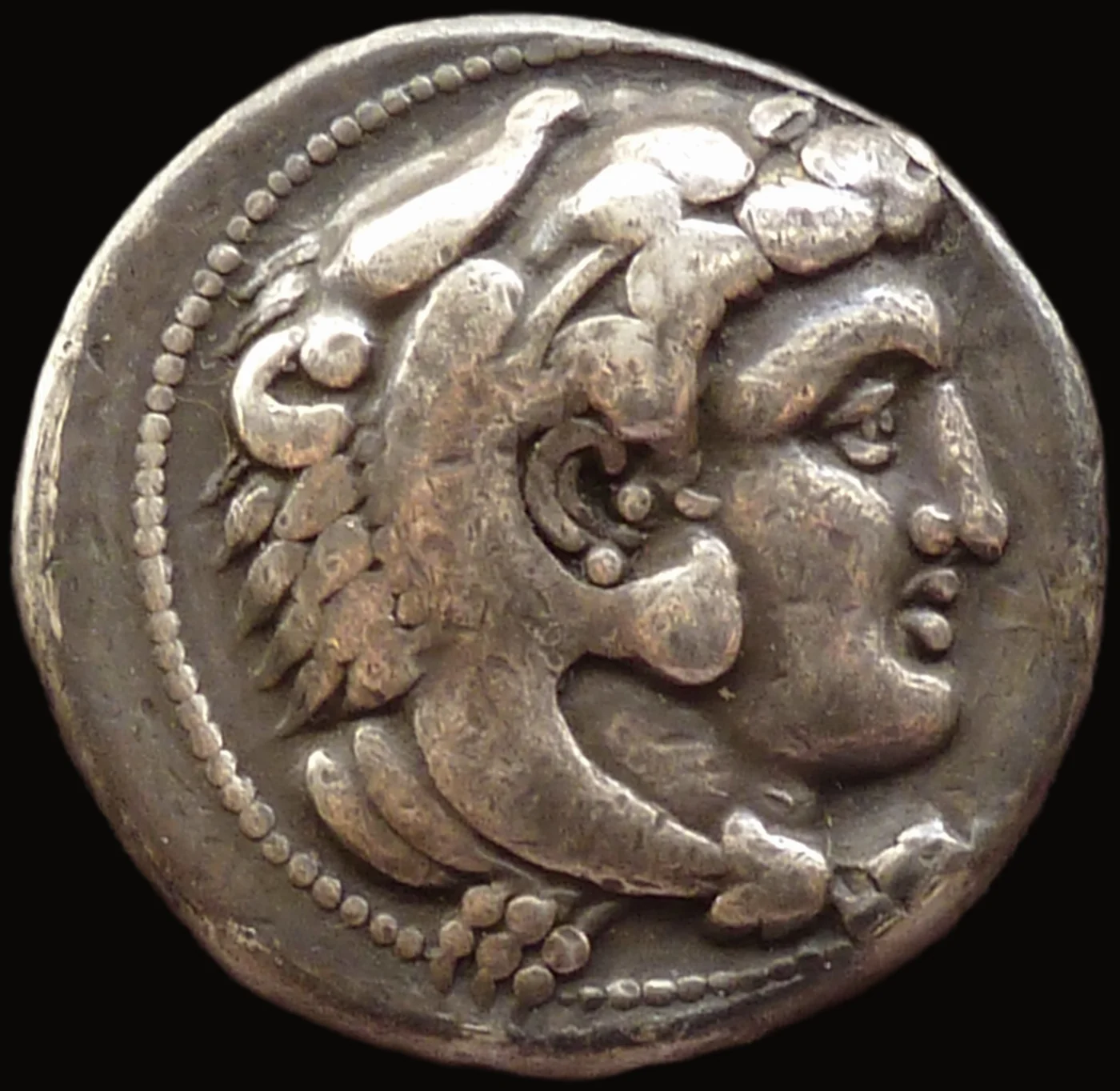
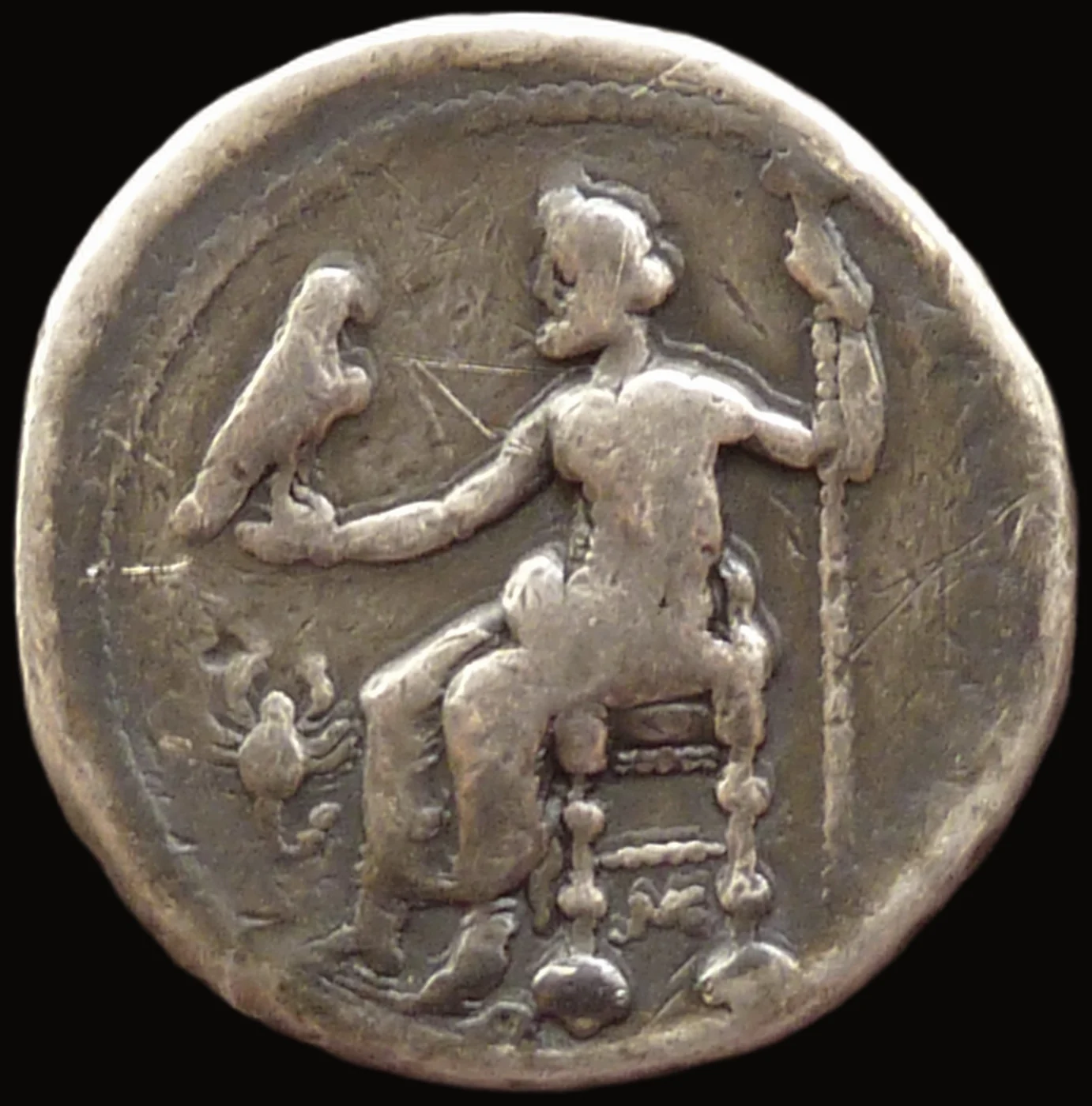
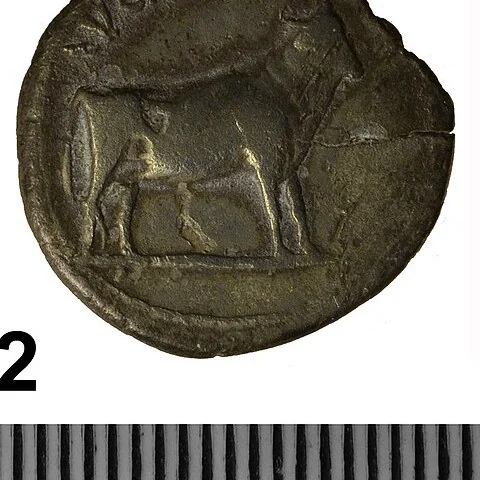
- A tetradrachm from circa 330–325 BC, weighing 17 grams. The obverse shows Heracles wearing a lion skin, while the reverse depicts Zeus enthroned holding an eagle and a scepter, with the inscription "ΑΛΕΞΑΝΔΡΟΥ" (of Alexander). Unlike his father's silver, this was a deliberate change to unify the entire empire under the Attic standard, making the international standard of the Greek world the standard of the empire. The scorpion symbol on the reverse indicates the Myriandros mint—a mark to differentiate between mints in the network that struck the same type.
- State the material from its color (gold, silver, copper, bronze, paper...).
- State the shape from its outline (round, square, lump, oval).
- State the main subject on the obverse by its name (face, beast, letters, building...). Do not write interpretations.
- State how the reverse was made (punch mark, engraved die, cast letters, no photo).
- Read the inscription. If you cannot read it, write "illegible."
- Write one thing you noticed was "missing" in the form of a question.
- Name
- Denarius
- Material and shape
- silver・round
- Diameter
- diameter 19 mm
- Weight
- no field in the ledger
- Ledger entry
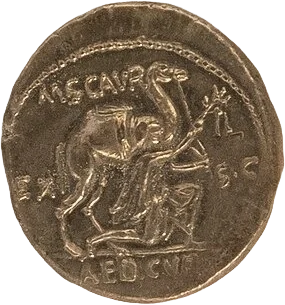
- Rome's standard silver coin, born in the middle of the Second Punic War. The board of three moneyers (tresviri monetales) in charge of the issue cut the myths and achievements of their own houses into the imagery — the coin was the first mass medium. Later, under the empire, the fineness of the silver went down.
- State the material from its color (gold, silver, copper, bronze, paper...).
- State the shape from its outline (round, square, lump, oval).
- State the main subject on the obverse by its name (face, beast, letters, building...). Do not write interpretations.
- State how the reverse was made (punch mark, engraved die, cast letters, no photo).
- Read the inscription. If you cannot read it, write "illegible."
- Write one thing you noticed was "missing" in the form of a question.
- Name
- EID MAR denarius
- Material and shape
- silver・round
- Diameter
- diameter 19 mm
- Weight
- no field in the ledger
- Ledger entry
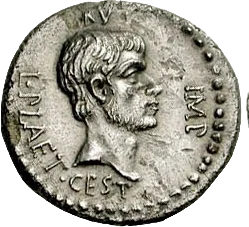
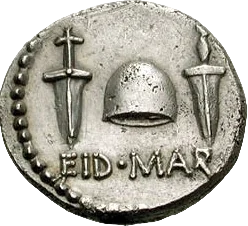
- Issued by Brutus, who assassinated Caesar. The Phrygian cap that means liberty, two daggers, and the legend 'EID MAR' — the Ides of March, 15 March, the day of the killing. Setting his own face beside the day he struck down a dictator makes this the most political coin in history.
- State the material from its color (gold, silver, copper, bronze, paper...).
- State the shape from its outline (round, square, lump, oval).
- State the main subject on the obverse by its name (face, beast, letters, building...). Do not write interpretations.
- State how the reverse was made (punch mark, engraved die, cast letters, no photo).
- Read the inscription. If you cannot read it, write "illegible."
- Write one thing you noticed was "missing" in the form of a question.
- Name
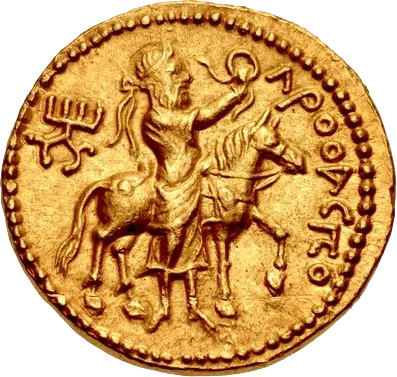
- Gold Coin of Kanishka I (Dinar)
- Material and shape
- gold・round
- Diameter
- diameter 20 mm
- Weight
- no field in the ledger
- Ledger entry
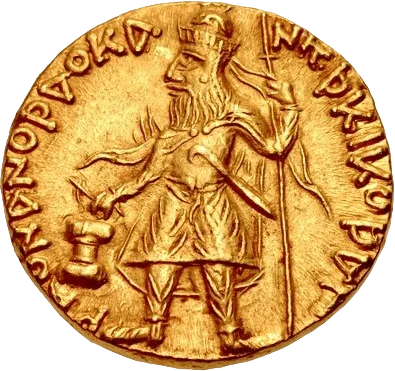
- A gold dinar of Kanishka I of the Kushan Empire. The source notes a diameter of 20 mm, a weight of 7.99 grams, and Bactria as the main mint. The obverse inscription in Bactrian reads: "King of Kings, Kanishka the Kushan." The king stands facing left, holding a goad and a scepter, and is making a sacrifice at a fire altar. The name "dinar" and its weight standard are derived from Roman gold coins. Gold that flowed in from the West was restruck here in the image of the king.
- State the material from its color (gold, silver, copper, bronze, paper...).
- State the shape from its outline (round, square, lump, oval).
- State the main subject on the obverse by its name (face, beast, letters, building...). Do not write interpretations.
- State how the reverse was made (punch mark, engraved die, cast letters, no photo).
- Read the inscription. If you cannot read it, write "illegible."
- Write one thing you noticed was "missing" in the form of a question.
- Name
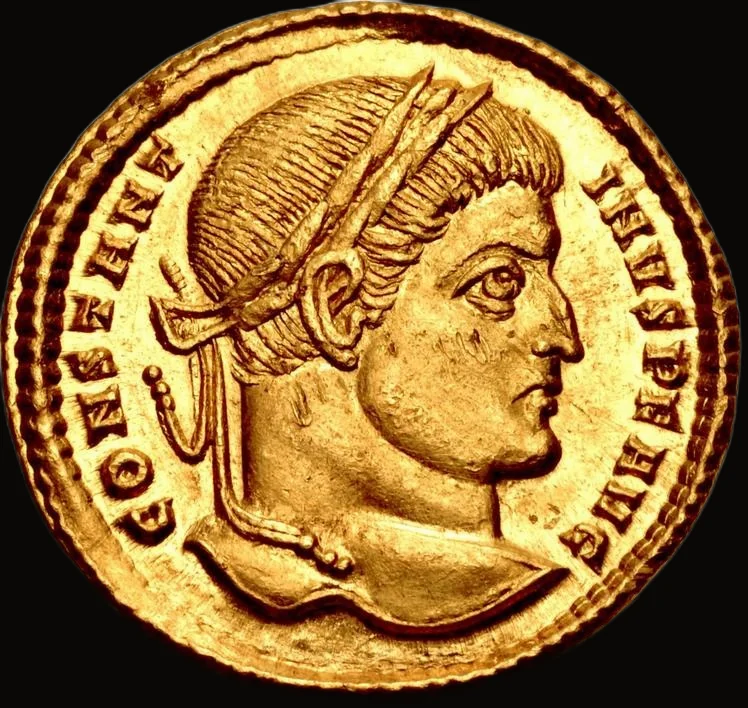
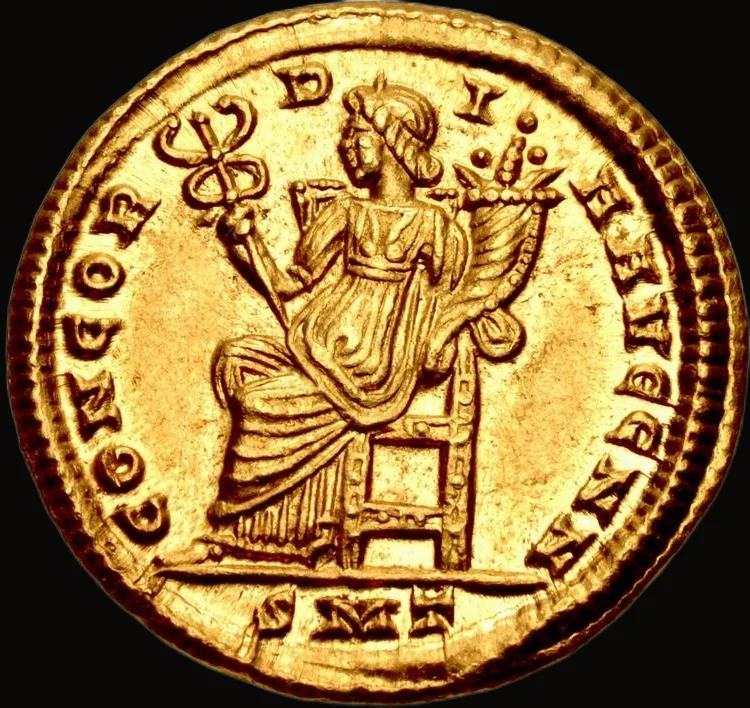
- Solidus of Constantine
- Material and shape
- gold・round
- Diameter
- diameter 19 mm
- Weight
- no field in the ledger
- Ledger entry
- A solidus struck in 320 AD at the Ticinum mint. Diameter 19 mm, 4.38 grams. This gold coin, introduced by Constantine I, was struck at 72 to a Roman pound (libra) and was called "nomisma" in the Greek-speaking eastern part of the Empire——a term derived from Aristotle's teaching that money exists not by nature but by law or custom (nomos). Its nominal fineness of 24 carats was maintained for approximately seven centuries, and the economic historian Lopez dubbed it "the dollar of the Middle Ages."
- State the material from its color (gold, silver, copper, bronze, paper...).
- State the shape from its outline (round, square, lump, oval).
- State the main subject on the obverse by its name (face, beast, letters, building...). Do not write interpretations.
- State how the reverse was made (punch mark, engraved die, cast letters, no photo).
- Read the inscription. If you cannot read it, write "illegible."
- Write one thing you noticed was "missing" in the form of a question.
- Name
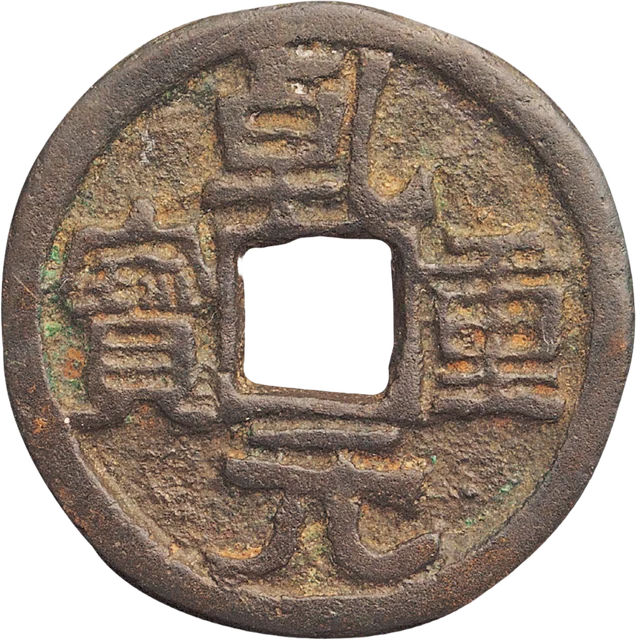
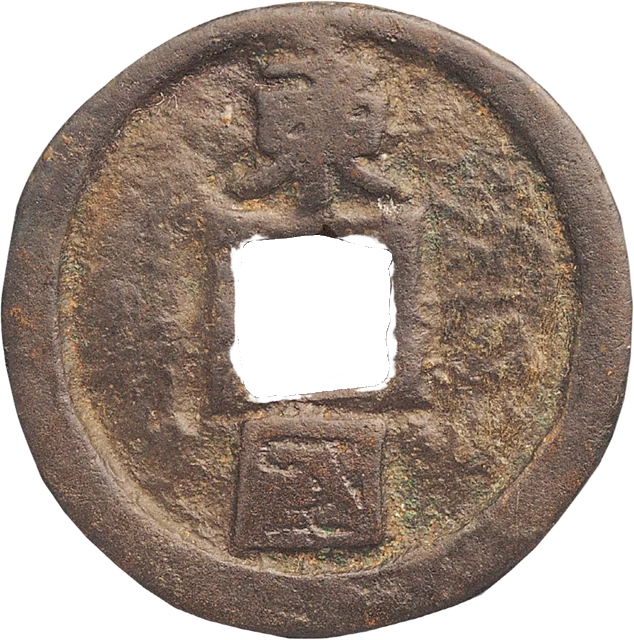
- Geonwon Jungbo (reverse Dongguk)
- Material and shape
- iron・round
- Diameter
- diameter 25.9 mm
- Weight
- no field in the ledger
- Ledger entry
- An iron coin cast in 996 by King Seongjong of Goryeo. While borrowing the style of the Tang Qian Yuan Zhong Bao coin, the two characters for "Dongguk" (Eastern Country) were added to the reverse, proclaiming it as a coin of their own country. It was created in the context of trade with the Khitan, and records of the mold indicate a weight of about 9.4 grams and a diameter of 25.9 mm. The history of cast coinage on the Korean peninsula begins with this single piece.
- State the material from its color (gold, silver, copper, bronze, paper...).
- State the shape from its outline (round, square, lump, oval).
- State the main subject on the obverse by its name (face, beast, letters, building...). Do not write interpretations.
- State how the reverse was made (punch mark, engraved die, cast letters, no photo).
- Read the inscription. If you cannot read it, write "illegible."
- Write one thing you noticed was "missing" in the form of a question.
- Name
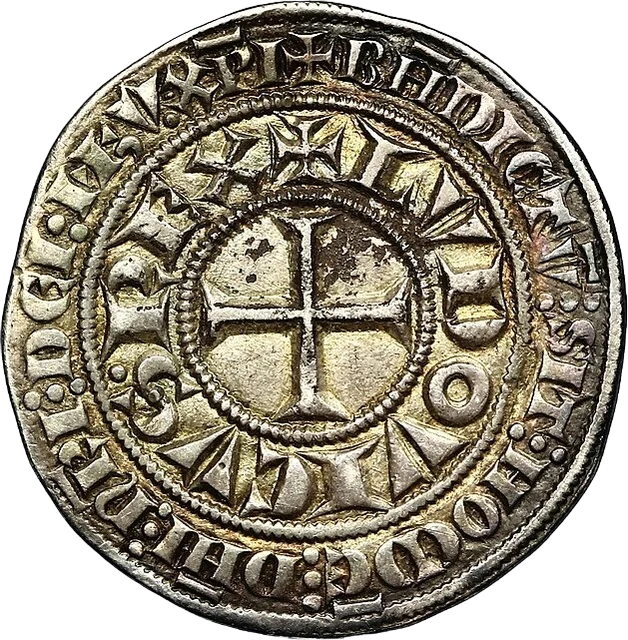
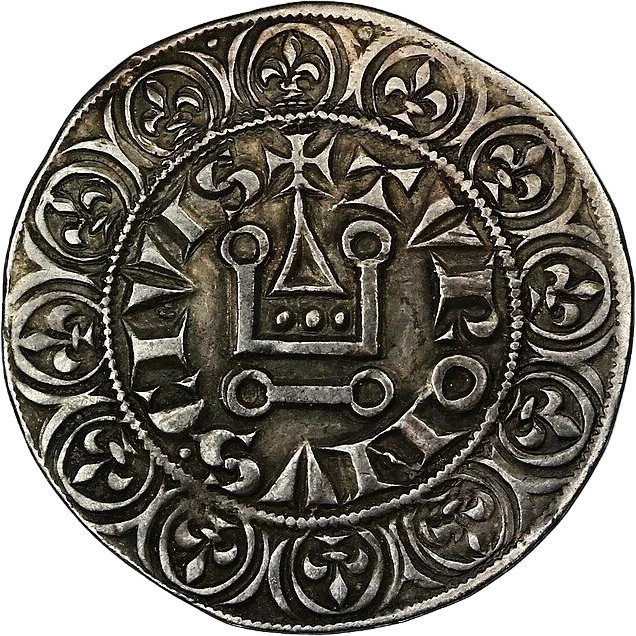
- Gros tournois
- Material and shape
- silver・round
- Diameter
- diameter 25.4 mm
- Weight
- no field in the ledger
- Ledger entry
- By the ordinance of 24 July 1266, Louis IX issued the large silver coin known as the gros tournois. The standard was 4.22 grams in weight at a silver fineness of 958‰; surviving pieces run to about 4.06 grams and 25.4 millimetres across. Since the Carolingians France had had in effect only one denomination, the denier; here, for the first time in eight centuries, a good royal coin of substantial value appeared. The face carries a cross and the king's name, the back the design of the castle of Tours and twelve lilies — two authorities, religion and kingship, cut into a single piece. It was a coin that drove the king's measure into a divided world of money.
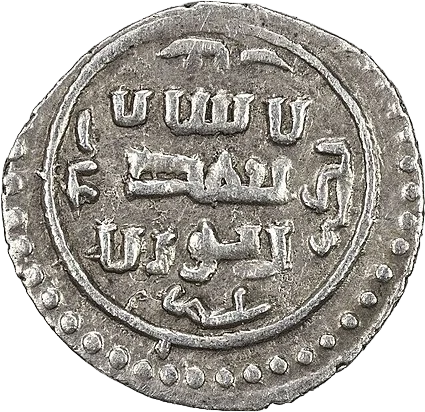
- State the material from its color (gold, silver, copper, bronze, paper...).
- State the shape from its outline (round, square, lump, oval).
- State the main subject on the obverse by its name (face, beast, letters, building...). Do not write interpretations.
- State how the reverse was made (punch mark, engraved die, cast letters, no photo).
- Read the inscription. If you cannot read it, write "illegible."
- Write one thing you noticed was "missing" in the form of a question.
- Name
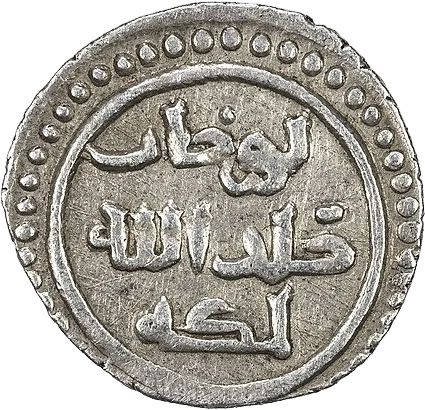
- Akçe
- Material and shape
- silver・round
- Diameter
- diameter 12 mm
- Weight
- no field in the ledger
- Ledger entry
- The basic silver coin of the Ottoman Empire. Its name means 'the white one', and the pay of the Janissaries was made in it. Every debasement brought a revolt, and it became a mirror of the empire's decline.
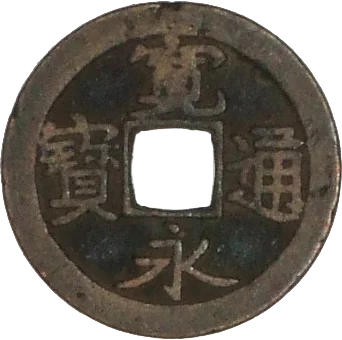
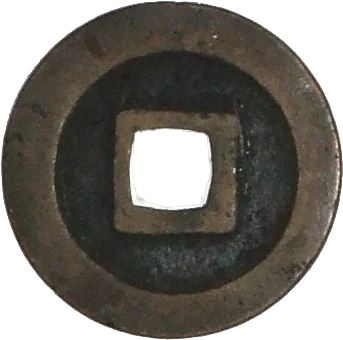
- State the material from its color (gold, silver, copper, bronze, paper...).
- State the shape from its outline (round, square, lump, oval).
- State the main subject on the obverse by its name (face, beast, letters, building...). Do not write interpretations.
- State how the reverse was made (punch mark, engraved die, cast letters, no photo).
- Read the inscription. If you cannot read it, write "illegible."
- Write one thing you noticed was "missing" in the form of a question.
- Name
- Kan'ei Tsūhō (Ko-Kan'ei, Shiba issue)
- Material and shape
- copper・round
- Diameter
- diameter 25 mm
- Weight
- no field in the ledger
- Ledger entry
- Casting began at Edo and at Sakamoto in Ōmi in the thirteenth year of Kan'ei, in the time of the third shogun Iemitsu. It was the first coin made in Japan in 678 years, counting from the Kengen Taihō. Those cast at Aminawate in Shiba are called Shiba-sen, and are told apart by their cursive-style strokes. The diameter is 2.5 cm, the weight about 1 monme. For the two hundred years and more that followed, ordinary life turned on this one piece.
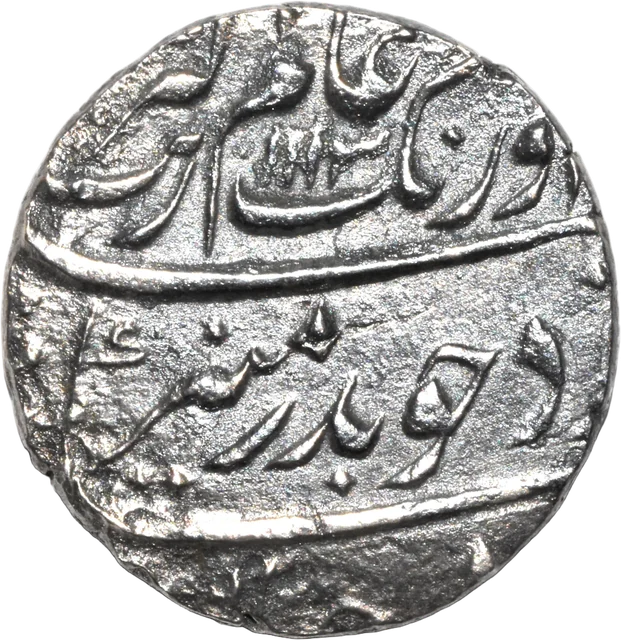
- State the material from its color (gold, silver, copper, bronze, paper...).
- State the shape from its outline (round, square, lump, oval).
- State the main subject on the obverse by its name (face, beast, letters, building...). Do not write interpretations.
- State how the reverse was made (punch mark, engraved die, cast letters, no photo).
- Read the inscription. If you cannot read it, write "illegible."
- Write one thing you noticed was "missing" in the form of a question.
- Name
- Rupee of Aurangzeb (from a shipwreck)
- Material and shape
- silver・round
- Diameter
- diameter 25 mm
- Weight
- no field in the ledger
- Ledger entry
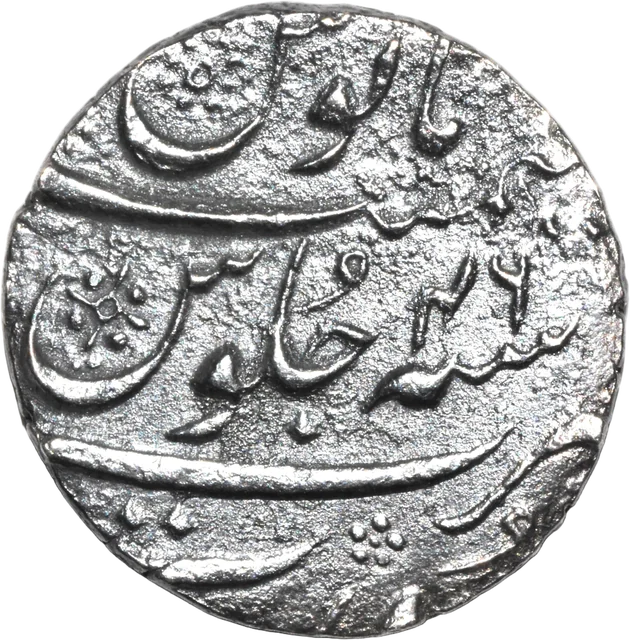
- A silver rupee of the Mughal emperor Aurangzeb. The source notes: Surat mint, 1113 AH, regnal year 46 (1702 AD), 25 mm, 10.34 grams, KM 300.86. This particular coin was recovered from a shipwreck off the Great Basses Reef, Sri Lanka. It was recovered by the author Arthur C. Clarke. Surat was the largest trading port of the Mughal Empire. Silver struck there was loaded onto a ship, sank into the sea, and returned to human hands after three centuries.
- State the material from its color (gold, silver, copper, bronze, paper...).
- State the shape from its outline (round, square, lump, oval).
- State the main subject on the obverse by its name (face, beast, letters, building...). Do not write interpretations.
- State how the reverse was made (punch mark, engraved die, cast letters, no photo).
- Read the inscription. If you cannot read it, write "illegible."
- Write one thing you noticed was "missing" in the form of a question.
- Name
- East India Company rupee
- Material and shape
- silver・round
- Diameter
- diameter 30 mm
- Weight
- no field in the ledger
- Ledger entry
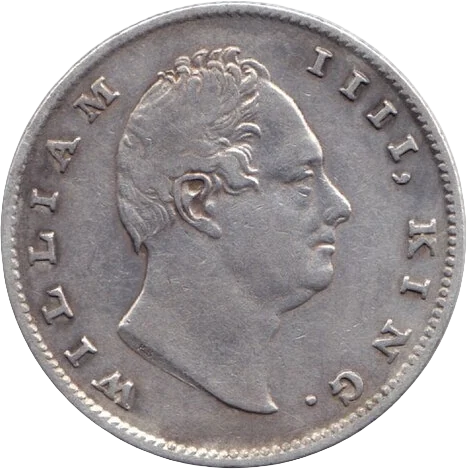
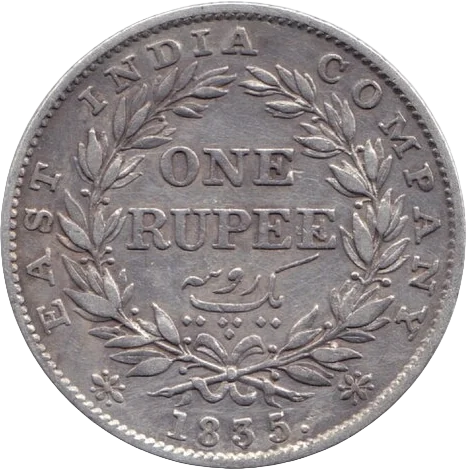
- The silver rupee issued by the British East India Company. A witness to the age when a single trading company gathered taxes like a state and struck money. In time the queen's portrait would take its place.
- State the material from its color (gold, silver, copper, bronze, paper...).
- State the shape from its outline (round, square, lump, oval).
- State the main subject on the obverse by its name (face, beast, letters, building...). Do not write interpretations.
- State how the reverse was made (punch mark, engraved die, cast letters, no photo).
- Read the inscription. If you cannot read it, write "illegible."
- Write one thing you noticed was "missing" in the form of a question.
- Name
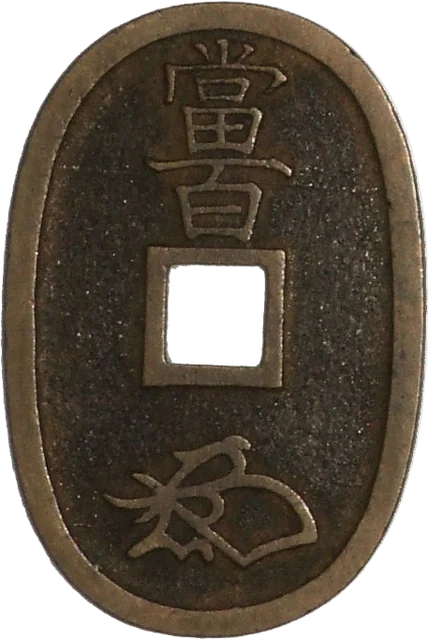
- Tenpō Tsūhō (Honza chōkaku)
- Material and shape
- copper・oval
- Diameter
- diameter 50 mm
- Weight
- no field in the ledger
- Ledger entry
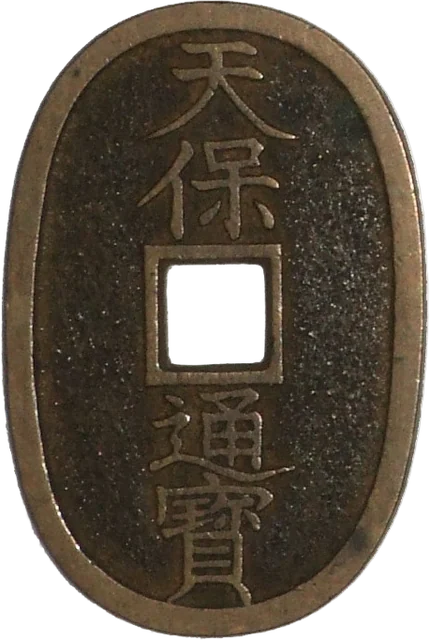
- First cast in the sixth year of Tenpō. An oval that recalls the koban, with a square hole cut through it, and cast on the back 'tō hyaku', worth one hundred, with the cipher of the Gotō house of the gold mint. About 50 millimetres long, weight 5 monme 5 bu, about 20.6 grams. The metal in it is only that of five or six one-mon pieces, and in the town it passed at 80 mon. It is the coin with which the shogunate itself tried out, in the crudest form of all, the argument that writing a hundred makes it a hundred.
- State the material from its color (gold, silver, copper, bronze, paper...).
- State the shape from its outline (round, square, lump, oval).
- State the main subject on the obverse by its name (face, beast, letters, building...). Do not write interpretations.
- State how the reverse was made (punch mark, engraved die, cast letters, no photo).
- Read the inscription. If you cannot read it, write "illegible."
- Write one thing you noticed was "missing" in the form of a question.
- Name
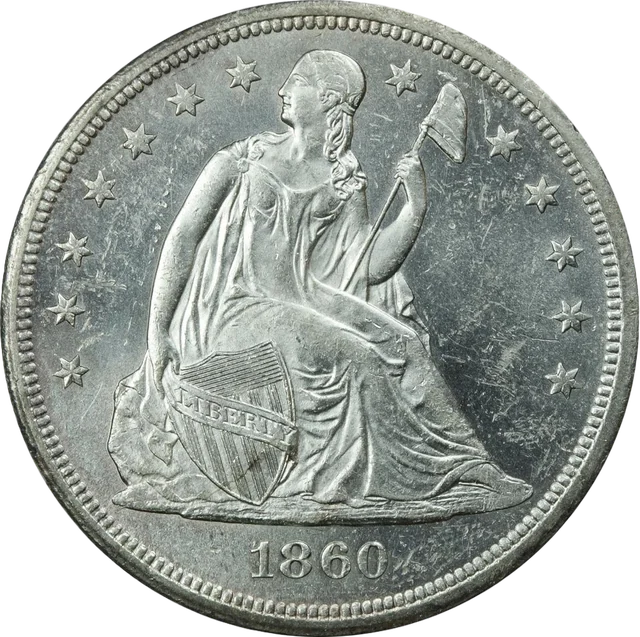
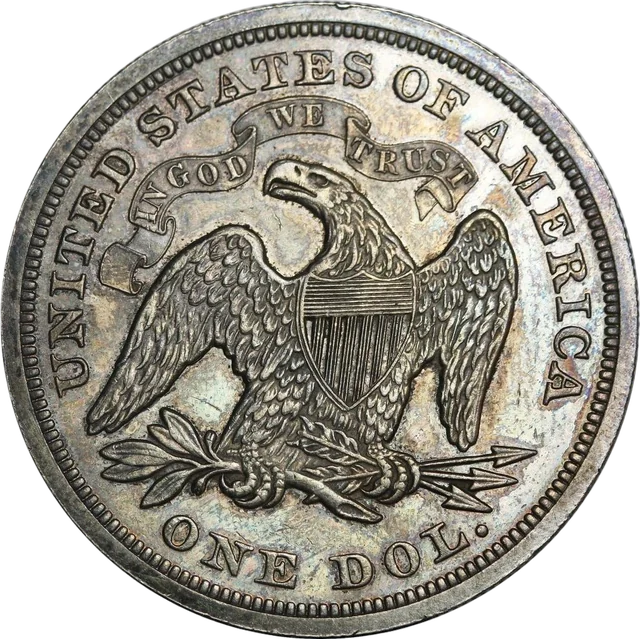
- Seated Liberty dollar
- Material and shape
- silver・round
- Diameter
- diameter 38.1 mm
- Weight
- no field in the ledger
- Ledger entry
- Liberty, seated on a rock, holds up a shield bearing the legend LIBERTY and raises a cap on a pole. A Seated Liberty dollar dated 1860 — the standard silver dollar struck under the principle of bimetallism. Just then the silver mines of Nevada were raising their output, and Germany's move to the gold standard was about to press the world price of silver down. In 1873 a revision of the coinage law quietly took this standard silver dollar off the list of coins to be struck. Almost nobody paid the clause any attention at the time; a few years later it was called 'the Crime of 1873' and became a fire that burned through politics. A coin sitting still, not yet knowing that the age of silver was ending.
- State the material from its color (gold, silver, copper, bronze, paper...).
- State the shape from its outline (round, square, lump, oval).
- State the main subject on the obverse by its name (face, beast, letters, building...). Do not write interpretations.
- State how the reverse was made (punch mark, engraved die, cast letters, no photo).
- Read the inscription. If you cannot read it, write "illegible."
- Write one thing you noticed was "missing" in the form of a question.
- Name
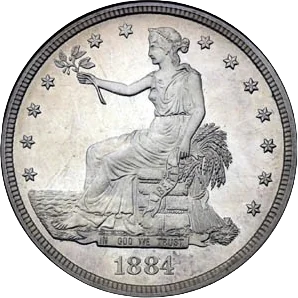
- Trade dollar
- Material and shape
- silver・round
- Diameter
- diameter 38.1 mm
- Weight
- no field in the ledger
- Ledger entry
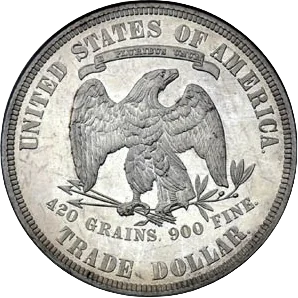
- '420 GRAINS, 900 FINE.' — it declares its own weight and fineness on the face of the coin, and signs itself below with 'TRADE DOLLAR'. It is a silver coin for trade, born in the era of the coinage law of 1873 that took the standard silver dollar off the list. Liberty, seated on a bale, holds out an olive branch and faces the sea. A country that had begun its daily life on somebody else's silver, the Spanish dollar, was now trying to send silver of its own out across the sea. This piece is dated 1884. In the middle of the thirty years' war between gold and silver, silver was fighting for its place both inside the country and outside it.
- State the material from its color (gold, silver, copper, bronze, paper...).
- State the shape from its outline (round, square, lump, oval).
- State the main subject on the obverse by its name (face, beast, letters, building...). Do not write interpretations.
- State how the reverse was made (punch mark, engraved die, cast letters, no photo).
- Read the inscription. If you cannot read it, write "illegible."
- Write one thing you noticed was "missing" in the form of a question.
- Name
- Morgan dollar
- Material and shape
- silver・round
- Diameter
- diameter 38.1 mm
- Weight
- no field in the ledger
- Ledger entry
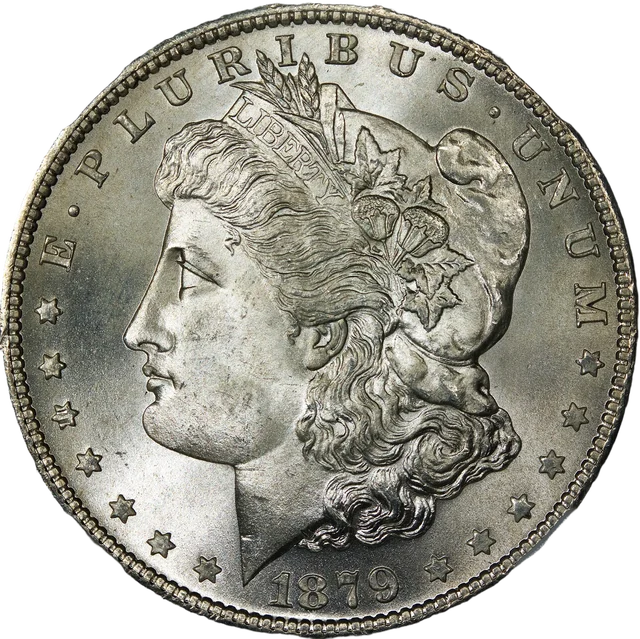
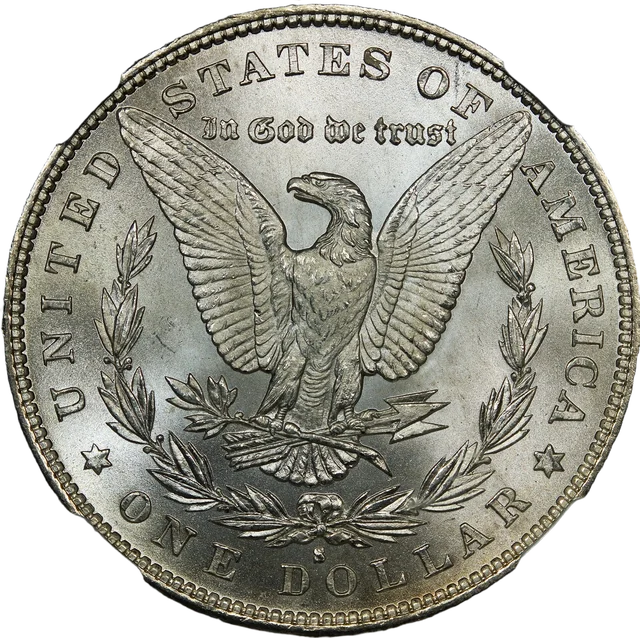
- This silver coin is politics' answer to the clause called 'the Crime of 1873'. The Bland–Allison Act of 1878 ordered the government to buy a set amount of silver every month and to coin silver dollars — the birth of the Morgan dollar. The name comes from George T. Morgan, who designed it. On the face, the legend E PLURIBUS UNUM and the profile of Liberty; on the back, an eagle with wings spread. The gold standard was the currency of creditors and of the East, free coinage of silver the currency of debtors and of the West and the South — in an age when the choice of standard was itself a conflict of class and region, this silver coin went on being struck as the banner of the silver side. This piece is dated 1879.
- State the material from its color (gold, silver, copper, bronze, paper...).
- State the shape from its outline (round, square, lump, oval).
- State the main subject on the obverse by its name (face, beast, letters, building...). Do not write interpretations.
- State how the reverse was made (punch mark, engraved die, cast letters, no photo).
- Read the inscription. If you cannot read it, write "illegible."
- Write one thing you noticed was "missing" in the form of a question.
- Name
- Gold Lira of Mehmed V
- Material and shape
- gold・round
- Diameter
- diameter 22 mm
- Weight
- no field in the ledger
- Ledger entry
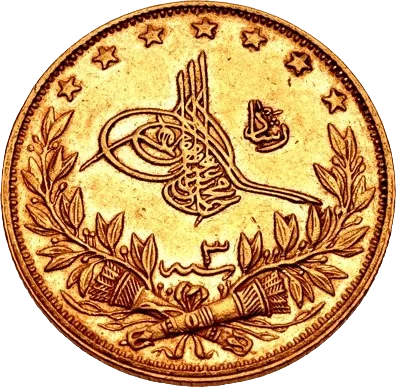
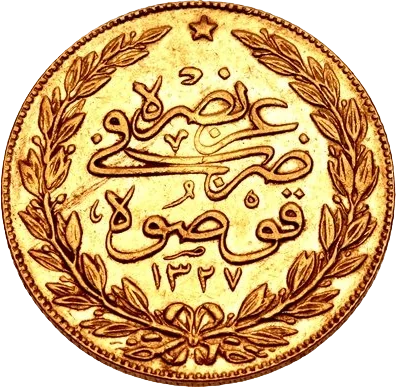
- Gold Lira = 100 Kurush. This specimen was struck in Kosova in 1911, the third year of the reign of Emperor Mehmed V, to commemorate his imperial visit. Its actual weight is 7.19 grams. The standard of 7.216 grams and a fineness of 917, established by the 1844 reform, was maintained until the end of the empire, even in an era when paper money was losing credibility. It was the pinnacle of the monetary ladder, continually proving the promise of the reform in precious metal.
- State the material from its color (gold, silver, copper, bronze, paper...).
- State the shape from its outline (round, square, lump, oval).
- State the main subject on the obverse by its name (face, beast, letters, building...). Do not write interpretations.
- State how the reverse was made (punch mark, engraved die, cast letters, no photo).
- Read the inscription. If you cannot read it, write "illegible."
- Write one thing you noticed was "missing" in the form of a question.
- Name
- One-sen aluminium coin (Fuji)
- Material and shape
- aluminium・round
- Diameter
- diameter 16 mm
- Weight
- no field in the ledger
- Ledger entry
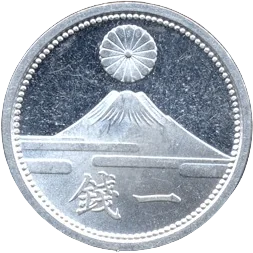
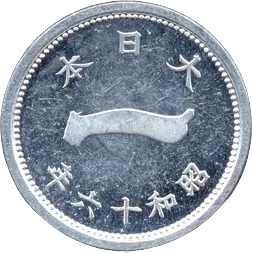
- Issued in the sixteenth year of Shōwa. Pure aluminium, 16 millimetres across, weight 0.65 grams. It had been pared down further from the 17.5 millimetres and 0.9 grams of the year before, and in the later part of the eighteenth year of Shōwa it became 0.55 grams. As metal was turned over to war production, what was left to ordinary people was only the feel of the one-sen piece in the hand growing lighter.
- State the material from its color (gold, silver, copper, bronze, paper...).
- State the shape from its outline (round, square, lump, oval).
- State the main subject on the obverse by its name (face, beast, letters, building...). Do not write interpretations.
- State how the reverse was made (punch mark, engraved die, cast letters, no photo).
- Read the inscription. If you cannot read it, write "illegible."
- Write one thing you noticed was "missing" in the form of a question.
- Name
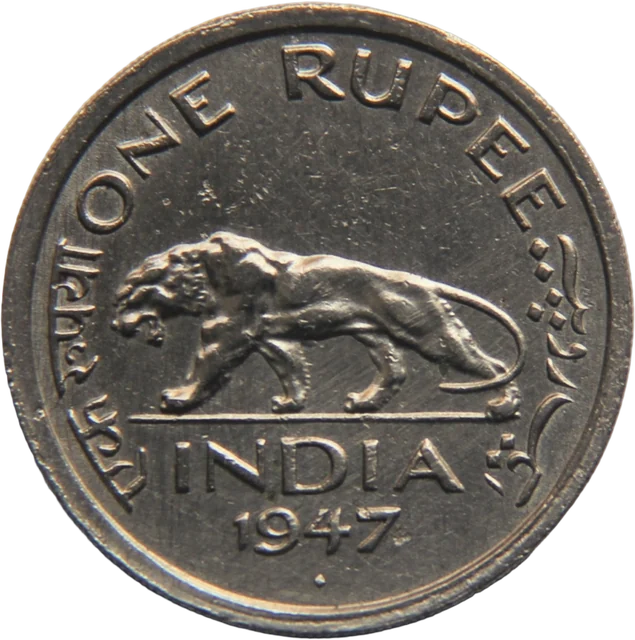
- 1 Rupee (1947, Bengal Tiger)
- Material and shape
- nickel・round
- Diameter
- diameter 28 mm
- Weight
- no field in the ledger
- Ledger entry
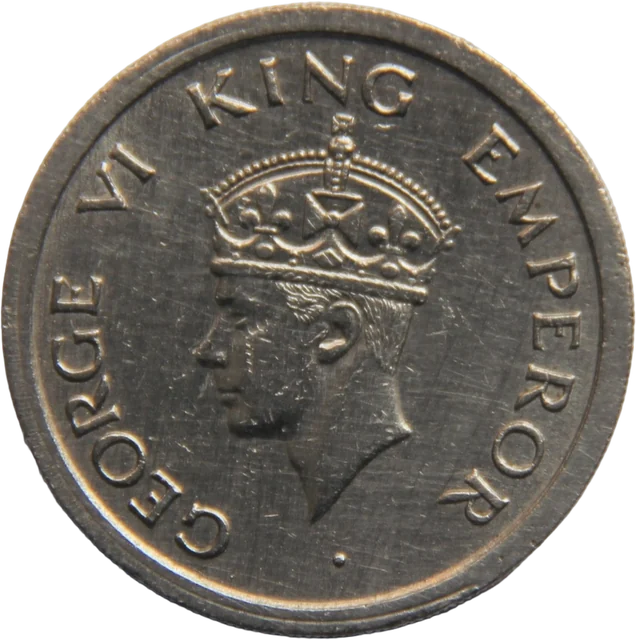
- The one rupee of 1947. Composition nickel, diameter 28 mm, weight 11.8 g, mintage 159,939,000. Obverse engraved by Percy Metcalfe, reverse by P. W. M. Brindley. The reverse features a Bengal tiger, and the denomination is written in three languages: English, Hindi, and Urdu. The dot below the year is the mint mark for the Bombay Mint. Silver was finally removed from the rupee coin. Four hundred years after its standard was set by Sher Shah, the unit continued on, having lost its intrinsic metal.
- State the material from its color (gold, silver, copper, bronze, paper...).
- State the shape from its outline (round, square, lump, oval).
- State the main subject on the obverse by its name (face, beast, letters, building...). Do not write interpretations.
- State how the reverse was made (punch mark, engraved die, cast letters, no photo).
- Read the inscription. If you cannot read it, write "illegible."
- Write one thing you noticed was "missing" in the form of a question.
- Name
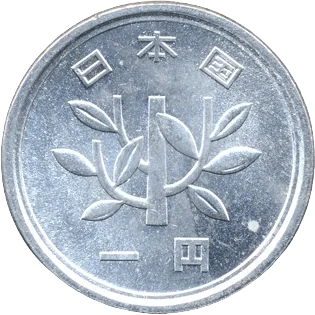
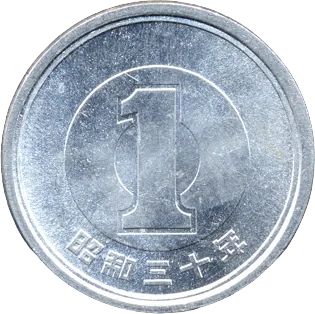
- One-yen aluminium coin
- Material and shape
- aluminium・round
- Diameter
- diameter 20 mm
- Weight
- no field in the ledger
- Ledger entry
- Issued in June of the thirtieth year of Shōwa. Pure aluminium, 20 millimetres across, weight 1 gram. The design was the first after the war to be sought from the public, and the young tree on the face by Nakamura Masami and the '1' on the back by Takashima Tonio were chosen. Out of more than 2,500 entries, lines drawn by citizens whose names were not known became, just as they were, the design of the nation's money.
- State the material from its color (gold, silver, copper, bronze, paper...).
- State the shape from its outline (round, square, lump, oval).
- State the main subject on the obverse by its name (face, beast, letters, building...). Do not write interpretations.
- State how the reverse was made (punch mark, engraved die, cast letters, no photo).
- Read the inscription. If you cannot read it, write "illegible."
- Write one thing you noticed was "missing" in the form of a question.
- Name
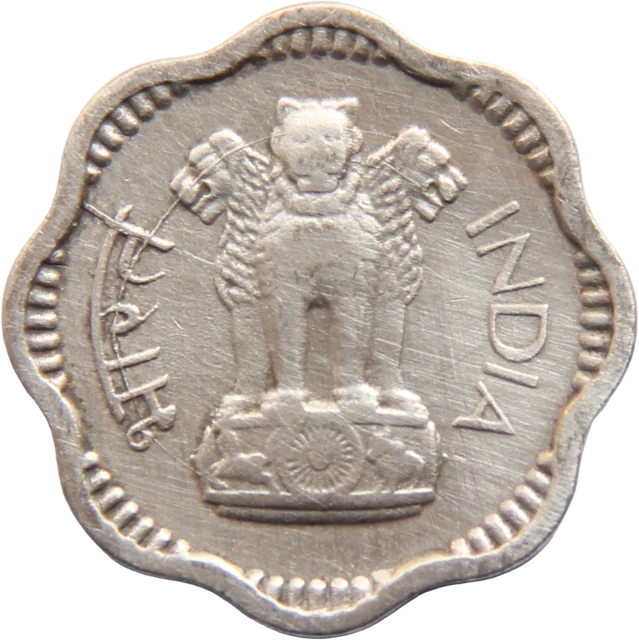
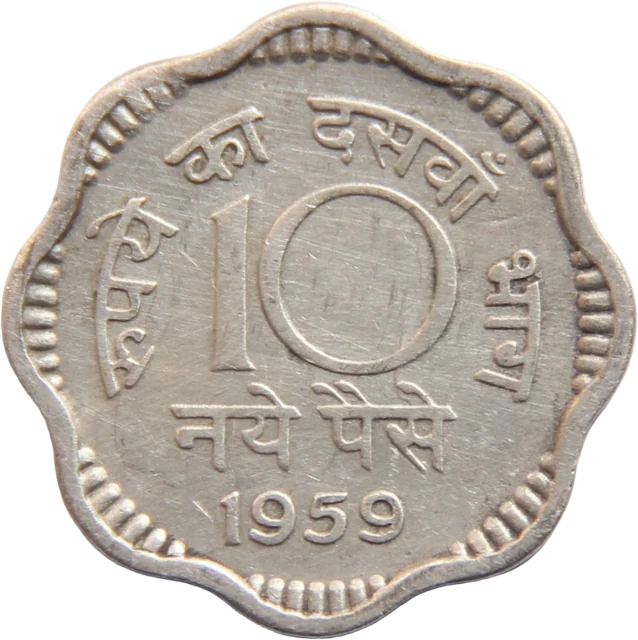
- 10 Naya Paisa (1959)
- Material and shape
- nickel・scalloped edge
- Diameter
- diameter 23 mm
- Weight
- no field in the ledger
- Ledger entry
- A 10 naya paisa coin from 1959. The source states it is made of copper-nickel, is scalloped, has a diameter of 23 mm, a weight of 4.9 grams, and a total mintage of 991,876,000 from 1957 to 1963. The inscription at the top is in Hindi, रुपये का दसवाँ भाग—"One-tenth of a Rupee." It states the denomination as a fraction rather than a number. The scalloped edge is a shape designed to allow the denomination to be identified by touch, even in the dark. This coin was demonetized on June 30, 2011.
Open to enrolled students
Ahead: Lesson 3: Catalog — Transcribing into Seven Fields — and the reference section (timeline, people, sources).
Already enrolled? Log in. Free sample: Vol. 1, Source Criticism (free in full).