Counterfeit Coin and the Pursuer
C10 — Chain of people
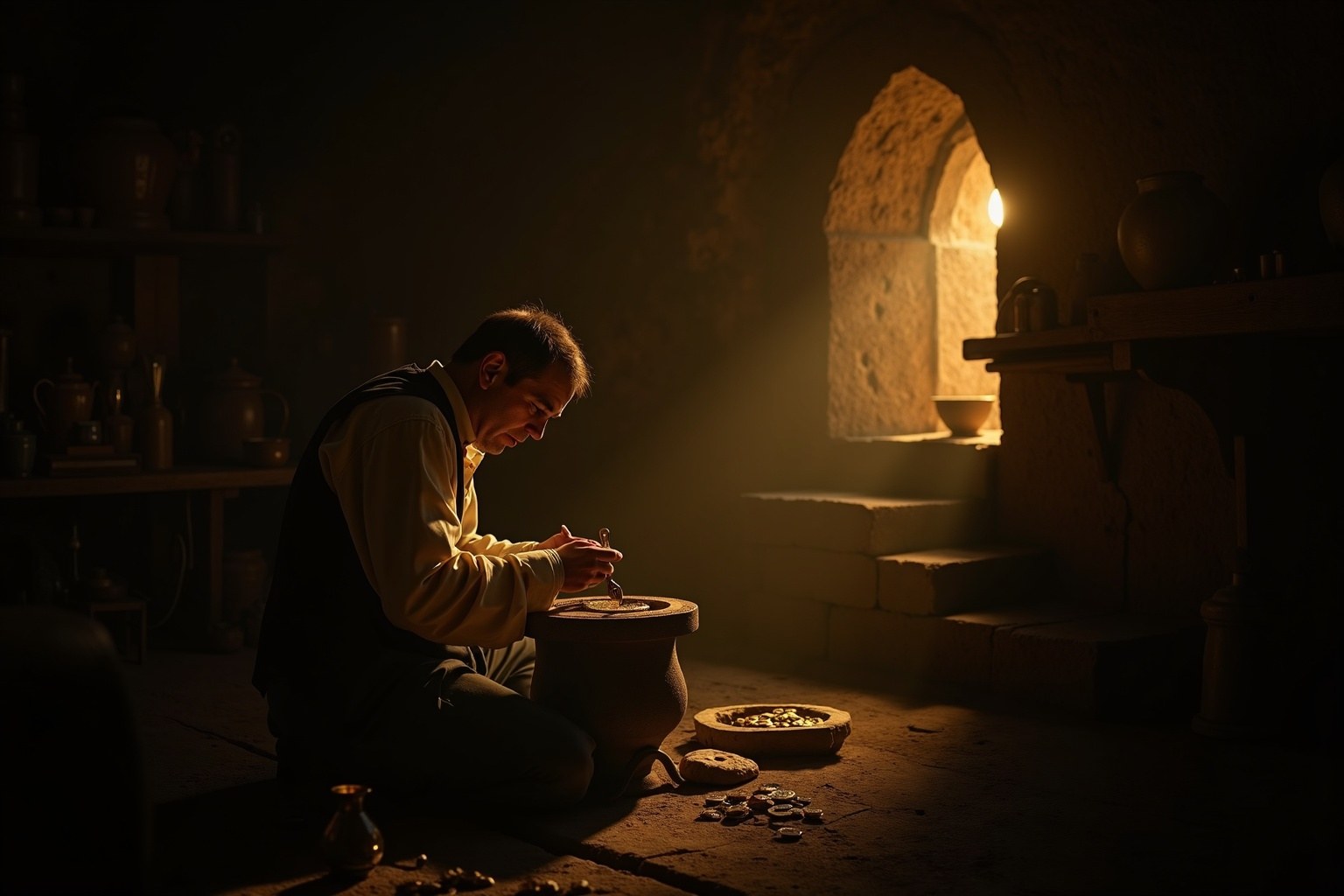
Records survive from the counterfeiters and from those who hunted them.
Supervised by: Mitsuru Hayama / Reading time (main text): About 8 min (4,027 characters of text at 500 chars/min; exercises and readings not included) / Beyond the text: 10 exercises · 2 coins · 10 readings · 1 references
What this course teaches you to do
- You can explain in what order anti-forgery technique advanced.
- You can treat "counterfeit" and "official coin of lowered quality" as distinct things.
- You can give an example where forgery carried a political meaning.
- You can explain what today's anti-forgery measures are actually protecting.
- Can discuss the lineage of the protectors (masters of machinery, whistleblowers, modern designers) by citing key figures.
- Can discuss Operation Bernhard, including its dual nature of perpetration and victimization.
Lessons (8)
- How anti-counterfeiting technique advancedThe aim of anti-forgery has always been to spare the checking. Today's devices are invisible to the eye.
- Who held the largest mould of all"Counterfeit" has two definitions, quality and authority. Law defines by authority; the receiver cares about quality.
- Counterfeiting becomes a tool of politicsForgery makes even the genuine suspect. It is at once the making of a fake and the killing of the real.
- Newton as the pursuerOnly the caught forgers leave records. So the surviving record cannot tell us the rate of success.
- The Master Who Fought for Ninety Years — Varin and the MachineResistance to machine striking lasted for ninety years. The enemies of security technology were not just counterfeiters.
- The Governor Who Made the Accusation — Masayoshi Matsukata and the Counterfeit Notes of ChikuzenIt was a single prefectural governor who exposed the domain's counterfeiting. Twelve days later, the domains were abolished and prefectures established. There is an order to the executioners.
- Those Ordered to Counterfeit — The Ambiguity of Operation BernhardThe most high-precision counterfeit notes in history were made by concentration camp prisoners. The perpetrators' tools and the victims were one and the same.
- Modern Designers — The Front Line of an Anonymous StruggleHelical ridges, micro-lettering, and a three-layer structure. Modern pursuers win the battle through design, before an incident occurs.
Readings (10)
- The upheaval at the end of the shogunate and the counterfeit coin Japan 1868–1869 Edo, the Kinza
§2. The scene of opening the ledgers to show "the largest mould of all." - The Kenmu Restoration Japan 1334–1335 Nijo-gawara, Kyoto
§3. A lampoon in which forged imperial edicts come second on the list. - From reconstruction to the palm of the hand Japan 2021 the Mint
§1. Today's anti-forgery measures. Note "unreadable by the naked eye." - The birth of the yen Japan 1872 Frankfurt
The scene of ordering precise printing technology from abroad as a countermeasure to forged notes. - The louis d'or and machine striking France 1640–1672 The Paris mint
Section 5. The ninety-year internal front: another enemy of the art of defense. - The upheaval at the end of the shogunate and the counterfeit coin Japan 1869–1871 Tokyo, Takanawa
Section 6. A record of accusation, read with the restraint of "I will not call it karma." - A history of false money Overview: 2,700 years of the world AD 1942 Operation Bernhard
Section 7. The strategy where the instrument of harm and the victim were one and the same. - The Tester Greece 375/4 BC The money-changer's table in the Agora
This is one of the oldest examples of the pursuers' system being codified into law. The articles stipulate everything from seating arrangements to fifty lashes for neglecting one's duties—please note the level of detail. - The republic and the escudo (2) Portugal 1925 A printing works in London
This was a case where what was forged was not the banknote itself, but the authority to order its printing. Please consider at what point a banknote, produced with genuine plates and paper through the official process, becomes a counterfeit. - Infalsificables Mexico 1916 Carranza Government
A paper currency named "Unforgeable" fell to one-hundredth of its value in six months. This serves as a confirmation that the technology to prevent counterfeiting and the power to protect value are two different things.
Assessment
10 exercises in this course (7 check, 0 compare, 3 written). Progress is recorded by self-assessment.
References
- Isaac Newton, Warden and Master of the Royal Mint 1696-1727 — The Royal Mint Museum A primary account of the Great Recoinage of 1696. Newton became Warden of the Mint in 1696, and Master of the Mint from 1699 until his death (1727). He emphasized the accuracy of weight and fineness, and completed the recoinage in 3 years.
Only works and primary sources whose existence has been verified are listed.