The Door Opened by Nominal Currency for the Outflow of Koban
While people were starving to death in Osaka, the shogunate minted a silver coin to support its finances. The gap between this coin's face value and its intrinsic content would eventually open the door for the nation's gold to flow overseas.
The Starving City and the Scholar Who Set It Ablaze
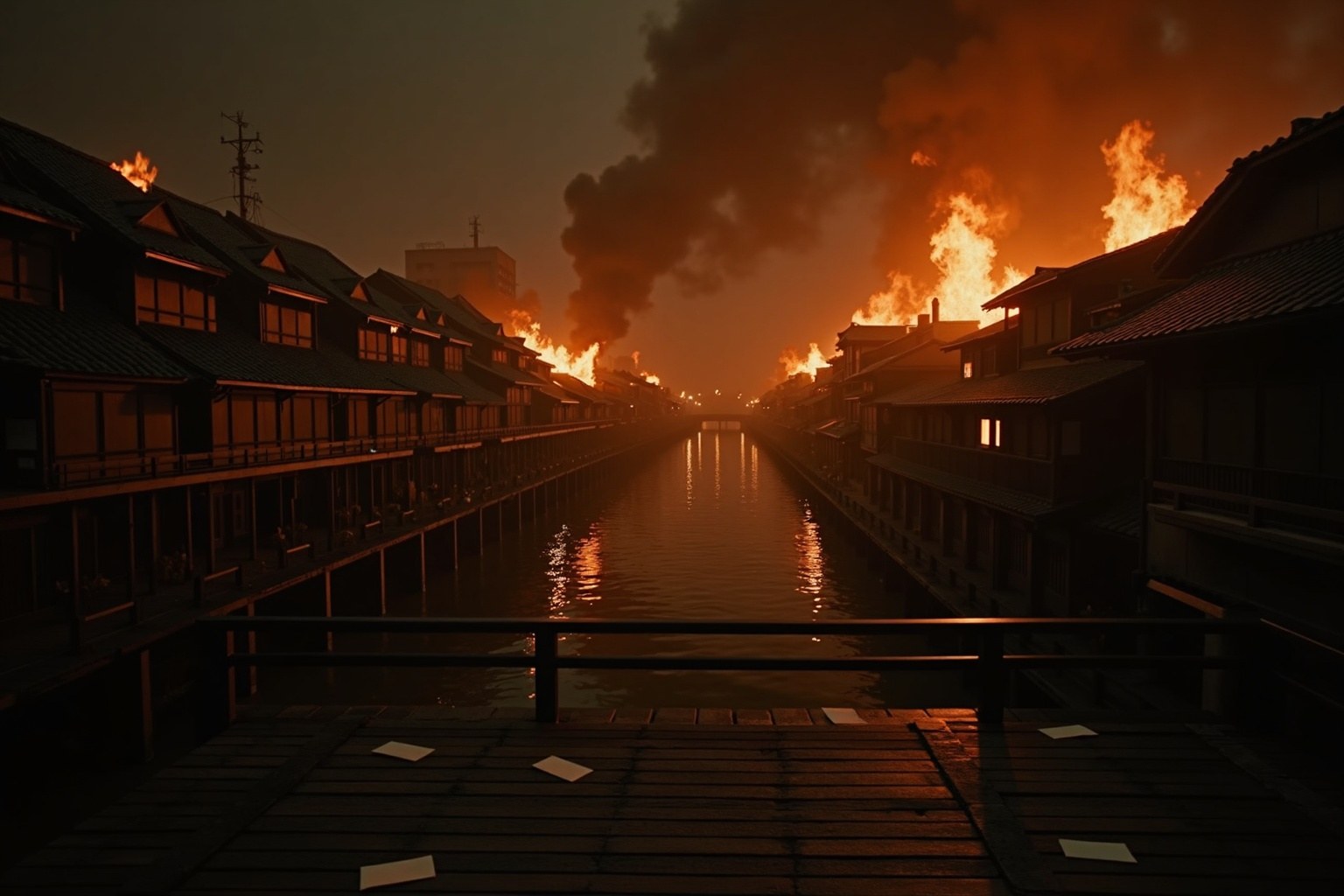
During the famine that began with the heavy rains and cold of 1833, the country's population decreased by 1,252,000 people in five years. In Osaka, more than 150 to 200 people were starving to death every day. Nevertheless, the East Town Magistrate, Atobe Yoshisuke, continued to send Osaka's rice to Edo to cover the expenses for the upcoming proclamation of the new shogun.
Ōshio Heihachirō, a former *yoriki* (police official) of the town magistrate's office and a Yangming scholar, had his proposals for relief rejected. He then sold his collection of 50,000 books and distributed one *shu* of gold to each of 10,000 poor people. What he handed out was charity scrip, redeemable for one *shu* of gold. On the morning of the 19th day of the second month of 1837, he raised an army of about 300 disciples, peasants, and townspeople and attacked the storehouses of wealthy merchants such as Kōnoike, Mitsui, and Tennōjiya Gohei. The uprising was suppressed in half a day, but 3,389 houses were burned, amounting to 12,578 households. This was one-fifth of the city of Osaka.
A Government That Couldn't Run Without Seigniorage
High prices are because the *kabunakama* (merchant guilds) are monopolizing trade. Thinking so, the senior councilor Mizuno Tadakuni ordered the dissolution of the *kabunakama* in 1841. The result was the opposite. When the distribution network was severed, the flow of goods into Edo dwindled, and the economy slumped.
What was driving up prices was not the monopoly. It was the currency minted by the shogunate itself. The shogunate had issued the Tenpō Tsūhō and reminted koban and ichibugin, gaining a seigniorage of over five million *ryō* in just over five years. The Tenpō Koban, issued in 1837, had a gold content in the 56 percent range, and its weight had dropped to three *monme*. The Tenpō Ichibugin was made in the same year.
The seigniorage gained from this recoinage from 1837 to 1842 amounted to 5,053,403 *ryō*. This was more than thirty percent of the shogunate's annual revenue. The government could not run without seigniorage. Even Mizuno Tadakuni, who promoted the reforms, could not break this system.
The World of Weight and the World of Face Value
The Tenpō Ichibugin was a silver coin of tale, counted in the gold unit system despite being silver. Although its silver fineness was close to ninety-nine percent, it was a nominal currency, with the amount of silver per *ryō* being only 9.2 *monme*.
In 1858, the Treaty of Amity and Commerce between the United States and Japan was concluded. Article Five stipulated that foreign and Japanese currencies of the same type should circulate at the same weight. A foreign silver coin, that is, a Mexican dollar, was by weight nearly equal to three Ichibugin coins. Therefore, it should be exchanged for three coins. The logic was sound.
However, the Ichibugin was a nominal currency where four coins passed as one *ryō* of koban. The world of weight and the world of face value. If you connect the two with a single line, a gap appears at the boundary. The difference between face value and intrinsic content became the very entry point for the outflow of koban from the country.
One-to-Five and One-to-Fifteen
Research on his diaries and letters indicates that Consul General Harris profited from the exchange. However, to reduce the story to the malice of one person is to see nothing. The world ran on silver, and the shogunate had no way of knowing the international exchange rates. The gap was born from this structure.
The exchange ratio of gold to silver was one-to-five in Japan, and one-to-fifteen in the outside world. This disparity would force open the door to the next era. Only the Finance Magistrate Mizuno Tadanori foresaw this and sounded the alarm.
More in Reading a coin
The Fate of Gold, Divided by Its Use
The Toyotomi faction converted the gold and silver left by Hideyoshi into military power, while Tokugawa Ieyasu established a monetary system valid throughout the country. This is the story of how gold and silver from the same era met completely opposite ends depending on how they were used.

The Value of the Yen as Defined by the 20 Yen Gold Coin
The old 20 yen gold coin was the highest denomination established by the New Coinage Act. The value of this coin, which equated one yen to 1.5 grams of pure gold, was halved in the 30th year of Meiji. Behind this was the war indemnity left in London.

The Fate of Paper Inscribed with "Time Flies"
In the center, "FUGIO" (time flies) and a sundial; below it, "MIND YOUR BUSINESS." Printed to finance the War of Independence, the Continental currency, contrary to its motto, lost its value and left an idiom in the English language.
If you would like to read on
Everything in these pieces comes from the material itself.