Before the Shimabara Rebellion
People who couldn't pay taxes were punished harshly. Their bodies were collateral for the tax.
The shogunate began minting the domestic Kan'ei Tsūhō coin the year before the Shimabara Rebellion. In an age when the bodies of those unable to pay taxes became collateral, a domestic coin was created for the first time in 678 years.
Kan'ei Tsūhō in 3 Minutes
Swipe to see more
Before the Shimabara Rebellion
People who couldn't pay taxes were punished harshly. Their bodies were collateral for the tax.
1636
The shogunate started making a domestic coin, the Kan'ei Tsūhō.
After 678 years
The coins used before that came from other countries.
Around that time
They set up places to make coins in Edo and Ōmi, casting them in sand molds.
One coin was worth exactly 1 mon.
1768
A brass 4-mon coin was made. It was called 'nami-sen' (wave coin) for the wave pattern on its back.
At an Edo food stall
A 16-mon bowl of soba went from 16 1-mon coins to 4 nami-sen coins.
1732
The western provinces were overrun by insects, and the rice harvest dropped sharply.
During that famine
The death toll varies by as much as 80 times depending on the record. The true number is still unknown.
New Year's, the next year
The first uchikowashi (destructive riots) happened in Edo. Rumors created the targets for destruction.
The rice merchants whose shops were destroyed had actually been trying to keep prices down.
678years later
This is how long it had been since the Kengen Taihō, the last domestically produced coin.
630,000koku of rice
The rice harvest in 46 western domains in 1732.
80times
The difference in the recorded death toll for the same famine.
You run a soba stall in Edo. A bowl of soba is 16 mon. How would you prefer your customers to pay?
Pick one
Counting 16 coins takes a bit of effort. At a busy stall, paying the bill took time.
With 4-mon coins, you only need 4. Paying the bill at the stall was done in a flash. A new type of business even appeared, the '4-mon shop,' which sold things for 4 mon.
The face value of a single coin changed the pace of daily life.
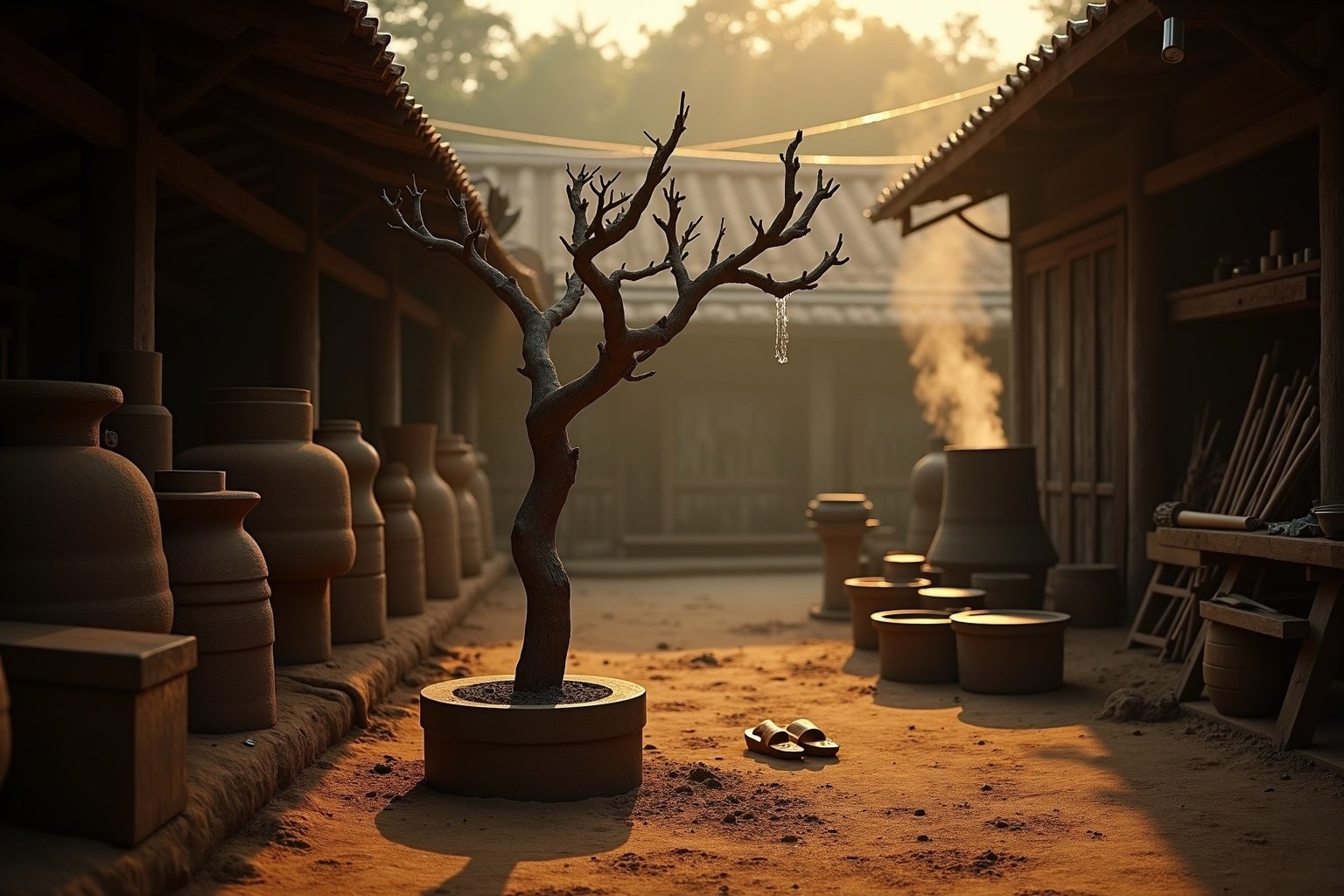
The Matsukura clan did not ease the annual tribute even in years of poor harvest. Those who could not pay were put in water prisons, forced to stand for days in winter water up to their necks. A form of torture in which a person was dressed in a straw raincoat and set on fire was called the "mino dance."
This name and scene were recorded by Duarte Correa, a Portuguese man in Nagasaki. Descriptions of the harsh rule also remain in the diary of the Dutch factory chief Couckebacker and in the "Nabeshima Katsushige Kōfu." Many of the stories about individual tortures were written after the rebellion, and their details differ. Nevertheless, different lines of records consistently report that failure to pay the annual tribute was paid for with one's body. The bodies of those unable to pay taxes became collateral for the tax.
The shogunate began minting the domestic Kan'ei Tsūhō in 1636, the year before this rebellion. It was during the reign of the third shogun, Iemitsu. This was twenty years after Ieyasu passed away. Until then, the coins of this country had been imported; it had been 678 years since the Kengen Taihō, the last domestically produced coin.
Mints were established in Asakusa and Shiba in Edo, and in Sakamoto in Ōmi Province, where Kan'ei Tsūhō were cast. Those cast at Aminawate in Shiba were called Shibasen and are distinguished by a dot in a cursive style. The diameter was two and a half centimeters, and the weight was about one monme. The coin trees were pulled from the sand molds, the coins were broken off, and then filed. One coin was worth exactly one mon. The era of reliance on Chinese coins was finally coming to an end.
Time passed after the creation of the Kan'ei Tsūhō, and in 1768, a brass 4-mon coin was established. It was made at the mint in Senda Shinden, Fukagawa, Edo, and people called it the Namisen ("wave coin") because of the wave pattern struck on the reverse.
The 4-mon coin changed the pace of life. A bowl of nihachi soba cost sixteen mon. With 1-mon coins, one had to count out sixteen, but with Namisen, four were enough. Paying at a food stall could be done in a single breath. A type of business called a "shimon-ya" also emerged, which sold items that could be bought for four mon. It is said that strings of coins functioned, in effect, like paper money.
A little before that, in 1732, the western provinces were overrun by insects. After a period of long rains and low temperatures, planthoppers and locusts swarmed. The total assessed rice yield (kokudaka) of the 46 domains in the western region was 2.36 million koku, but the harvest that year was only about 630,000 koku.
The number of people who starved to death in this famine, according to figures compiled by the shogunate, is 12,172. However, the "Tokugawa Jikki" records the number as 969,900. The death toll for the same famine differs by a factor of eighty. The number is still not settled today. The price of one koku of rice, which had been about 64 monme of silver, rose to the 120-monme range. On New Year's of the following year, the first uchikowashi (destructive riot) occurred in Edo. The house of the rice merchant Takama Denbei was destroyed by about 1,700 impoverished people. However, Takama had not been hoarding rice; he was a merchant who had been trying to keep prices down. Rumors had created the target.
In 1668, a single coin born in Kameido, Edo, brought an end to the era of imported coins. This coin would survive famines and continue to be legal tender in Japan until the Shōwa era.
Yongle Tongbao coins were minted in Ming China, but hardly circulated within the country. There was a country that minted coins for export which it did not use itself, and a country that did not mint its own coins but used imported ones as its standard.
The Keichō Chōgin, which had no face value, was valued directly by its weight on a scale. In the era when this silver coin was created, gold and silver shook faiths, gathered a hundred thousand soldiers, and decided the fate of castles.
The rest of the story is in the material of NOMISMA.
Price
After purchase, the full courses, the illustrated books, every country’s story and the numismatics examination are open to you.
See the price →