Stable Coinage and a Bankrupt Kingdom
During the era of Louis XV, France's metallic currency remained stable for half a century, and trade grew. Yet, by the end of that same century, the kingdom was bankrupt. If the value of the currency was not changing, why did its finances collapse?
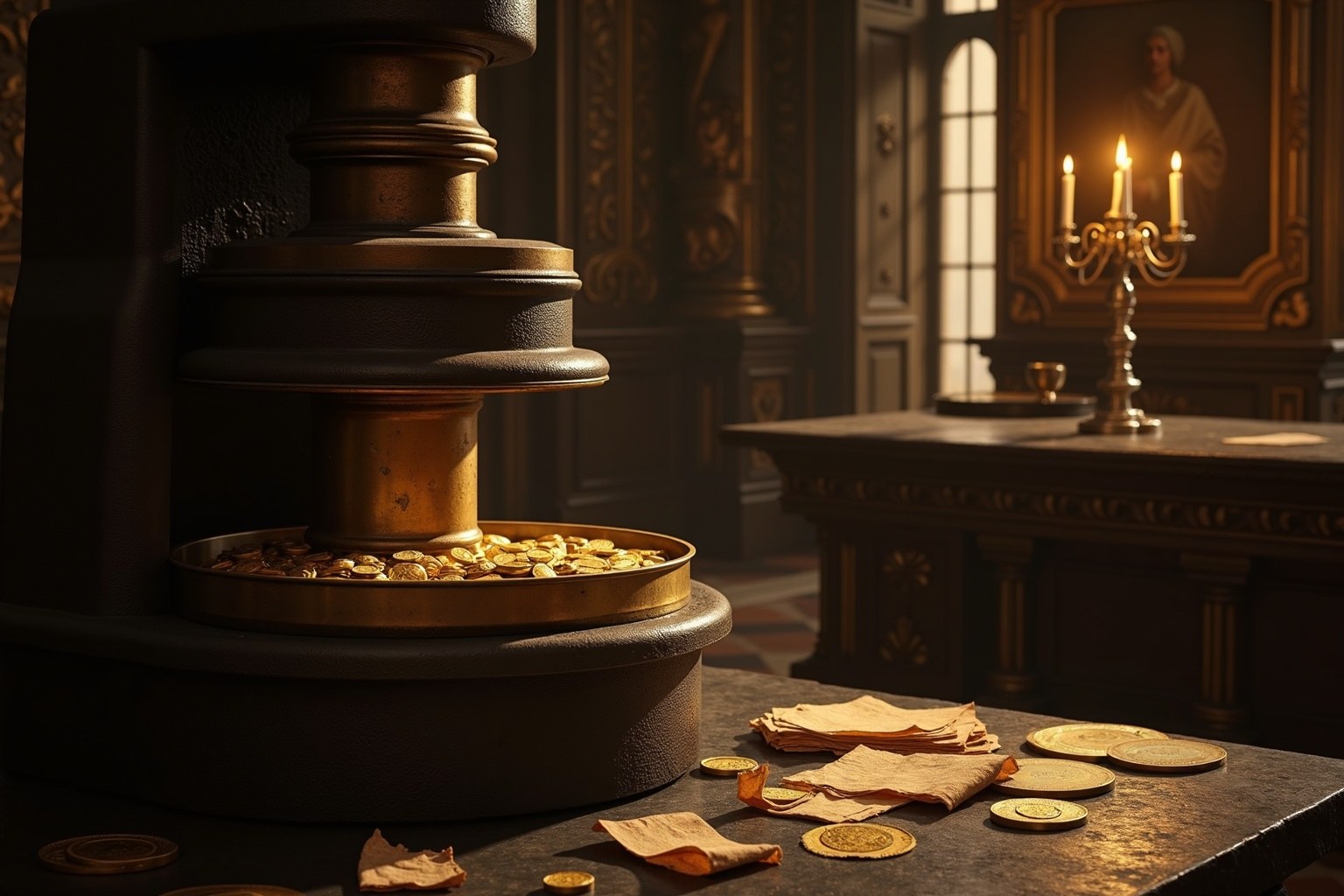
After John Law's bubble turned to ash, France abandoned paper and returned to metal. The silver écu in one's hand was a metal founded on the memory of never trusting paper again, or so its substance suggests.
A Value Unchanged for Half a Century
The reform of 1726 fixed the par value of metallic currency. One livre was set at just over 4.5 grams of pure silver. The gold Louis d'or was valued at 20 livres, and the silver écu at 6 livres. The value of the Louis d'or was raised to 24 livres in 1740, which would be the last change in par value before the Revolution.
For about half a century thereafter, the currency barely fluctuated. The practice of debasement, habitual under Louis XIV, came to an end. As the currency stabilized, maritime trade grew from 80 million livres in 1716 to 308 million livres in 1748. Yet, by the end of this century, the kingdom was bankrupt.
The Debt Left by War
The cause was not the devaluation of the currency, but the debt accumulated with each war. The cost of the Seven Years' War was approximately 1.8 billion livres. The preceding War of the Austrian Succession had cost another billion livres or so.
The war at sea was disastrous. Around the time the war began, the British fleet captured some 300 French merchant ships. And with the peace treaty of 1763, France lost Canada in the north to Britain, as well as many of its strongholds in India. It lost an empire, and only debt remained. The currency could not be tampered with, so where did the war funds come from? The answer was borrowing.
The Wall That Blocked Taxation
The proper way to repay debt is through taxation. However, France's tax system was fundamentally distorted. The Third Estate, which comprised 98% of the population, paid most of the taxes, while the clergy and nobility were exempt from the main direct taxes.
In 1749, Controller-General Machault attempted to address this distortion. He tried to impose a one-twentieth tax on net income, extending it for the first time to the clergy and nobility. However, the Parlement of Paris rejected it, and the king withdrew the tax on the clergy the following year. Attempts to tax the privileged were crushed each time by the resistance of the privileged.
Cause and Symbol
The reign of Louis XV is often described in terms of the extravagance of his mistress, Madame de Pompadour. However, the main cause of the bankruptcy was not the splendor of the court, but the defeat in the Seven Years' War, its costs, and the resulting debt. The extravagance was a symbol, not the cause.
When the king died in 1774, his grandson Louis XVI inherited a kingdom on the brink of catastrophe. An inflexible currency, the privileges of tax exemption, and war debt. These three things were passed on to the next generation.
More in Topics in money

A Promise Locked in a Vault, A Door That Never Opened
In 1917, the promise to exchange gold coins for banknotes was suspended. An economic boom born from the war in Europe created nouveaux riches and queues of people seeking rice, eventually leading to a long recession.

The Rebellion that Began with an Account Book, and the Cannonballs Paid for with Rights
The rebellion began not with a sword, but with an account book. Under a daimyō said to have reported his 40,000-koku domain as 100,000 koku, the tax rate doubled. The bodies of those unable to pay were subjected to torture, and to quell the eventual uprising, foreign cannonballs were fired from the sea.

Coinage Struck on Paper, the Promise of Leiden
In besieged Leiden, silver ran out, and coinage was struck from church books. What backed this paper, which had no metallic support, was a single promise: that if the city survived, it would be redeemed for specie.
If you would like to read on
Everything in these pieces comes from the material itself.