Gold maravedí of Alfonso VIII
1174–1217 (held to be struck at Toledo) ・ gold ・ 12th century ・ Toledo
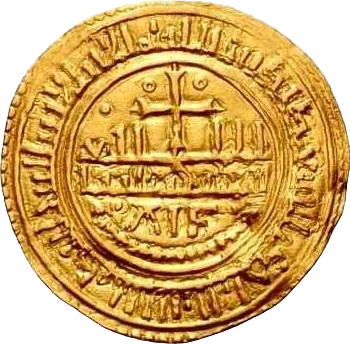
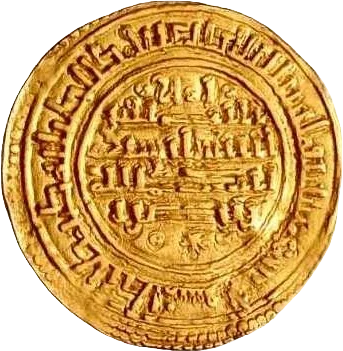
What fills the face is an Arabic legend, and within it a cross and the letters ALF — the gold maravedí struck at Toledo by Alfonso VIII, king of Castile (held to be of 1174–1217). It is cut with 'Alfonso, son of Sancho, amir of the Catholics', calls the pope 'the imam of the church', and carries a verse of the Gospels around the rim. The dating is not by the Hijri calendar but by the Spanish era — the language the enemy's, the faith his own, the calendar the peninsula's. The source of the name is the morabetino, the gold coin of the Almoravids. In a peninsula where the enemy's money had become the measure of reckoning, a Christian king began to strike that gold himself. It is a full gold coinage more than half a century earlier than the fiorino. But the maravedí fell in time to silver, then to low-grade billon, lost its body and lived on in the ledgers as a unit of account into the 19th century — its beginning was the name of the strongest gold coin of the peninsula.