Comparing photos to find the tool that struck the coins: the "die"
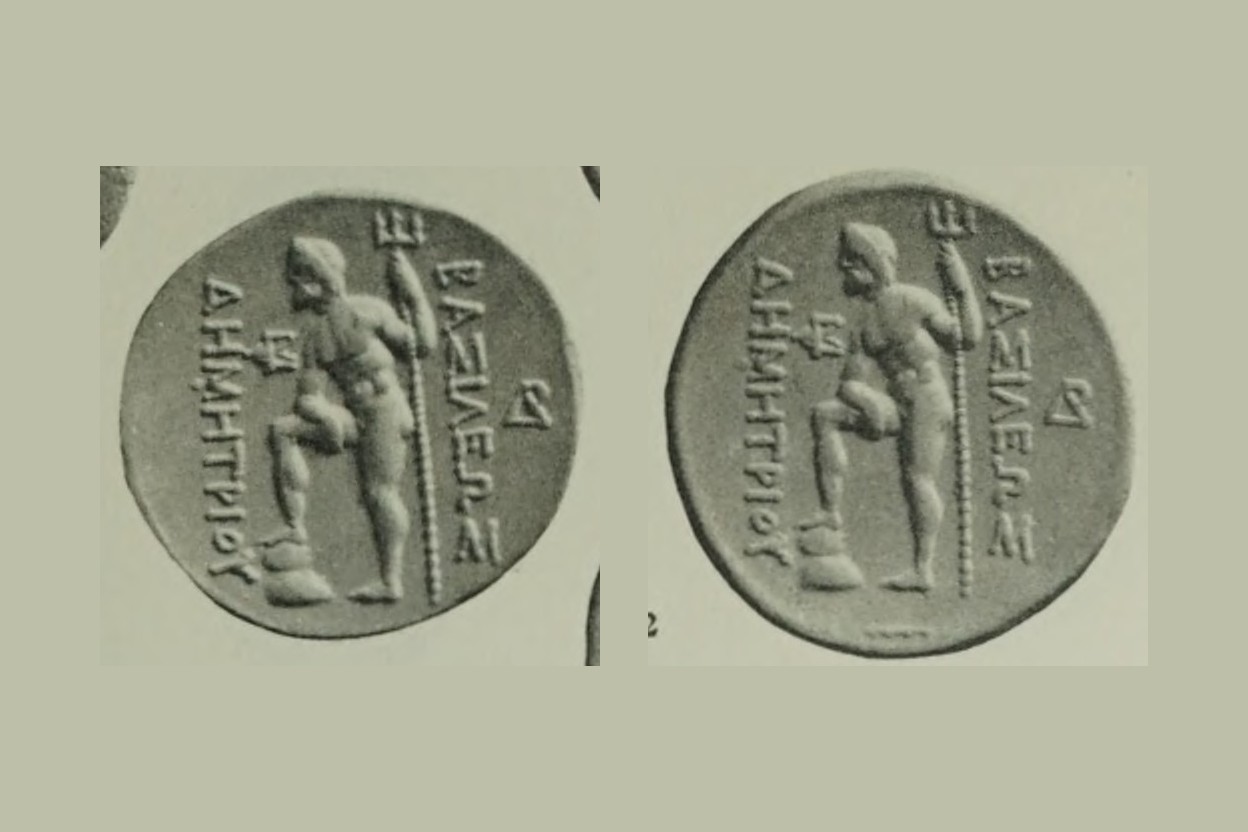
When the reverses of two silver coins are placed side by side, even the position of the letters is identical. Although the obverses are different, why are the reverses so alike? Taking the tool (the die) that provides the answer as our clue, we look for coins struck from the same die and consider the mintage volume.
Time to read the text: about 14 min The review questions are optional and not included in this time. What you can read: the course opening and contents are free; the full text is for those who have purchased After purchase, you can read the full text once your access starts.
Source photoThe reverses of XII-11 and XII-12. Two coins that Newell considered to have been struck from the same single reverse die (the obverses are from separate obverse dies). Source: Newell 1927, Plate XII, 11 and 12 (copy: Internet Archive's coinageofdemetri00newe, funded by SNS Library and Washington University Libraries, published 1927 and in the public domain). Only the reverses have been cropped from a copy of the same page of Plate XII to the same size, without scaling, and placed side by side. No rotation or correction has been applied.
These are the reverses of two silver coins. Poseidon with his right foot on a rock, a trident, and the letters of the king's name arranged vertically on the left and right.
Source photo
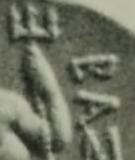
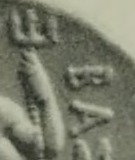
Part of the reverse of Photo A (Plate XII-11)Part of the reverse of Photo B (Plate XII-12)
Source: Newell 1927, Plate XII, 11 & 12 (copy: Internet Archive's coinageofdemetri00newe, published 1927 and in the public domain). No rotation, correction, or drawing has been added. Cropping with the same size frame does not mean the actual sizes of the coins are the same.
Here are the tip of the trident and the first letter of the right column. The same parts of the two coins have been cropped without scaling and placed side by side. At what height of the trident does the first letter begin?
Although they are separate coins, why do they match so perfectly?
The answer lies in the tools used to strike the coins. A piece of silver is placed between the obverse and reverse dies and struck with a hammer. Scratches on the dies and the positions of the letters are transferred to all coins struck.
The striking of a single coin
Engraving the die Separate dies for obverse and reverse. An inverted image is engraved into steel.
The obverse die is set in place. It is placed in the anvil.
The blank is placed and struck. The reverse die is aligned from above and struck with a hammer.
Both sides are imprinted onto a single piece. Scratches and chips on the die are also transferred directly.
Dies wear out. The obverse wears out more slowly than the reverse. We count the obverse dies.
Let's try comparing a pair ourselves. In Section 1, we will trace the letters and monograms on the reverses of these two coins one by one. In the exercise, we will compare the obverses of five coins to see if they "match," "do not match," or "cannot be decided from this photograph."
Let's examine the photos a bit more to see why the lettering aligns.
Calculate n/d from the number of specimens and the number of dies, and explain the range and assumptions when estimating the mintage.
You can start this course without reading any other course.
If you want to know more about checking sources (optional)
Is It Really True? Checking History We re-examine the origins of money and famous anecdotes, comparing them with historical records and actual artifacts.
Assessment
8 exercises in this course (5 check, 0 compare, 3 written). Progress is recorded by self-assessment.
For those who want to learn more (Advanced topic, from Section 5 of the main text)
The main text reaches a pause at the end of Section 4. From Section 5 on is an advanced topic that considers issue size by counting dies.
31 obverse dies and 84 reverse dies (for the same group of silver coins). The obverse dies lasted longer, and the reverse dies were replaced sooner.
n/d (number of specimens ÷ number of dies) is used to measure if the sample is sufficient. Counting only the 43 coins from the plates gives 1.48, which is below the benchmark of 1.5.
Assuming an average of 20,000 coins could be struck from one obverse die, the estimate from the 19 observed obverse dies is 380,000 coins. This is an estimate based on an assumption and is not necessarily a lower limit.
The number and quality of dies tell us about the size of the mint and the time remaining for the king. However, this should be cited with reservations.
Recap: 3-minute summary (optional)
Finding coins struck from the same die in 3 minutes
Two silver coin reverses side by side — why are they so identical?The obverses of these two were struck by different dies, but on their reverses, even the positions of the letters and monogram match. The reason lies in the die that struck them.
What is a die? — The tool that strikes, and the coin that is struckFlaws on a die are transferred to the coin. We count the obverse dies, which wear out more slowly.
Identifying the same die — “similar” and “identical”Design, type number, and die are different things. The determination for a die is one of three: 'match', 'no match', or 'cannot be decided from this photograph'.
Die Chains — Connecting individual coins to reconstruct the striking sequenceShared dies link individual coins. Which came first is a separate question, to be read together with the researcher's arrangement (style, re-engraving, wear).
How many dies were used? — The observed number and the original numberThe number of dies counted is the number observed. If there are dies known from a single specimen, there must also be dies yet to be discovered.
Estimating the Mintage — From the Number of Dies to the Number of CoinsThe 20,000 coins per obverse die is a hypothetical average. The range is 10,000–40,000. The result of the multiplication is a trial calculation based on certain conditions, and not necessarily a lower bound.
What Can and Cannot Be Said — The Limits of Die StudiesSample construction, die recutting, confidence intervals, and circulation volume. Do not speak beyond these four boundaries.
The State Seen from a Single Coin — What the Number of Dies Reveals about the Scale and Timeline of MintageThe number of dies speaks to the scale and timeline of the mint. However, they must be cited with reservations.
Readings (4)
Silver with a portrait Italy the 16th century The Zecca of Rome Thousands of coins are struck from a single die, which is used until it wears out. The premise of Sections 2 and 6 is written from the engraver's perspective.
The silver of the colonies Italy the 6th century BC Sybaris and Metapontum The obverse die and the reverse die are separate tools, struck together with perfect alignment. This explains Section 2's "one for the obverse, one for the reverse" from the striker's perspective.
The beauty of Syracuse Italy the 5th–4th centuries BC An engraver's workshop An example of an artisan who carved a die engraving their name. This confirms, with a name, that the die is an "engraved tool".
The Face of Coinage Overview: the world General History Whose Face Is on the Coin? A new die is carved and used for the next striking. Even if the design changes, the weight and fineness are confirmed—a connection to the source criticism in Section 8.