A Single Silver Coin
That Crossed the World
How the 8 Reales Connected Potosí, Manila, China, and the Dollar
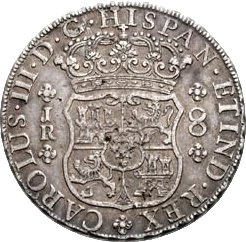
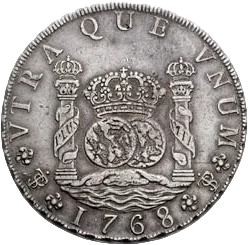
Spanish 8 reales silver coin, 1768, Potosí mint. CAROLUS III — the name of King Charles III of Spain encircles the design, commonly known as the Pillar Dollar. The system of this single coin outlasted the country that created it.
Source: CNG / CC BY-SA 3.0 (from the school's physical ledger dollar/spanish_dollar)
What can a single silver coin
leave behind for the world?
This Volume in 3 Minutes
- In 1545, a mountain of silver was discovered in the Andean highlands. In the second half of the 16th century, this single mountain produced about 60% of the world's silver — and that silver was bought with blood.
- It was not the veins of ore but refining technology that connected the mountain to the world. The Patio process (1554) and cupellation — the true starting point of the Silver Way was the arrival of technology.
- 1571, Manila. Historians Flynn and Giráldez called this year the "birth of global trade" — we will examine this one year, with the caveat of who proposed this theory.
- The empire that mined the silver was not its greatest beneficiary. Because it was borrowed before it arrived — the silver passed straight into the ledgers of Genoa.
- On the other side of the globe, Japanese silver from Iwami joined the same flow on a scale "said to be one-third of the world's total."
- The final destination was China. In a land that used silver in bulk and did not mint it into coins, the Mexican "eagle" silver coin became the standard, accepted by count.
- The first to see the entire route were economic historians 400 years later. In the Seville registers: 16,886 tons of silver — but "only what was registered."
- At the final destination, there is no more silver. What remains is the name — dollar, yen, yuan. The words in your wallet are survivors of this journey.
- This book is the itinerary of that single coin. It stops at eight stations, and at each station, an actual specimen awaits.
Itinerary — Table of Contents
- DepartureThere Is a Silver Coin
- Station 1Cerro Rico — The Mountain That Eats Men
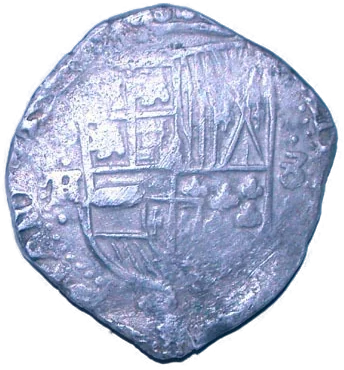
- Station 2The Mint — From Cob to Pillar
- Station 3The Atlantic — The Ledger, Not the Sword
- Station 4Another Silver Island — Iwami
- Station 5The Pacific — The Manila Galleon
- Station 6China — The Land That Sucked in Silver
- Station 7The Reckoning — Hamilton's Ledger
- Station 8Only the Name Remains — Dollar, Yen, Yuan
- TerminusThe Silver Vanished, the Name Remained
- Back MatterGALLERY / PEOPLE / TIMELINE / DATA / SOURCES
There Is a Silver Coin
It was born in the highlands of South America, crossed the Pacific, was weighed in the markets of China, and was also accepted in North America.
The system of this single coin will outlast the country that created it.
CNG / CC BY-SA 3.0
This book is the itinerary of that single coin. The people who mined the silver, weighed it, transported it, and seized it — the Silver Way was a path from hand to hand. Stopping at eight stations, we will journey from a mountain in South America to your wallet.
When you reach the terminus, the silver is gone, and only the names remain. Dollar. Yen. And Yuan.
What can a single silver coin leave behind for the world?
Cerro Rico — The Mountain That Eats Men
The story begins in a place farthest from Europe. In 1545, in the Andean highlands, at an elevation of about 4,824 meters, a conical mountain was discovered. Cerro Rico — the Rich Mountain. At its foot, a town called Potosí arose.
In the second half of the 16th century, this single mountain produced about 60% of the silver mined in the world. An expression was even coined to describe immense wealth: "to be worth a Potosí." The name of a single mountain became a unit of wealth.
It was technology that changed the mountain
However, an ore vein is just rock unless it can be mined and refined. What changed the mountain's significance was the Patio process, put into practice by Bartolomé de Medina in Pachuca in 1554 — though some sources say 1555. Powdered ore and mercury were spread and mixed in a paved courtyard (patio), and over time, the silver was absorbed by the mercury. Not roasted in a furnace, but mixed in a courtyard. This method made it possible to extract silver even from low-grade ore with little silver content. The person who put it into practice was not a miner, but a merchant from Seville.
And this technology had a faucet: mercury. Mercury was a royal monopoly — an *estanco*. New Spain relied on mercury from the Almadén mine in the mother country, while the Viceroyalty of Peru relied on Huancavelica. The amount of mercury delivered directly determined the upper limit of silver production. The land that mined the silver did not hold the key to increasing its output — the faucet was across the Atlantic, in the hands of the king.
The Crown also used this faucet as a measuring tool. The benchmark was one mark of silver for every pound of mercury. Distributing mercury was also a way of measuring production. The very quantity of the world's currency was tied to the tunnels of a single mine in the mother country.
The mountain eats men
In 1573, Viceroy Francisco de Toledo introduced a system called the mita to the mines. The mita was originally a system of corvée labor in the Inca Empire. Toledo repurposed it, conscripting adult males in rotation from the provinces of the Andean highlands to work in the Potosí mines. It was forced labor. Those conscripted were called *mitayos*, and they worked alongside *mingas*, who were free wage laborers, in the same tunnels. The mita system persisted until the end of colonial rule.
The textbook also records the cost. About 13,000 people were conscripted for forced labor each year, and many perished from falls, lung diseases, and mercury poisoning. The indigenous people of this land eventually lost half of their population.
Here, pay attention to the name. The name of the system, Mita, is an "old thing" from the Inca period. However, its substance, which was labor for community projects, was changed to a levy for the silver mines. Repurposing an existing system reduces resistance. Even if the name is the same, the substance may have changed — the reading discipline learned in Issue 1 first comes into play here.
National Museum Liverpool / Frances McIntosh (PAS) / CC BY-SA 2.0
Open to enrolled students
Ahead: The Mint — From Cob to Pillar, The Atlantic — Ledgers over Swords, Another Silver Island — Iwami, The Pacific — The Manila Galleons, China — The Land That Absorbed Silver, Cross-check — Hamilton's Ledgers, Only the Names Remain — Dollar, Yen, Yuan, The Silver Vanished, the Names Remained — and the reference section (timeline, people, sources).
Already enrolled? Log in. Free sample: Vol. 1, Source Criticism (free in full).