The Simultaneity of the Axial Age
C01 — Chain of people
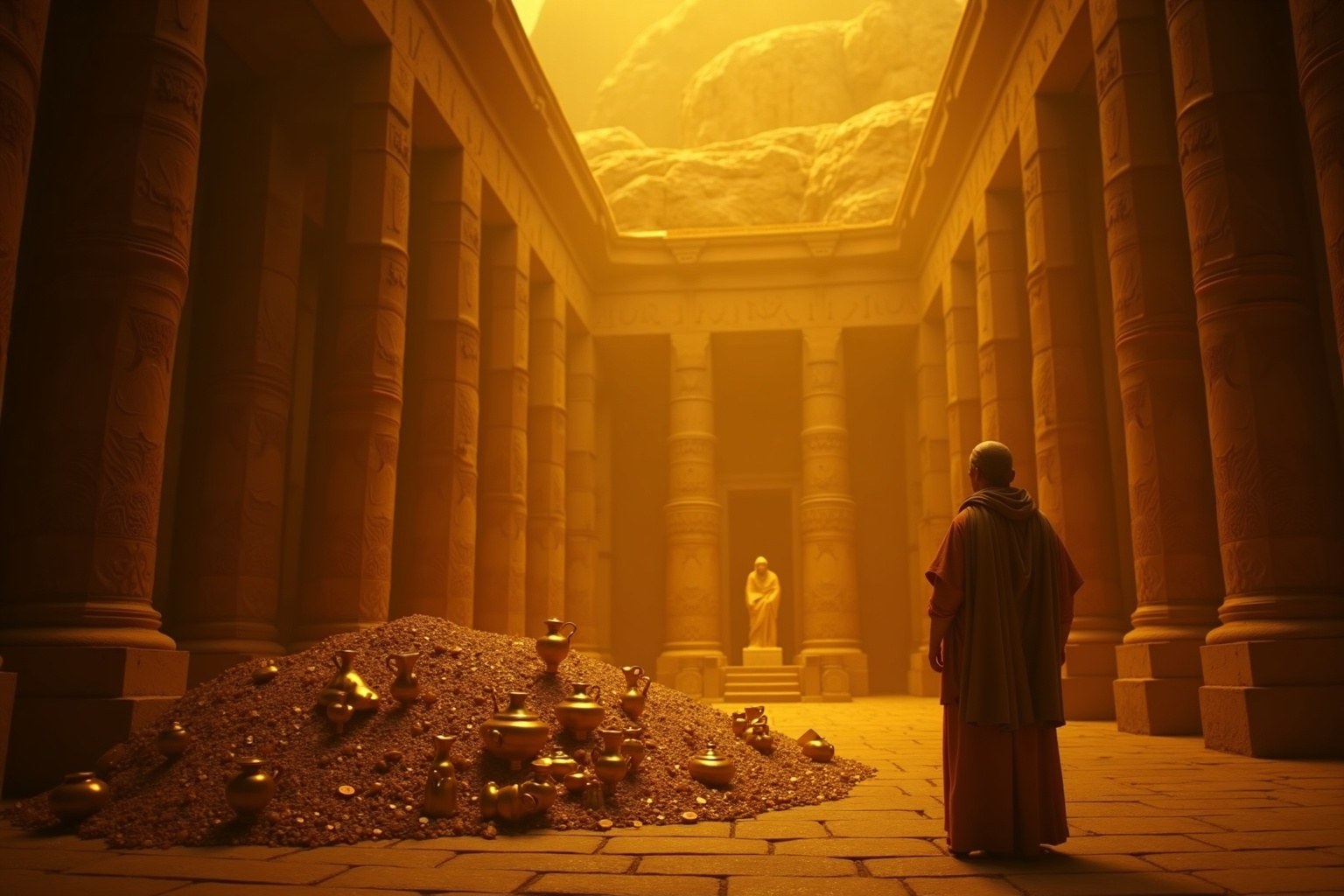
In the sixth century BCE, in Lydia, China, and India, at almost the same time. Three lands, unknown to one another, arrived at the same invention—the most mysterious riddle of synchronicity in numismatic history.
Supervised by: Mitsuru Hayama / Reading time (main text): About 6 min (2,932 characters of text at 500 chars/min; exercises and readings not included) / Beyond the text: 7 exercises · 1 coins · 6 readings
What this course teaches you to do
- Can explain the three inventions of coinage (Lydia, China, India), including the characteristic features of each form.
- Can cite, from concrete examples, the social conditions common to all three.
- Can compare explanatory hypotheses for synchronicity on a scale of verifiability.
- Can examine the very premise of "independent invention," along with the limitations of the evidence.
Lessons (6)
- The West — A Mark by the RiverFrom striated metal pieces to the mark of the lion. The Western invention was the invention of the "guarantee."
- East — Coins that Jingle in a BagChina's invention was the cast coin. Strung through a hole, counted, and bundled—a shape optimized for "counting."
- South — The Marks of Punched Silver CoinsMany marks of the sun and animals on small pieces of silver. The invention of the South was a third form: the overlapping of punched marks.
- Finding Common Conditions — Similarities Among the Three LandsCities, trade, and states. Enumerating the conditions common to the three places of invention, within the scope of the course material.
- Theories on the Simultaneity — Candidate Answers and Their LimitsThe coincidence theory, the maturity of conditions theory, and the unknown diffusion theory. All of these theories stand before a wall of verifiability.
- Verifying "Independent Invention" — Questioning the PremiseCan we definitively say "independent"? The course concludes by turning a critical eye to the premise itself.
Readings (6)
- Islam and India Overview: 2,700 years of the world the 6th century BC India · Punch-Marked Silver
The thesis of this course. A paragraph declaring the simultaneity of three lands. - Before the beginning Overview: 2,700 years of the world 650 BC Blank Electrum
Section 1. The form of a Western invention before its completion. - Lydia Overview: 2,700 years of the world 600 BC Lydia · Sardis
Section 1. The Moment of the Invention of the Guarantee - Gods and money Overview: 2,700 years of the world from 2000 BC The Temple as Bank
Section 5. Temple Ledgers Operating Without Coinage—The Challenge to the Preconditions Theory - The Sixteen Kingdoms Strike Coinage India 6th century BCE Coinage of Magadha
This is material evidence that India, separately from the West, independently arrived at the same invention. Please observe that only the weight—thirty-two ratti, approximately 3.4 grams—remained constant across countries, eras, and workshops, and that the name of this silver, rupiya-rupa, would become the name of a currency eighteen hundred years later. - Money in the shape of tools China the 7th–3rd centuries BC The market of Linzi, capital of Qi
The answer produced by the third great land was bronze in the shape of a small knife. Please see the reason why this inconvenient shape, with some examples exceeding seventeen centimeters in length, nevertheless continued to be used for several hundred years. It is another kind of beginning, in which a tool became currency while remaining a tool.
Assessment
7 exercises in this course (4 check, 1 compare, 2 written). Progress is recorded by self-assessment.