Comparing the Origins
of Money
The Birth of Coinage — Three Lands and a Recurring Invention
Source photo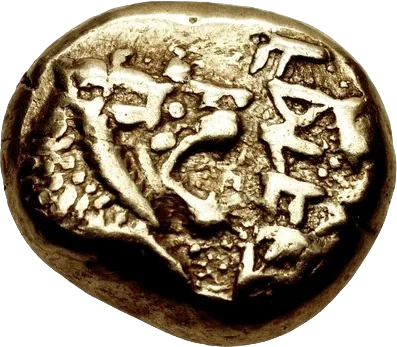
Electrum trite, 610-560 BC, Lydia, Sardis. Struck with a lion's head on alluvial gold from the Pactolus River—natural gold containing silver. Many scholars read the inscription WALWET as the name of King Alyattes. Analysis shows the gold content is 54%. The researcher Kroll interprets that the royal house fixed its value as equivalent to Lydian electrum as found in nature (with an average gold content of about 73%)—it was the one who struck the mark that determined the value. However, this is not the only "beginning"—that is the theme of this book.
Source: CNG / CC BY-SA 3.0 (from NOMISMA's specimen ledger Electrum trite)
How many "beginnings"
of money are there?
This book in 3 minutes
- “Money was born because barter is inconvenient”—the scene from Smith often cited for this explanation is a hypothesis written as "we shall suppose," and no records of a society living by barter have been shown. What remains on old Mesopotamian clay tablets are ledgers of barley allocations and loans.
- This book's perspective: Money is needed when transacting with strangers. Among acquaintances, records were sufficient.
- The royal lion coins, according to analysis, are 54% gold. Silver was added to the alloy before it was stamped. The researcher Kroll interprets that the royal house set its value to be the same as that of natural electrum (on average about 73% gold) — according to this interpretation, it was the one who stamped it who determined its value.
- Coinage was not invented in one place. It arose independently in three lands—Lydia in the West, India in the South, and China in the East—and the form of guarantee differed in each.
- The word "birth" refers to two things: the first for humankind and the first for a given land. Conflating them makes the history of coinage unreadable.
- Invented three times, spread countless times. The lands it reached had windows, and these windows have names (emporion = "trading post").
- Japan began by importing. The 3.75 g weight of the Tang dynasty's Kaiyuan Tongbao became the "monme," and it took ninety years to transition from weighing silver to counting coins.
- The second birth was the banknote. A problem → private ingenuity → state guarantee—even when the material changes, the grammar of birth remains the same.
- The birth of one currency is also the end of another. Birth and extinction are two sides of the same event.
Table of Contents
- PROLOGUEA Line from a Textbook, a Line from a Clay Tablet
- 1It Is Not Written That It Arose from Barter
- 2What the Stamp Guaranteed Was Not the Metal
- 3Born Separately in Three Lands
- 4Birth Happens Many Times
- 5Blank, Lion, and to the Sea
- 6Places of Birth, Places of Transmission — The Names of the Windows
- 7The Island That Began with Imports — A Ninety-Year Runway
- 8The Second Birth — Deposit Certificates in Sichuan
- EPILOGUEThere Is More Than One Story of Birth
- CASE STUDIESThe Four Faces of Birth (4 Articles)
- BACK MATTEROBJECTS / PEOPLE / TIMELINE / DATA / SOURCES
A Line from a Textbook, a Line from a Clay Tablet
Let's compare two sentences.
One is a line from a textbook: People bartered, and because it was inconvenient, coinage was born.
Another is a line from a Mesopotamian clay tablet—a ledger of barley and emmer wheat allocations from around 3100–2900 BC. There are also records of barley loans from around 1780 BC (both are in the collection of the Metropolitan Museum of Art).
The former is an explanation, the latter is a record. The oft-cited scene from Smith's "The Wealth of Nations" (1776) was a hypothesis that began with "we shall suppose." For those who have read Issue 1, "Is It Really True? Checking History," the answer should already be clear—being logical and having evidence are two different things. This volume goes beyond that answer. When we gather and arrange only the "beginnings" for which there is evidence, what kind of story does the birth of money become?
Let me state the conclusion upfront. There is more than one story. The birth happened independently in three lands and was then repeated many times in various places. That is why the title of this book is "Comparing the Origins of Money" (former title: "The beginning was not a single coin.").
How many "beginnings" of money are there?
It Is Not Written That It Arose from Barter
- What remains on old clay tablets are not records of barter, but ledgers of barley allocations and loans.
- We cannot definitively say the "barter theory" is wrong—we say that no records of a society living by barter have been shown.
- This book's perspective: Money was needed when transacting with strangers.
Mesopotamian clay tablets record the allocation of barley and emmer wheat from around 3100–2900 BC. One tablet from around 1780 BC records a loan of barley, marked with two cylinder seals (both are in the collection of the Metropolitan Museum of Art). The old records that remain tell not of barter, but of ledgers for allocations and loans.
Here, let's examine the loan records one step further. Who owes how much to whom? If that is recorded, payment can be made later. This book considers that for people who knew each other, records alone were sufficient.
So, why was money born? This book's perspective is that it was for transacting with strangers. Records of debt circulated within the community, while money was needed when going outside the community—this distinction underlies this entire book.
Let's make one point of procedure clear. This book does not categorically state that the explanation 'born from barter' is wrong. It says that no records of a society living by barter have been shown. As an explanation, it is logical. Being logical and having evidence are two different things. In 1913, Mitchell-Innes questioned the historical backing for this explanation. We dissected where this explanation came from in Chapter 7 of Issue No. 1.
Key points so far
- What remains on old clay tablets are not records of barter, but ledgers of barley allocations and loans
- This book's perspective: Records suffice for acquaintances; money is a tool for strangers
- The barter theory is not "wrong," but rather "no records of a society living by barter have been shown"
This is the end of the free sample
What follows — What the punch mark guaranteed was not the metal., Born separately, in three different lands., Birth happens many times., Blank, Lion, and to the Sea, The Place of Birth, the Place of Transmission—The Name of the Window, The Island That Began with Imports—A Ninety-Year Runway, The Second Birth — Deposit Receipts of Sichuan, The story of birth is not just one., The Four Faces of Birth — is for purchasers (the reference section too).
Already a student? Log in to read on.