Credit is an omission.
Banks and Credit — From the Memory of a Desk to the Lender of Last Resort
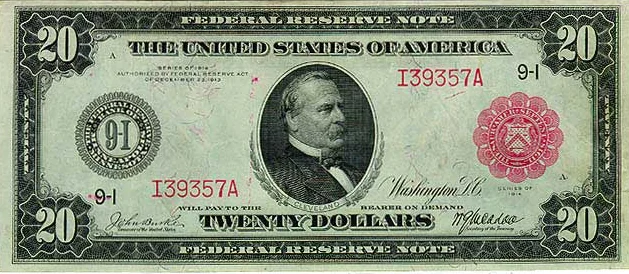
20-dollar Federal Reserve Note, 1914 series. Portrait of Cleveland. "AUTHORIZED BY FEDERAL RESERVE ACT OF DECEMBER 23 1913" — the note itself inscribes its own legal basis. The child of the "lender of last resort," finally established on the third attempt by a country that had created and buried a central bank twice. The mechanism by which a nation's credit creates money — this single note embodies the theme of this volume.
Source: Public domain (from the school's physical ledger, dollar/frn_1914)
The omitted verification,
in whose hands does it now lie?
This volume in 3 minutes
- Credit is the omission of verification. The omitted verification has not disappeared, but rather has been transferred to someone else — if the party to whom it was transferred neglects to check, it can collapse at that point.
- There is a staircase of omission — the exchange, the bank, the banknote, the central bank. The higher the step, the faster, cheaper, and farther transactions can reach.
- When the king's name became the name of the type, coinage became an institution — something that continues even when individuals change is called an institution.
- A bank is a desk (banco), bankruptcy is a broken desk (banca rotta). The etymology of these words contains the entire toolkit of early banking.
- The Bank of Amsterdam did not issue banknotes. What it invented was settlement by ledger — and the ledger was trusted more than the physical assets.
- A bank run is not caused by irrationality. It is precisely because each individual is acting correctly that it cannot be stopped — herein lies the reason it cannot be halted by morality.
- Government bonds and the central bank were born as twins (1694, Bank of England). The central bank was born not as a guardian of prices, but as a vessel for the nation's debt.
- America created a central bank twice, and killed it twice. The third time was a federation of twelve banks that "made fear itself into a structure" — the shape of an institution is engraved with the history of that country's fears.
- The existence of an institution and its functioning are two different things. The lender of last resort is not a building or a law, but stands on the decision to "act" on the morning of a crisis, and on words that can be believed.
Table of Contents
- PROLOGUEWhen the Cost of Investigation Exceeds the Profit
- 1The Staircase of Omission — From the Exchange to the Central Bank
- 2When a Name Becomes Fixed, It Becomes an Institution
- 3The Memory of a Desk — Banco and Banca Rotta
- 4The Ledger over the Physical — Amsterdam's Quiet Invention
- 5A Bank Run Occurs from a Collection of Correct Decisions
- 6The Guardian Born of War — Government Bonds and the Central Bank are Twins
- 7The Central Bank That Was Killed Twice — America's 120 Years
- 8To Exist and to Function — The Lender of Last Resort
- EPILOGUEOn Whose Investigation Does Your Note Stand?
- CASE STUDIESCase Studies on the Limits of Credit (4 cases)
- BACK MATTEROBJECTS / PEOPLE / GLOSSARY / TIMELINE / DATA / SOURCES
When the Cost of Investigation Exceeds the Profit
Imagine a transaction in a world without credit. Each time you trade, you investigate the other party. Who are they? Do they have assets? What is their reputation? Can you take collateral? Only after all that do you finally sell.
If you did this every time, you couldn't do business with distant partners. This is because the cost of investigation would exceed the profit.
The mechanism of credit is established by having someone else take on this work of investigation. A staircase built from these mechanisms of substitution — that is the theme of this book.
First, let me write the most important line in this course. ⚠ At any stage, the task of verification does not disappear. It is only transferred. If the party to whom it is transferred neglects to check, it can collapse at that point. This structure has not changed to this day.
As the numbers show, the monetary history of any country cannot be told without discussing credit. In eight chapters, we will ascend the staircase of omission one step at a time. The first half (Chapters 1-4) covers the birth of the mechanism — the exchange, the typed penny, the desk and bookkeeping, and settlement by ledger. The second half (Chapters 5-8) covers the trials of the mechanism — bank runs, the birth of the guardian, the killing of the guardian, and the winter of "existing but not acting."
The omitted verification, in whose hands does it now lie?
The Staircase of Omission — From the Exchange to the Central Bank
- The mechanism of credit is built up in four steps — the exchange, the bank, the banknote, and the central bank.
- The principle is the same at every step: taking on the work of investigation.
- The Antwerp Exchange of 1531 was not the "world's first stock exchange" — stocks did not yet exist.
Transactions without credit involved five hassles: knowing the other party, verifying their assets, checking their reputation, taking collateral, and then, finally, selling. The mechanism of credit eliminates the hassles in the middle.
A real-life scene from the first step — 1531, Antwerp
Expanding commerce requires a dedicated building. In 1531, a permanent exchange was built in Antwerp. The dedication inscribed is said to have read — For the use of merchants of all nations and all languages. Although variations in the wording are reported, its spirit is clear.
Traded here were commodities, bills of exchange, and public bonds. Even the rates for loans to monarchs were decided within this building. By the mid-16th century, the city's population exceeded one hundred thousand, and it is said to have been home to ten thousand foreign merchants, making it one of the largest cities north of the Alps.
⚠ Note that some books introduce this as the 'world's first stock exchange', but stocks did not yet exist. The joint-stock company would be born in 1602. The more famous the name, the more worthwhile it is to verify its substance (Protocol of Issue No. 1).
Key points so far
- The mechanism of credit = taking over the work of investigation. The steps are: exchange → bank → banknote → central bank
- 1531 Antwerp: Commodities, bills of exchange, public bonds. Rates for loans to monarchs were also decided here.
- Not the 'world's first stock exchange'. It predates the birth of stocks (1602) by seventy years.
Open to enrolled students
Ahead: When a name becomes fixed, it becomes an institution., The memory of the desk — Banco and Banca Rotta, The Ledger over the Specimen — Amsterdam's Quiet Invention, A bank run is what happens when a collection of correct decisions are made., The Watchdog Born of War — Government Bonds and Central Banks are Twins, The Central Bank That Was Killed Twice — America's 120 Years, To exist and to function — The lender of last resort, Upon whose research does your single coin stand?, Case Studies on the Limits of Credit — and the reference section (timeline, people, sources).
Already enrolled? Log in. Free sample: Vol. 1, Source Criticism (free in full).