From Irregular to Perfectly Round
Manufacturing Technology — Striking, Casting, and the Machines That Mass-Produce Trust

Pillar Dollar (Columnario, 8 reales), 1768. Two hemispheres and the Pillars of Hercules, with the motto "UTRAQUE UNUM" — Both are one. And, the rope-like milling on the edge. In the era of cobs, the edges of silver coins were clipped to steal small amounts of silver — with a milled edge, any clipping is immediately obvious. The standardization of shape is not a matter of aesthetics, but a technology of trust — this single coin embodies the theme of this volume.
Source: Public domain (from the school's specimen ledger real/columnario)
What was this shape
designed to prevent?
This Volume in 3 Minutes
- There are two main methods of coin production: striking (in the West) and casting (in East Asia). It is not a matter of superiority, but of different requirements.
- Cob coins circulated despite being irregular. A coin was simply stamped bullion — the limitations of the hammer era directly shaped this view of money.
- The three problems solved by milled coinage (shape, edge, and quality) all converge on one point: making fraud more difficult. It was a technology not for beauty, but to eliminate doubt.
- The edge milling and inscription were both decoration and protection — "DECUS ET TUTAMEN" literally states its own function.
- The screw press solved precision, and steam power solved quantity. The two ounces of the Cartwheel were the weight of the Industrial Revolution.
- As the number of mints increases, quality declines — because the cost of supervision exceeds the profit from issuance. This is the same structure as the proliferation of banknotes (Issue 6).
- Not changing is also a technology. The standard of the real remained unchanged for 189 years — a technology for maintaining consistency in something that would otherwise inevitably drift.
- Bracteates turned thinness into a form of expression. For technologies that deviate from the standard, we must ask, "Why was this possible here?"
- Perfectly round, uniform edge, layered structure — The history of manufacturing technology is the history of the technology for mass-producing trust. Therefore, this book always examines the form of the actual object at the beginning of each chapter.
Table of Contents
- PROLOGUETo Strike or to Cast
- 1The Limits of the Hammer — The Cob as a Frank Compromise
- 2The Three Problems Solved by Machines
- 3The Birth of the Perfect Circle — 1732, Mexico City
- 4The Edge Speaks — Both Decoration and Defense
- 5The Quantity of Steam — The Cartwheel
- 6More Mints, Lower Quality
- 7The Longevity of a Standard — Not Changing as a Technology
- 8The Paradox of Thinness and the Apex of Layering
- EPILOGUEMass-Producing Trust
- BACK MATTEROBJECTS / PEOPLE / TIMELINE / DATA / SOURCES
To Strike or to Cast
- The two coins below. Distinguish between the left edge and the right edge — the irregular distortion and the casting flash marks.
- The square hole in the center of the right coin. Is it for decoration, or is it a trace of the manufacturing process?
- Then ask: of these two manufacturing methods, which is more "advanced"? (This is a trick question.)
There are two main methods of coin production.
Striking — A metal is rolled out, a blank is cut, and it is struck between dies. This is how almost all Western coins are made. The force of the strike remains on the surface, and any imperfections on the die are transferred directly (material for E2 Die Studies).
Casting — Molten metal is poured into a mold. This is how almost all East Asian cash coins are made. The central hole was an innovation that allowed the coins to be strung on a rod after casting to finish their edges.
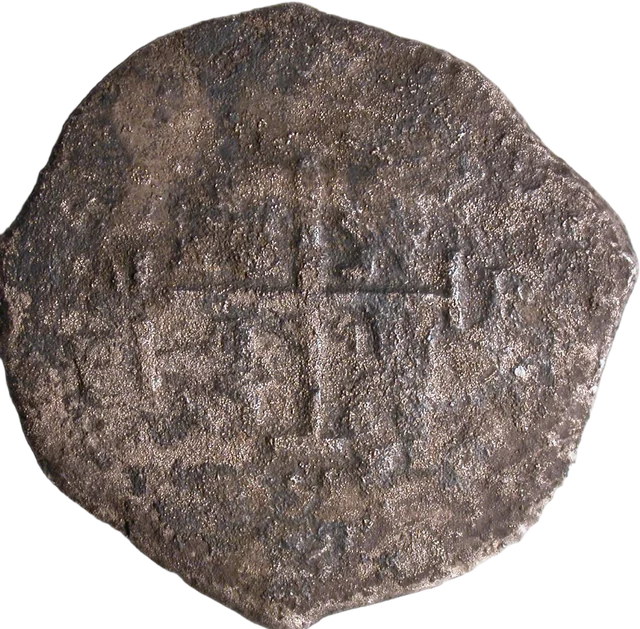
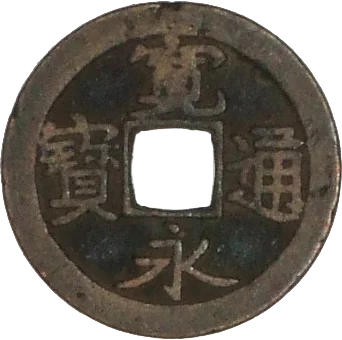
Sources: Left, Royal Institution of Cornwall / CC BY 2.0; Right, As6673 / CC BY-SA 3.0 (from the school's specimen ledgers real/cob_eight_reales and zeni/kanei-shiba)
With practice, you can tell them apart at a glance. Struck coins tend to have irregular edges, while cast coins have traces of casting flash on their edges.
⚠ Be careful not to assume that striking is more advanced. Casting allows for cheap mass production from the same mold. It is better suited for societies that require large quantities of low-denomination cash coins. The technology is chosen to fit the purpose. It is not a matter of superiority, but of different requirements.
This is a TYPE B book — specimen observation. Each chapter begins with a "First, Observe" box and ends with a one-line "In-Hand Check." The partner for observation in this volume is the shape itself. Irregularity, edge, milling, layers — each aspect of the shape tells us "what it was designed to prevent."
What was this shape designed to prevent?
Open to enrolled students
Ahead: The Three Problems Solved by Machines, The Birth of the Perfect Circle — 1732, Mexico City, The Edge Speaks — An Ornament and a Guard, The quantity of steam — the cartwheel, More mints, lower quality, The longevity of a standard—not changing is also a technique, The Paradox of Thinness and the Apex of Layering, Mass-Producing Trust — and the reference section (timeline, people, sources).
Already enrolled? Log in. Free sample: Vol. 1, Source Criticism (free in full).