The Journey of the Coin Broken into Eight
There was a silver coin born in a South American silver mine, which crossed the Pacific Ocean to become a tax in China. This single coin, called the "Piece of Eight" because it could be broken into eight pieces, became the world's first international currency and even served as a model for a new nation.
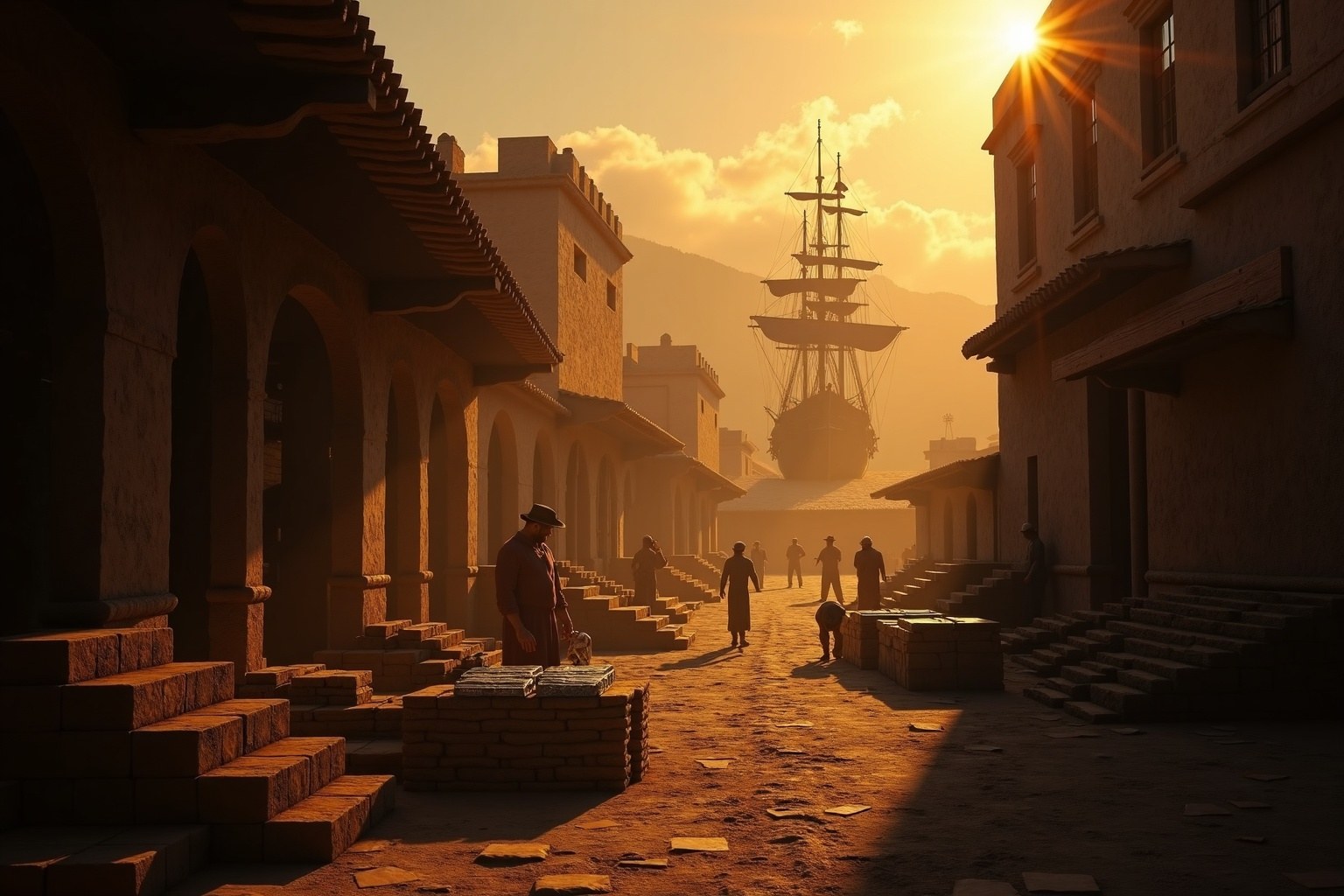
One Coin, for Large and Small Amounts
There was a large Spanish silver coin struck from the silver of the Potosí mines in South America: the 8 real. It was called the "Piece of Eight" because it could be divided into eight parts.
This silver coin was accepted across many seas due to its convenience. As a countable currency, it saved the time of bringing out scales for every transaction. For a port merchant making dozens of transactions a day, this was a significant difference.
Furthermore, the ability to be broken into eight meant it could be used for small payments. In the North American colonies, the silver coins were actually cut into eight pieces, and one such piece was called a "bit". A single coin effective for both large transactions and small payments. That is why it was so widely used in Europe, the Americas, and the Far East. Some books call it the first world currency, born in the sixteenth century.
The Empire that Inhaled Silver
The journey of these silver coins often ended in China. This was because the Ming dynasty was expanding the Single Whip Reform, a policy that consolidated various taxes and labor services into a single payment in silver.
According to the *History of Ming*, this reform was intermittently implemented during the Jiajing era, but it was enforced nationwide in the ninth year of the Wanli era, 1581. The person credited with spreading this reform across the country is said to be Zhang Juzheng, who was the Senior Grand Secretary.
The commodity in which taxes are collected determines what a state needs. From the moment it was decided to collect them in silver, this country developed a continuous need for it. As if being drawn in by a vacuum, silver from all over the world flowed into this massive nation. Silver from Potosí and Mexico, mined on the other side of the globe, traveled far across the sea to become tax for the eastern empire.
The Flow of Silver, Targeted at Sea
Silver crossed the Pacific Ocean aboard sailing ships known as the Manila Galleons. For two hundred and fifty years, from 1565 to 1815, these ships connected Acapulco and Manila. Mexican silver was loaded into their holds and exchanged in Manila for goods such as silk from Chinese merchants.
It is said that one hundred and eight ships sailed this route. However, twenty-six of them were either captured by enemies during wartime or sank at sea. For example, in 1587, Cavendish captured the *Santa Ana*. Also, in 1743, Anson captured the *Covadonga*.
One historian wrote that silver "circumnavigated the world and made the world go round." What was targeted on the seas was precisely this flow of silver.
A New Nation's Standard
This coin that had traveled the world would eventually become the model for a new nation: the newly independent United States of America.
On April 2, 1792, the United States approved the Coinage Act and built a mint in the then-capital, Philadelphia. It then defined the value of its new currency, the dollar, to be the same as the Spanish 8-real silver coin. The name "dollar" traces back to the European silver coin, the thaler.
What was revolutionary was the decimal system. A cent is one-hundredth of a dollar. In other words, the new nation pegged the value of its currency to a coin the world already trusted, and only changed the system of calculation to a new one.
The law describes the value of one dollar as follows: three hundred seventy-one and four-sixteenths grains of pure silver, or four hundred sixteen grains of standard silver.
More in A closer look at coins
The King's Name, Inscribed in the Enemy's Language
Arabic script fills the surface. Within it, a cross and a king's name are inscribed. This is the story told by a single gold coin, struck by a Christian king in imitation of an Islamic dynasty's gold currency.

The King's Mark and the Two Electrums
Around 600 BC, the King of Lydia struck a lion's mark, declaring the value of his currency. However, its content was of a lower fineness than the natural gold found in the river. A gap already existed between the value guaranteed by the mark and the coin's intrinsic worth.

The Day Ten Mon Became One Mon
In an era when a daily wage of ten mon could buy two *shō* of rice, the government ordered that one mon of the new coin be made equivalent to ten mon of the old. The wealth in one's hand became one-tenth of its value. This occurred in the year when the power of Fujiwara no Nakamaro was at its zenith.
If you would like to read on
The rest of the story is in the material of NOMISMA.
Price
After purchase, the full courses, the illustrated books, every country’s story and the numismatics examination are open to you.
See the price →