Paper can be printed,
trust cannot.
Banknotes — From receipts to the Rentenmark, the youngest and most fragile invention
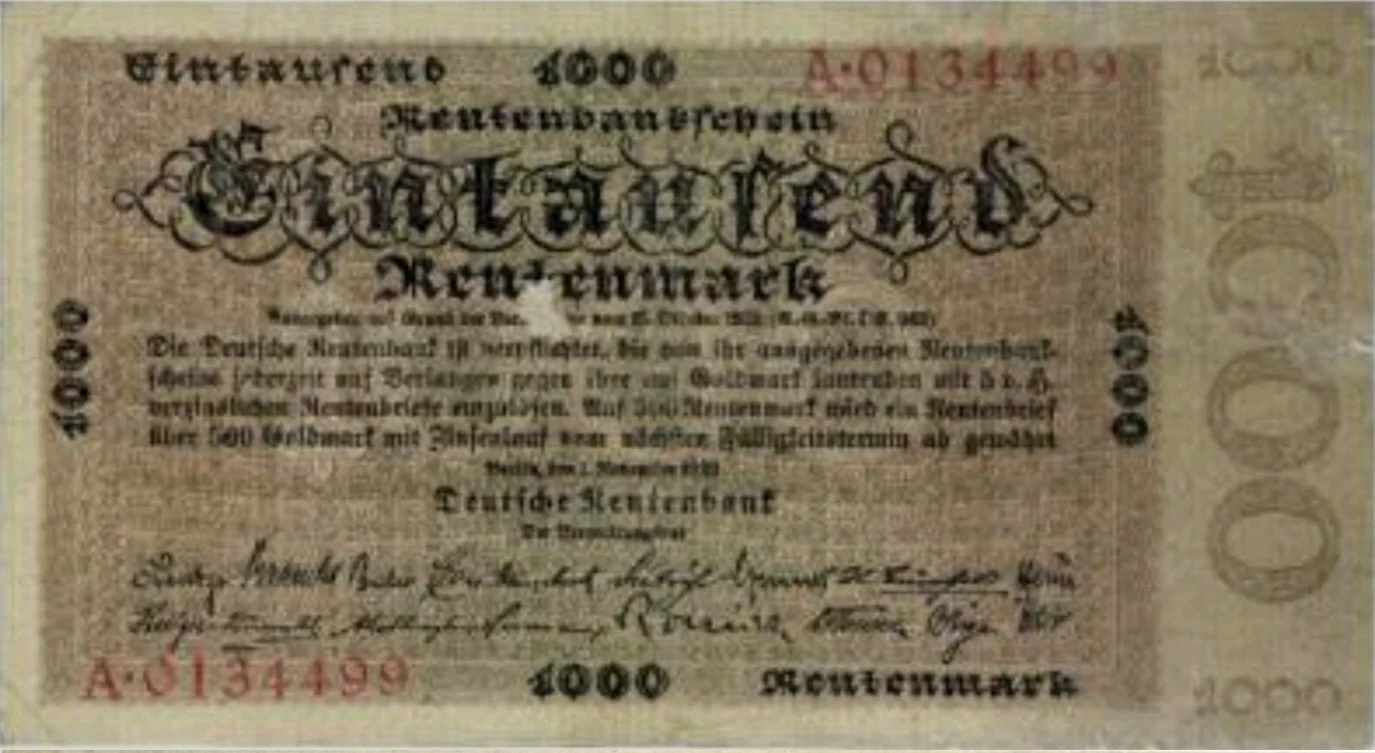
1000 Rentenmark note, November 1, 1923 (face). Backed not by gold, but by a mortgage on all agricultural land and industrial assets in the country—a promise of the nation itself. When the promise to 'print no more' was believed, paper returned to being money. This single note preemptively states the conclusion of this entire book.
Source: Deutsche Rentenbank / Public domain (from this school's object ledger mark/rentenmark_1923)
How can unbacked paper
have value?
This book in 3 minutes
- Banknotes are the youngest and most fragile invention in monetary history.
- The difference between convertible and inconvertible is one point: whether metal is returned at the counter. Inconvertible does not mean weak—it's just a different way of creating trust.
- Banknote systems are created after a period of disorder. The system does not create trust first (the Bank of Japan waited three years from its opening to issue convertible notes).
- In a forest of thousands of types of banknotes, the very effort of verification lowered their value. The effectiveness of unification lies more in eliminating the need for verification than in preventing counterfeiting.
- Paper is also a physical substance. The Daikoku-satsu notes were gnawed by rats because of the konjac powder in them—trust could only begin with the quality of the paper itself.
- London's receipts and China's Jiaozi—liberation from storage and liberation from weight. From different starting points to the same invention.
- John Law's insight (money doesn't have to be metal) was correct. What broke down was discipline—a correct insight is no substitute for discipline.
- The Confederate paper became worthless as paper. The only thing that changed was the existence of the promisor—that is the net weight of a banknote.
- And then the Rentenmark—its backing was almost symbolic, yet it worked. Trust can be designed.
Table of Contents
- PROLOGUEThe Net Weight of a Piece of Paper
- 1Divided by What You Get Back at the Counter
- 2When Banknotes Are Born, War Financing Is Usually Involved
- 3A Forest of Thousands of Varieties—The Tax of Verification
- 4Paper Is Also a Substance—The Lesson of Konjac Powder
- 5The Goldsmith's Receipt—Another Origin of Banknotes
- 6The Paper That Swallowed a Nation—John Law's Experiment
- 7Green Paper, Vanished Paper—Two Banknotes of the Civil War
- 8Redesigning from a Scrap of Paper—The Survival of the Rentenmark
- EPILOGUESubtracting the Master from the Note in Your Wallet
- CASE STUDIESCase Studies on the Limits of Paper (4 examples)
- BACKMATTEROBJECTS / PEOPLE / GLOSSARY / TIMELINE / DATA / SOURCES
The Net Weight of a Piece of Paper
Let's place two pieces of paper side by side. Both are banknotes from the American Civil War.
One is the North's Greenback—a government note with a deep green reverse. It is the direct ancestor of today's American banknotes.
The other is a Confederate banknote. Its design and the printed promise remained impressive—yet in 1865, it became almost worthless. The ink, watermark, and serial number did not change at all. The only thing that changed was outside the paper: the existence of the promisor.
The difference between these two notes is the theme of this book. The value of a banknote is not printed anywhere on the paper. So where is it? At the counter, in discipline, and in the promisor. In eight chapters, we will explore where it resides.
Let me state the conclusion of this course upfront. Paper can be printed. Trust cannot. All eight chapters are variations on this single line.
How can unbacked paper have value? And when does it cease to have it? These two are one and the same question.
Divided by What You Get Back at the Counter
- The difference between convertible and inconvertible is determined by the action at the counter—not the name of the system.
- Inconvertible does not mean weak. All major currencies today are inconvertible, and they have not collapsed.
- Convertibility creates trust by 'we can always redeem it,' while inconvertibility does so by 'there is no need to redeem it'—the goal is the same, the method is different.
There are two types of banknotes: convertible and inconvertible. The difference is just one point: whether you get metal back when you take it to the counter.
If you presented a Daikoku-satsu note from Meiji 18 (1885), you would receive a one-yen silver coin engraved with a dragon. That is convertible. Today, if you take a banknote from your wallet to a bank, you will not get metal back. That is inconvertible.
Here is a counterintuitive fact. Inconvertible does not mean weak. All major currencies today are inconvertible, yet they have not collapsed. What matters is not whether people believe they can get it back, but whether they feel the need to get it back in the first place.
The convertible system created trust by demonstrating that 'it can always be redeemed.' The inconvertible system maintains trust by making people feel 'there is no need to redeem it.' The goal is the same, only the method is different. The remaining chapters of this book will document how each of these two methods was born, how it broke down, and how it was rebuilt.
Key points so far
- Convertibility/inconvertibility is determined by the action at the counter, not by names or official stances.
- Inconvertibility is not weak—it's just a different way of building trust.
- 'We can always redeem it' and 'There is no need to redeem it'—the history of these two methods makes up the rest of this book.
Open to enrolled students
Ahead: When banknotes are born, war expenses are usually involved., A forest of several thousand varieties — a tax in the form of verification effort., Paper is also a material — the lesson of konjac flour., Goldsmiths' receipts — another way banknotes were born., The Paper That Devoured a Nation — John Law's Experiment, Green Paper, Vanished Paper — The Two Banknotes of the Civil War, Redesigning from a Scrap of Paper — The Survival of the Rentenmark, Subtracting the Master from a Note in Your Wallet, Limit Cases for Paper — and the reference section (timeline, people, sources).
Already enrolled? Log in. Free sample: Vol. 1, Source Criticism (free in full).