The beginning
was not a single coin.
The Birth of Coinage — Three Lands and a Recurring Invention
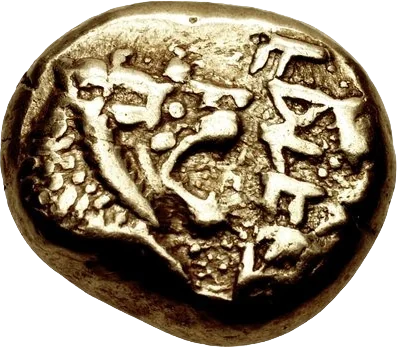
Electrum trite. 610–560 BC. Lydia, Sardis. King Alyattes of Lydia struck a lion punch mark on electrum—natural gold containing silver—panned from the Pactolus River. This is considered the first coin, an invention in which the state guarantees weight and fineness. However, this was not the only "beginning"—which is the theme of this book.
Source: CNG / CC BY-SA 3.0 (NOMISMA SCHOLA Collection coin/electrum-trite)
How many "beginnings"
of money are there?
This book in 3 minutes
- "Coinage arose because barter was inconvenient"—no records have been found to support this textbook sentence. The oldest records speak not of exchange, but of debt.
- Coinage is needed when transacting with strangers. Among acquaintances, a record was enough.
- Electrum from the river and stamped electrum are the same metal. The only thing that changed was "who guarantees the content"—coinage is not about the material, but about the guarantee.
- Coinage was not invented in one place. It arose independently in three lands—Lydia in the West, India in the South, and China in the East—and the form of guarantee differed in each.
- The word "birth" refers to two things: the first for humankind and the first for a given land. Conflating them makes the history of coinage unreadable.
- Invented three times, spread countless times. The lands it reached had windows, and these windows have names (emporion = "trading post").
- Japan began by importing. The 3.75 g weight of the Tang dynasty's Kaiyuan Tongbao became the "monme," and it took ninety years to transition from weighing silver to counting coins.
- The second birth was the banknote. A problem → private ingenuity → state guarantee—even when the material changes, the grammar of birth remains the same.
- The birth of one currency is also the end of another. Birth and extinction are two sides of the same event.
Table of Contents
- PROLOGUEA Line from a Textbook, a Line from a Clay Tablet
- 1It Is Not Written That It Arose from Barter
- 2What the Stamp Guaranteed Was Not the Metal
- 3Born Separately in Three Lands
- 4Birth Happens Many Times
- 5From Striations to a Lion, and Then to the Sea
- 6Places of Birth, Places of Transmission — The Names of the Windows
- 7The Island That Began with Imports — A Ninety-Year Runway
- 8The Second Birth — Deposit Certificates in Sichuan
- EPILOGUEThere Is More Than One Story of Birth
- CASE STUDIESThe Four Faces of Birth (4 Articles)
- BACK MATTEROBJECTS / PEOPLE / TIMELINE / DATA / SOURCES
A Line from a Textbook, a Line from a Clay Tablet
Let's compare two sentences.
One is a line from a textbook: People bartered, and because it was inconvenient, coinage was born.
The other is a line inscribed by a temple scribe on a clay tablet in Mesopotamia in 3000 BC: who lent how much barley to whom.
The former is an explanation, the latter a record. And the only surviving ancient testimony about the "beginning" of coinage is the latter. For those who have read Issue 1, "Source Criticism," the answer should already be clear: being logical is one thing, having evidence is another. This book goes beyond that answer. What story of the birth of coinage emerges when we gather and arrange only the "beginnings" for which there is evidence?
Let me state the conclusion upfront. There is more than one story. The birth happened independently in three lands and was then repeated many times in various places. That is why the title of this book is "The Beginning Was Not a Single Coin."
How many "beginnings" of money are there?
It Is Not Written That It Arose from Barter
- The oldest records speak not of exchange, but of debt.
- The "barter theory" cannot be definitively called wrong—rather, we say that no evidence has been found.
- Coinage was needed when transacting with strangers.
3000 BC, Mesopotamia. What temple scribes inscribed on clay tablets was who lent how much barley to whom—it was about credit and records. What remains documented as the beginning of money is not the exchange of goods, but the recording of debt.
Here, let's delve one step deeper into the clay tablets. The textbook continues: what is written on the tablets is not an amount, but a relationship. Who owes how much to whom. If that is known, payment can be made later. For acquaintances, a record is enough.
So, why was coinage born? For transacting with strangers. Records of debt circulated within the community, while coinage was needed when going outside it—this distinction underlies this entire book.
Let me make one point clear. This book does not state definitively that the explanation 'money originated from barter' is wrong. It says that records stating so have not been found. As an explanation, it is logical. Being logical and having evidence are two different things — and a logical mistake is more troublesome than an illogical one. Because no one questions it, it continues to appear in textbooks for hundreds of years. How this theory spread over two hundred years was dissected in Chapter 7 of Issue No. 1.
Key points so far
- The oldest records are of debt, not exchange. They record relationships, not amounts.
- For acquaintances, records sufficed; coinage was a tool for strangers.
- The barter theory is not "wrong" but "lacks evidence." A logical error is troublesome.
Open to enrolled students
Ahead: What the punch mark guaranteed was not the metal., Born separately, in three different lands., Birth happens many times., From Stripes to the Lion, and to the Sea, The Place of Birth, the Place of Transmission—The Name of the Window, The Island That Began with Imports—A Ninety-Year Runway, The Second Birth — Deposit Receipts of Sichuan, The story of birth is not just one., The Four Faces of Birth — and the reference section (timeline, people, sources).
Already enrolled? Log in. Free sample: Vol. 1, Source Criticism (free in full).