Early Islamic dirham
The early Islamic period ・ silver ・ 8th century ・ A mint of the Islamic world (the place of striking is not identified)
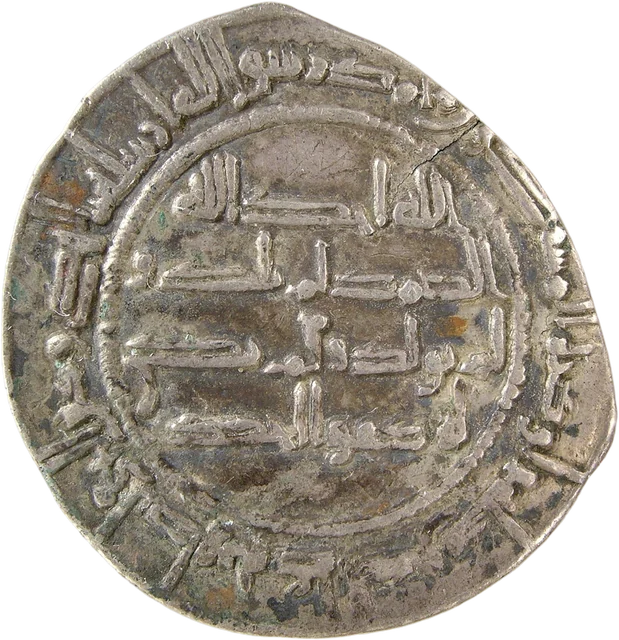
There is no image; only Kufic legends run around the face — an early Islamic silver dirham. It is a piece in the Los Angeles County Museum of Art (LACMA), and its place of striking has not been identified as al-Andalus. It is shown here as a representative of the world of the dirham to which the peninsula belonged. In 711 the Islamic armies overthrew the Visigothic kingdom, and the greater part of the peninsula became al-Andalus. The leading coin of the Umayyad emirate founded in 756 was the silver dirham. Gold returned in 929, with the proclamation of the caliphate by Abd al-Rahman III — the right to strike gold was a declaration of supreme power. At the same period, north of the Pyrenees was a world of the silver denier alone. The border between a gold economy and a silver economy ran across the peninsula. And what crossed that frontier more often than armies was money.