Merovingian gold tremissis
6th–7th century ・ gold ・ 7th century ・ Merovingian moneyers (monetarii)
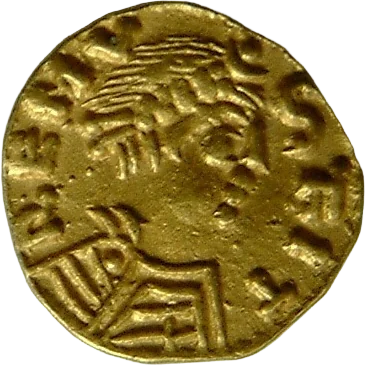
The tremissis was the small gold coin worth a third of the Roman solidus, about 1.5 grams of gold. After the fall of the western empire the Frankish kings struck gold borrowing the name of the emperor at Constantinople — pseudo-imperial coinage — and in time the emperor's name disappeared, leaving the name of the place of minting and of the moneyer cut in its place. What marks Merovingian gold is the extreme dispersion of minting: the 37 gold tremisses from the ship burial at Sutton Hoo each came from a different mint. It was not the money of a state but the money of places and of persons.